




(Re)purposing ‘The Critical’: A Review of Critical Thinking for Global Citizenship Education: A Conceptual Framework
 43
43 Development Education: Learning for Transformation
 Click to download
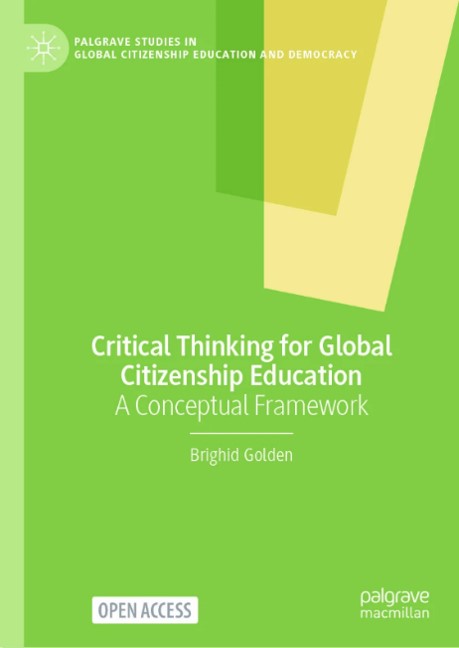
Brighid Golden (2025) Critical Thinking for Global Citizenship Education: A Conceptual Framework, London: Palgrave MacMillan, available in open access at: https://link.springer.com/book/10.1007/978-3-031-89642-2
 Introduction
Critical Thinking for Global Citizenship Education: A Conceptual Framework is a book authored by Brighid Golden, as part of the Palgrave Studies in Global Citizenship Education and Democracy Series. The book stems from the author’s doctorate thesis (Golden, 2022), under the sponsorship of the Development and Intercultural Education (DICE) Project and Irish Aid. The research was conducted in Ireland, a particularly interesting context with an extended tradition in global citizenship education (GCE) (see McAuley and Wegimont, 2026 for a recent overview).
The book dialogues closely with several interests of Policy and Practice readers. From an initial stage, the author clarifies her positioning regarding GCE. Golden describes GCE as being a distinctive yet porous field, a ‘collective commitment to global justice’ (Golden, 2025: 5). It operates in-between theory and practice, academia and civil society working in the scope of GCE, and in need of keeping the connection to its activist roots alive while expanding and linking past, present and future events. This overall framing makes this work potentially relevant to other contexts, most particularly European countries with similar GCE trajectories (Bourn, 2015; Scheunpflug and Wegimont, 2024).
Golden reminds us of the complexity and uncertainty of present times, with unprecedented and resurfacing challenges, for which critical GCE is argued as having the utmost importance. Global citizenship education is positioned in the book at several intersections, that shape the way GCE is presented. First, the work addresses the ‘nexus between the fields of critical thinking and global citizenship education’ (Golden, 2025: 3). Second, is the assumption that ‘education and teaching must be a conversation between theory and practice if we are to reach the ambitious goals of GCE’ (Ibid.: 4). This is very evident in the book’s structure and content, rendering it of both scientifical and pedagogical value. Those aiming to gather theoretical insight and/or implementing GCE for critical thinking (CT) in education – the big ‘why’ of this book – will find this a useful resource. The text reads fluently and is organised in three parts and seven chapters.
Part one: the need for a framework for critical global learning
Part one is comprised of three chapters mostly covering the conceptual basis of the work. Chapter one guides the reader in understanding the definition and relevance of ‘critical global learning’, a terminology that Golden adopts throughout the text. Critical global learning intersects critical thinking and GCE and is:
“(…) a reflective educational process founded on the values of global justice, equity and human rights. It focuses on engaging in understanding and questioning the dominant systems and structures which create and perpetuate multiple forms of inequality globally. It encourages us to consider how our lives interact with the questions being explored and fosters an interest in acting collectively to address inequality. It is a learning process which recognises different ways of understanding the world and consequently draws on multiple perspectives to inform the learning process” (Ibid.: 12).
Critical global learning and critical thinking are briefly debated within wider education theory (specifically, civic education and the purpose of education), and with a consonant pedagogy that will later inform a Conceptual Framework proposed by the author. The chapter ends with an important note on the relevance of ‘reflexivity, self-awareness, and positionality in the context of critical global learning’ (Ibid.: 17-21). Here the author discusses personal trajectory and pitfalls, how power imbalances in teacher-student relationships limit possibilities for CT and ‘authentic engagement with self-reflection’ (Ibid.: 19) or how the multiple roles we assume can, inadvertently, hinder or compete with doing critical GCE.
Chapter two is devoted to unpacking the concept of critical thinking, situating how it intersects with GCE, and discusses criticisms common to CT. The chapter opens with a questioning of CT as a ‘universal good (…) repeatedly listed as an outcome of education’ and debates ‘whether there is a need to exercise caution when engaging in criticality with our learners’ (Ibid.: 27). It continues briefly listing classical definitions of CT, that present it as a multidimensional and ‘cross-disciplinary skill’ (Ibid.: 32). The centrality of CT to GCE is well explored in this chapter and remaining parts of the book. Many of the endeavours of (critical) GCE are in fact related to the self-reflection and perspective shifting that CT seeks to achieve. Furthermore, personal change and the possibility of impacting global issues are also linked to critical thinking, although the latter should not be conflated with social change.
Citing thinkers like Paulo Freire and bell hooks, the author emphasises the potential of CT ‘to be a catalyst for change by opening learners up to alternative ways of thinking and challenging hegemonic thinking’ (Ibid.: 33). The chapter ends with a very interesting reflection on common critiques of CT, which is useful to address the concept in theory and in practice, an aspect I will return to later.
Chapter three expands on the purpose and process of developing a framework that articulates both critical GCE and CT, covering the methodological aspects of its design, testing and sourcing. The author provides a clear description of the methodological choices leading up to the framework, which comprises a model and a planning tool. As is often the case, Golden created the resource that she needed for responding to the challenges of teaching GCE and critical thinking in initial teacher education (ITE), the sector in which she works. The framework is grounded on an extensive piece of research, based on a self-study about the author’s teaching experience, using three cycles of action-research, during three academic years, with large cohorts of future primary teachers in Irish higher education. The framework was tested and fine-tuned across the cycles, with the input of students and critical friends (teaching peers). As someone who values deeply the systematic understanding of GCE experiences (e.g. Coelho et al., 2025), I found the author’s choice of researching her own practice inspiring and very significant.
Part two: a conceptual framework for critical global learning
The second part of the book includes two chapters that describe the Model for Teaching Critical Global Learning (chapter four) and the Planning Tool designed to support the implementation of the model (chapter five). The framework is theoretically informed by Freire’s (1974) Critical Consciousness, Boler’s (1999) Pedagogy of Discomfort, Bourn’s (2015) Pedagogy of Development Education and Andreotti and de Souza’s Through Other Eyes (2008). It adopts ‘an interactive approach to teaching which is focused on dialogue, modelling skills and attitudes, sharing challenging content knowledge, and supporting students to engage with and reflect on their learning’ (Golden, 2025: 13).
The final Model is a three-part converging scheme, comprising nine main elements and twenty-one sub-elements. The main parts cover Considerations for Teaching, Critical Global Learning Skills and A Commitment to Criticality. This last part lies at the centre of the scheme, operating as a core pillar and, to my view, an end goal: ‘the crucial anchor necessary for students to become critical global learners and to develop and build on the skills included within this model’ (Ibid.: 68). The author carefully walks us through each of the parts, elements and sub-elements of the model over chapter four, explaining the theoretical basis of each component, and at times, their practical and pedagogical reasoning as well.
Complementing the Model is an explanation and visual representation of the Planning Tool (chapter five). The author uses a funnel-type scheme with three levels of input: Lesson Elements, Pre-conditions for Learning, and Outcomes (Ibid.: 98). The chapter has a very practical undertone which I found quite useful. While higher education, particularly ITE, is the context for implementation of this tool, its content can be adapted to other formal and nonformal education settings. Golden aimed for a mindful application of these elements to ensure they are equitably incorporated in all lessons (e.g., ensuring a balance between skills and content focus).
The Planning Tool is quite complete and mirrors the reality of preparing future teachers, yet Golden’s in-text explanation is needed for an accurate interpretation of the scheme. The scheme includes the ‘sub-elements’ but not the designation of the main elements which they represent (lesson elements, pre-conditions) and at times, the splitting of sub-elements that belong together limited a more immediate reading of the scheme.
Part three: considerations for the implementation of this conceptual framework for critical global learning
The final part of the book is comprised of chapters six and seven. The book closes its trajectory supporting readers in applying inputs concretely and contextually. In chapter six the author explores common challenges and tensions when implementing critical GCE. Chapter seven reflects on ‘opportunities for critical global learning (…) with a comment on considerations for readers when planning for the implementation of critical global learning in their own contexts’ (Ibid.: 21).
The tensions explored in chapter six cover aspects related to the pedagogical dimension, to the student and to external influences, which are aligned with the conceptual model devised and a good example of how research can inform and feed-back teaching processes. I particularly enjoyed the way this chapter (as well as four and five) is well grounded in education literature, particularly, teacher action and development. The author also takes us on an honest and thorough reflexive journey of researching her own practice and seeking ways to improve it accordingly, which is quite useful for those engaged in teaching and (higher education) pedagogy.
I felt that some elements like opportunities, enablers and barriers to GCE, that feature in chapter seven, could have been explored in chapter one. However, the author’s aim appears to have been to end the book by ‘passing the baton’ to the reader through the sustainable incorporation of the Framework’s (model and planning tool) into the reader’s practice. To this end, Golden proposes a five-step plan evolving from the individual to the contextual focus and finally, personalising and implementing the Framework.
On (re)purposing ‘the critical’
The book makes two important contributions to the broader field of global education, both of which are transferable into research and practice. The first is the ‘two-part conceptual framework for teaching critical global learning’ (Ibid.: 49), that combines a ‘model for teaching’ and a ‘planning tool’. Although scholarship about critical GCE has expanded, it is not uncommon to find a certain lack of specificity regarding what exactly is critical GCE and how it can be delivered. The Framework enables discussion, and envisions and maps critical GCE, and positions the purpose of criticality more clearly. According to the author, the Framework’s power lies in synthesising longstanding components of GCE that have not necessarily been articulated and systematised. Thus the:
“(…) core purpose of the conceptual framework, [is] not to reinvent the wheel or present an entirely new and unseen approach to critical thinking development or GCE, but to cohesively and accessibly bring together research-informed strategies, and best practice in a way which is manageable to implement in the classroom” (Ibid.: 50).
Golden also claims the ‘research study offers a new conceptualisation of critical global learning’ (Ibid.: 160). However, precisely because some version of the diverse components of the Framework has been proposed elsewhere, the conceptual innovation lacks clarity. To this end, it would have been important to systematically and critically review other conceptual models of GCE that dialogue or contrast with the work presented (e.g. dimensions of GCE proposed by Oxfam, UNESCO, OECD, the Council of Europe). Interestingly, Golden does engage with some of this literature, however, it is often to justify the relevance of CT and not so much the GCE aspect. Contrasting what these or other more recent models (e.g. Bosio and Schattle, 2023; Bosio, 2025) offer and where they overlap in the light of the author’s proposal would have been important and a good way of positioning this work and the reader within previous literature more explicitly.
Moreover, while offering an entry point to understand what critical GCE is, at times a deeper dialogue with previous literature, particularly addressing non-western realities (e.g. Akkari and Malek, 2020) would have strengthened the book. Golden includes an interpretation of critical GCE that is clear, yet a bit circumscribed considering the field’s diversity. The existence of many ‘definitions of GCE’ (Ibid.: 73, 135) is mentioned, however, engaging with them (and specially, its different orientations) remains limited (see e.g. Andreotti, 2016; Pashby et al, 2020).
This also concerns a need for inclusion of other empirical studies already conducted that align with the book’s focus, and other general aspects of GCE theory and practice that would have been productive to the topic of the ‘critical’ more broadly. Exploring how ‘the critical’ has been addressed in recent reviews of the critical orientation and how it intersects with other GCE traditions (see, e.g. Pashby et al., 2020) would allow for a more nuanced vision. Overall, given critical GCE is the book’s focus, a structured albeit concise positioning of critical GCE alongside other conceptual interpretations and similar empirical studies conducted could have improved the book’s depth and outreach.
The second point to highlight is the focus on critical thinking, a much needed reflection for the global and development education space. In fact, being ‘critical’, is predominant across the GCE field, even though it is not always clear what critical means. To this regard, an interesting entry point brought by Golden was the discussion of common critiques to CT, such as the ambiguity and (therefore) the impossibility of teaching CT, its potential to ‘devalue other ways of knowing’, its intrinsic value-neutrality, and finally the counterproductive nature of CT (Ibid.: pp. 34-43). In fact, this discussion ends by interweaving tensions that are highly relevant to GCE (and critical pedagogy at large). As a reader, linking GCE and CT acted as a meta-reflection that contributed to repurpose ‘the critical’ dimension of GCE.
Overall, through the Framework, experiences and insights presented, the book makes an interesting contribution to critical global education, grounded in the principles presented by the author as key: ‘a critical approach, the centrality of dialogue, the importance of active and participatory learning, and a pedagogy of discomfort’ (Golden, 2025: 13). Researchers, teachers and practitioners in the critical GCE space and/or focused on teaching critical thinking looking for a structured tool to implement and reflect on their practice might find this a very useful resource for professional development.
References
Akkari, A and Maleq, K (2020) ‘Rethinking Global Citizenship Education: A Critical Perspective’ in A Akkari and K Maleq (eds.) Global Citizenship Education: Critical and International Perspectives, Cham: Springer, pp. 205-217.
Andreotti, V (2016) ‘Global Education and Social Change: The Imperative to Engage with Different Discourses in H Hartmeyer and L Wegimont (eds.) Global Education in Europe Revisited: Strategies and Structures, Policy, Practice and Challenges, Münster: Waxmann, pp. 199-203.
Bosio, E (2025) [2023] ‘Global South University Educators’ Perceptions of Global Citizenship Education: Reflective Dialogue, Social Change, and Critical Awareness’, Prospects 55, 67–81.
Bosio, E, and Schattle, H (2023) [2021] ‘Ethical Global Citizenship Education: From Neoliberalism to a Values-based Pedagogy’, Prospects, 53, pp. 287–297.
Bourn, D (2015) The Theory and Practice of Development Education: A Pedagogy for Social Justice, Oxon: Routledge.
Coelho, D P, Caramelo, J, Amorim, JP and Menezes, I (2025) [2022] ‘Towards the Transformative Role of Global Citizenship Education Experiences in Higher Education: Crossing Students’ and Teachers’ Views, Journal of Transformative Education, 23(2), 149–164.
Golden, B (2022) Critical Global Learning: Lessons from a Self-Study Action Research Project within Initial Teacher Education in Ireland, PhD thesis, available: https://theses.gla.ac.uk/82932/ (accessed 20 May 2026).
Golden, B (2025) Critical Thinking for Global Citizenship Education: A Conceptual Framework, Cham: Palgrave MacMillan, available: https://link.springer.com/book/10.1007/978-3-031-89642-2 (accessed 20 May 2026).
McAuley, J and Wegimont, L (2026) Global Education in Ireland: The European Global Education Peer Review Process - National Report on Global Education in Ireland, Dublin: Global Education Network Europe.
Pashby, K, da Costa, M, Stein, S and Andreotti, V (2020) ‘A Meta-review of Typologies of Global Citizenship Education’, Comparative Education, 56(2), pp. 144-164.
Scheunpflug, A and Wegimont, L (eds.) (2024) Global Education in Europe: National Histories, Volume 1, Second edition, Dublin: Global Education Network Europe (GENE).
Dalila Pinto Coelho is an assistant professor in and a full member of the Centre for Research and Intervention in Education (CIIE) of the Faculty of Psychology and Education Sciences at the University of Porto (Portugal). With a background in educational sciences and international development, her work intersects global education, citizenship, and development issues through post and decolonial scholarship. E-mail: dalilacoelho@fpce.up.pt.