





Get Critical: Framework Adaptation for Critical Global Learning as Freirean Praxis and Pedagogical Inquiry
 43
43 Development Education: Learning for Transformation
 Click to download
Abstract: Get Critical is a Research Ireland-funded project that enabled the Irish non-governmental organisation (NGO) and Irish Aid strategic partner for higher education (HE), STAND, to engage in a process of adapting an established educational framework for critical global learning (Golden, 2025) guided by the framework author. The original framework for critical global learning was adapted and redesigned to better reflect the unique aspects of STAND’s educational context and organisational goals and is being used by STAND staff and facilitators to guide their educational activities. Centring systemic thinking and critical engagement with the root causes of global injustice, the project positions framework adaptation as a catalyst for re‑imagining global citizenship education (GCE) practice. This article outlines the participatory processes through which the framework was revised, presents the newly configured STAND Framework now shaping their pedagogical approach, and examines the organisational and educational outcomes emerging from its implementation.
The project followed a three-stage sequential design which included professional development, collaborative development and testing, and stakeholder feedback leading to a finalised adapted framework. Moving beyond a technical account of framework adaptation, the article positions this process as a case study in Freirean praxis, collaborative meaning‑making, and pedagogical re‑imagination. It explores how GCE educators engaged in dialogical reflection can interrogate their assumptions, surface organisational values, and critically analyse their existing pedagogical practices. This dialogical, reflective engagement illustrates how GCE educators can collectively refine and redesign their approaches to better cultivate learners’ capacities for systemic analysis and critical global engagement.
The resulting STAND Framework embodies a process‑oriented pedagogy rooted in criticality, emotional capacity, collective action, and transformative learning in line with the works of Freire (1970; 1974) and Shor (1992) who advocate for educational approaches which are experiential, dialogical, and who position learning as a co-created process. By analysing both the adaptation journey and the shifts it enabled within STAND, the article argues that intentional, reflective pedagogical redesign can support GCE educators in imagining and enacting new futures for GCE: futures grounded in systemic thinking, context-responsive practice, and a commitment to empowering learners to question, resist, and act for global justice.
Key words: Critical Thinking; Framework Adaptation; Pedagogical Development; Praxis.
Introduction: why adapt a framework?
Educational theory, frameworks, and pedagogies are not static, but are fluid and ever evolving in terms of how they are interpreted and implemented at individual levels. However, the process of interpretation, and potential adaptation is often unconscious on the part of the educator working to implement educational approaches which work in their context and align with their own understandings. This article argues that intentional and purposeful adaptation processes can catalyse organisational learning and pedagogical re-imagination, not just produce a better tool for use in practice; that the process of adaptation is as important as the outcome.
This article presents the findings from a Research Ireland-funded project called ‘Get Critical’ during which Irish NGO STAND adapted an established educational framework for critical global learning to create one which better aligned with their organisational goals, educational context, and collective beliefs. STAND are Irish Aid’s strategic partner for higher education and work with students, student leadership bodies, and academic and professional staff from across multiple campuses in Ireland, supporting them to integrate GCE into their practice and stand up for global justice, equality and sustainability. Not confined to formal education requirements, STAND offers national and campus-based programmes working through residentials, online spaces, exhibitions, and in tailored programmes for their audiences. Their staff deliver, coordinate and facilitate, as well as working with external facilitators hired for specific purposes. Their context is unique, and their remit is clear. They entered into this project in response to changing global contexts, namely the meta-crisis, which focuses on understanding the systemic causes of the climate emergency; racism and the far-right; the hollowing out of democracy; the genocide in Gaza; and neoliberal economics (McCloskey, 2026) and to ensure that they were centring critical thinking in their work and had a cohesive educational approach which tied their activities together.
The framework STAND adapted is outlined in Critical Thinking for Global Citizenship Education: A Conceptual Framework (Golden, 2025). The adaptation process involved professional development with the original framework author, a process of co-development, adaptation and testing, and a finalisation of the final STAND framework which now underpins not only their activities and projects but informs the monitoring and evaluation of their programmes and their reporting to funders and partners. This article presents the iterative adaptation process which STAND engaged in as a form of Freirean praxis which was rooted in dialogues, critical engagement, and served to surface assumptions and reorient pedagogy towards systemic analysis and collective action.
Foregrounding critical thinking within global citizenship education practice
This project foregrounds critical thinking development as a lynchpin for achieving the aims of GCE. Critical thinking features as a goal of many education systems, positioned as a 21st Century skill, the impact of critical thinking development within education is described as fundamental for informed decision‑making, democratic engagement, and solving complex global problems (Jaramillo Gómez et al., 2025). Within GCE work critical thinking is frequently listed as a skill, an outcome, or a transformative pedagogy. Indeed MacCallum (2014: 39) considered global learning to be a process of ‘realized critical thinking’ which allows for consideration of social, cultural, economic, political and environmental issues from multiple perspectives. Within this context, critical thinking development relates to deepening learners’ awareness of diverse perspectives, enabling them to question the status quo, and to dig deeper into considering root causes of justice issues (Andreotti, 2006). Centring critical thinking in education has never been more important than now. We live in a time when the concept of truth is being eroded by global leaders willing to spread mis- and dis-information, and when social media and independent self-declared journalism is on the rise. This context necessitates that education equip learners with the skills to analyse what they hear and encounter, question dominant narratives, and consider wider perspectives. Critical thinking development in this context acts as an opportunity to support learners in building empathy, making connection with others, developing resilience, and cultivating values crucial to GCE. In this way, we position critical thinking as a first step in informed critical action.
Although frequently named as an important skill to develop within GCE, how to develop this skill in this context is rarely researched or written about. The original framework upon which this project is based aimed to address this gap in research and literature, and this project builds on addressing this gap by considering how criticality can be fostered in another context. However, a further challenge within GCE is the consideration of how to implement pedagogical approaches in different contexts. Materials are often developed for use within formal education but rarely supported by evidence of how they can be used or adapted for other contexts. Fundamentally, this project aimed to address this research gap in providing a research informed approach to adapting frameworks designed for one context, namely initial teacher education (ITE), for use in a non-formal education context.
Conceptual grounding: criticality, systems thinking and praxis
The adaptation process was underpinned by a number of theoretical pillars including critical pedagogy and transformative learning, critical GCE, and understandings of praxis and professional learning. Critical pedagogy facilitates a view of ‘learning as revolution’ (hooks, 1994: 2), promoting educational approaches rooted in conscientisation (Freire, 1974) and co-creation (hooks, 1994; Shor, 1992). From this perspective, education must be viewed as a ‘practice of freedom’ (Freire, 1970) which encourages independence and supports learners to pose critical questions which challenge the status quo including the structure of the learning space itself. In her writing, hooks talks about ‘teaching to transgress’ and shares that to truly radicalise the hierarchical nature of the classroom, the educator must genuinely and authentically value all students’ contributions and students themselves as equal contributors creating the learning space. This involves deconstructing the notion that only the educator holds responsibility for shaping and influencing the classroom dynamics but instead proposes that ‘excitement is generated through collective effort’ (hooks, 1994: 8). While critical pedagogy focuses on breaking down hegemonic power structures, transformative learning also offers an approach to questioning assumptions about power, enabling deeper reflection on systems that shape us and our positioning and influence within those systems (Mezirow, 2006). These ideas underpinned STAND’s approach to this adaptation process as they worked to embed an approach to education which was rooted in genuine dialogue and enabled their students to experience freedom and develop and practice criticality.
The adaptation process was also underpinned by understandings of critical GCE and a desire to align with post-critical framings of GCE which emphasise uncertainty and complexity and aim for ongoing reflexive learning. Concepts of decolonisation and a commitment to deconstructing charity narratives and universalist doctrines (Andreotti, 2009; Bourn, 2015; Spivak, 1999) informed STAND’s review of the original framework and considerations for their own practice. STAND’s stated mission necessitated an understanding of collective affect-rooted action and systems thinking which informed decisions made. STAND staff were conscious of the emotional labour often involved in taking action and endeavoured to craft an educational approach rooted in hope and solidarity (hooks, 2010). Furthermore, an understanding not only of root causes of injustice but of complex systems influencing global challenges and opportunities for multi-level change was at the root of discussions during the adaptation process (Capra and Luisi, 2014).
The adaptation process itself was framed as praxis in that while reflective and rooted in theory, it was also action focused and included multiple ‘testing’ points and feedback loops. This was made possible through the community of practice style approach taken by STAND staff during the process. While there was one staff member leading the process, all staff involved in education programmes were involved in discussing, drafting, editing, testing, and reflecting on the evolving framework being designed. Cochran-Smith and Lytle (2009) use the term ‘inquiry-as-stewardship of practice’ to highlight the importance of educators continually questioning, interpreting, and reconstructing their own practice in dialogue with others. When this approach is taken at an organisational level educators become custodians of pedagogical integrity, actively shaping and protecting educational values, not acting as technicians delivering pre‑set material; they take responsibility for the evolution of their organisation’s pedagogy. This deeply collaborative approach to pedagogy development framed the adaptation process undertaken by STAND and is evident in the findings from this project.
Framework adaptation and pedagogical re-imagination as critical pedagogy
Drawing on Kemmis’s (2019) practice theory, framework adaptation offers an opportunity to reshape the sayings (shared language), doings (pedagogical routines), and relatings (collaborative relationships) that influence and shape practice. Adaptation therefore becomes simultaneously a redesign of pedagogy and the conditions that support it, and due to the approach taken by STAND, pedagogical redesign became organisational change. Fullan (2016) frames educational change as systemic, relational, and dependent on shared meaning-making.
By adapting the framework collaboratively, STAND embodied Sfard’s (1998) ‘participation metaphor’ in which learning becomes part of a community of practice as educators themselves participated in knowledge-building rather than simply absorbing a pre-made model, connecting with critical pedagogy approaches outlined earlier. Cochran-Smith and Lytle’s (2009) ‘inquiry as stance’ advocates for educators to engage in ongoing, collaborative inquiry into what their practice should be and do. The adapted STAND Framework presented in this article is not a fixed product but a reflection of educators’ ongoing stewardship over their own practice. Furthermore, Laurillard (2012) argues that teaching is a design science, meaning pedagogical approaches must be deliberately engineered, tested, and refined, not left to intuition or tradition. Framework adaptation can, therefore, be positioned as a structured design process, where educators iteratively redesign the learning conditions to better support their goals. The ‘Get Critical’ project reflects Laurillard’s vision in that it presents pedagogy as responsive, evidence-informed, and co‑constructed; qualities inherent to critical pedagogy’s emphasis on agency, dialogue, and purposeful intervention.
Crucially, this project presents framework adaptation as not simply a technical exercise, but as a political act. Critical pedagogy emphasises that education is never neutral (Freire, 1970; Shor, 1992). Adapting a learning framework is, therefore, a political choice about what knowledge, skills, and dispositions matter, and which worldviews are privileged. The adaptation process itself becomes an act of reshaping power relations and enabling educators to challenge inherited assumptions about GCE. The ‘Get Critical’ project positioned framework adaptation as an opportunity for STAND to more explicitly embed systemic analysis, multiple perspectives, and criticality into their organisational pedagogy. The re‑imagination of the framework became a living enactment of praxis, where organisational assumptions were surfaced, contested, and transformed. In the project collective reflection, facilitator inquiry, and iterative redesign constituted praxis. Through dialogue, staff interrogated their underlying beliefs about learning, justice, and agency, and redesigned pedagogy to align with those commitments. Importantly, these processes did not emerge in isolation within the project itself but reflected a broader organisational culture within STAND that values ongoing reflexivity, dialogue, and less-hierarchical forms of leadership. There is a recognition within STAND that commitments to challenging power must be practiced organisationally as well as pedagogically. Furthermore, these commitments shaped the methodology of this research project, ensuring that key considerations in relation to pedagogy development and critical pedagogy were reflected in the collaborative approach to research.
Context and original framework
The adaptation process undertaken by STAND followed a presentation of the original framework at an IDEA (Irish Development Education Association) research event in 2024. Staff members from STAND were present at the presentation and felt that while many aspects of the framework resonated with their work, they were interested in how it could be adapted to better suit their context and be used to inform their overall educational approach which would underpin all programmes and activities.
The original framework (Golden, 2025) was developed through a three-year self-study action research project and was designed to support student teachers to develop critical thinking skills in the context of GCE modules within ITE. The framework used the term ‘critical global learning’ to represent the interconnection between critical thinking and GCE. It consists of two parts. Firstly, a Model for Teaching Critical Global Learning which acts as a conceptual framework for understanding what critical thinking looks like in the context of GCE which includes a central commitment to criticality, and both skills that students should expect to develop, and teaching considerations for educators to be aware of. The second component is a planning tool which is designed to support the practical implementation of the model. The planning tool includes the conditions for learning which should be fostered in the classroom, elements which should form the basis of any lesson and outcomes that educators should be conscious of. The framework was grounded in the same theoretical principles which informed STAND’s adaptation process as outlined above and was intentionally designed to be an open system which could be adapted to other contexts.
While much of the content and underpinning values behind the original framework were in line with STAND’s work, their unique context meant that there were changes they needed to make for the framework to be better aligned with their organisational goals and educational context. Table one below outlines some of the unique distinctions between domains of the original framework, and STAND’s context.
Table 1: Mapping original framework domains → STAND’s needs/gaps
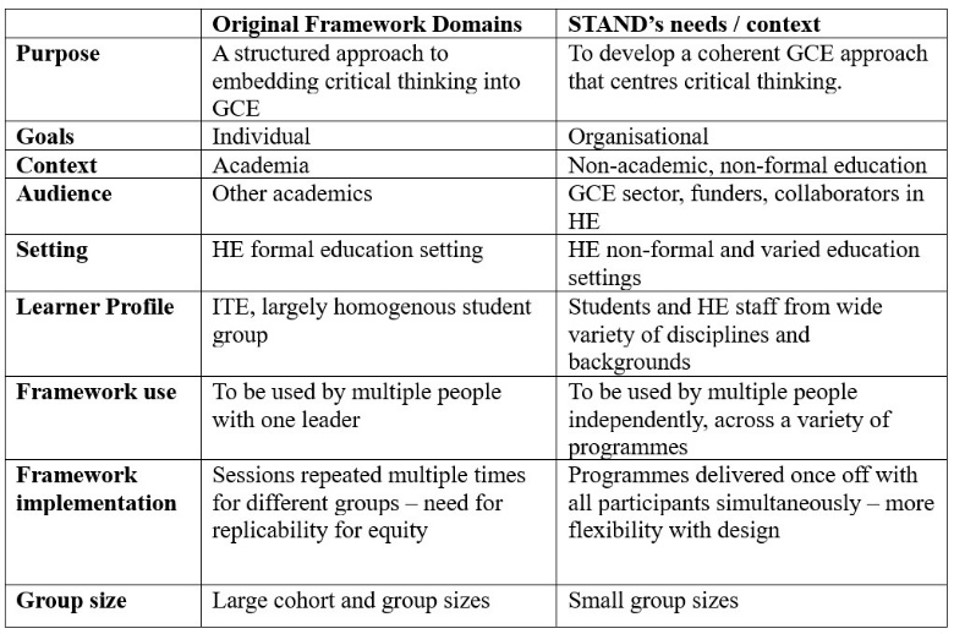
From the table it is clear to see that the original framework, though conceptually aligned with STAND’s goals, was not an ideal fit for their unique context. Their aims for the adaptation process included:
- Developing a coherent and intentional educational approach;
- Strengthening a shared educational identity, language, and understanding of critical and decolonial education in practice;
- Ensuring the organisation’s educational approach remained responsive to a changing and complex world;
- Creating a strong foundation for learning and impact evaluation across programmes.
Methodology: a three‑stage sequential design as Freirean co‑Inquiry
As outlined earlier, the process was conceptualised as Freirean praxis. This two-year project followed a three-stage sequential design which was practice-based, participatory, and iterative, drawing on principles of participatory design (Ten Holter, 2022):
Professional development
During this initial phase CPD was provided to all STAND staff (n=7) on the original framework by its author. This took the form of a one-day workshop which included content delivery, reflective activities, and collaborative dialogue to capture initial responses to the framework and consider how it overlapped with STAND’s existing frameworks and programmes, and where there may be gaps. As part of the professional development phase, STAND staff were provided with a pack of materials to frame their ongoing collaborative adaptation process.
Development and testing
During this phase STAND staff worked collaboratively to reimagine the original framework. This process was led by one staff member who chaired meetings, collated notes and suggestions, and presented their fellow staff members with proposed changes based on their collaborative discussions. During this phase staff members also tested out their evolving framework, using it to structure workshops, inform planning and design learning activities. This enabled an iterative process in which the team were enabled to reflect and test ideas independently while still feeding into an overall organisational redesign of the framework.
Feedback and finalisation
Once STAND staff were satisfied with a full draft of their reimagined framework they then shared it with relevant stakeholders. This process included a CPD session led by STAND to share the proposed new framework, and a facilitated reflective feedback session which took the form of a focus group interview with each group. The first group included five students who had engaged with STAND programmes, the second group included six facilitators and educators from the wider GCE community in Ireland, including some HE staff, and some people working on other Irish Aid Strategic Partnership programmes. This feedback informed a finalisation of the framework and supported staff to clarify aspects of the framework for more effective implementation. Data sources which informed the analysis of the adaptation process included three focus group interviews, notes generated in meetings and CPD sessions, and a researcher reflective diary. The focus group interviews included one with students, one with facilitators, and one with STAND staff at the conclusion of the project.
At all stages conversations about ethical research practice took place. Ethical approval was granted for the project, and all participants gave informed consent to participate in the project. Individual anonymity and the right to withdraw were made clear to participants from the outset. Although there was a lead researcher (Golden) on the project who led on research design and analysis, the process was collaborative ensuring that the project had value for the organisation. Data were analysed iteratively and thematically using abductive coding (Timmermans and Tavory, 2012), a qualitative research method that combines elements of both deductive and inductive approaches. Both approaches followed a reflexive thematic analysis approach following steps of data familiarisation, generating initial codes, and identifying, developing, reviewing and refining themes. The process involved an initial round of deductive coding to identify factors which led to changes in the framework in line with identified parameters such as framework elements, organisational goals, and other known contextual factors. Following this, open-ended inductive coding was engaged with which revealed underlying factors or additional parameters not initially considered. At all times attention was paid to the affective and ethical dimensions influencing participants contributions (Finlay, 2002), which is reflected in the interpretation of data and presentation of findings.
The adapted STAND framework
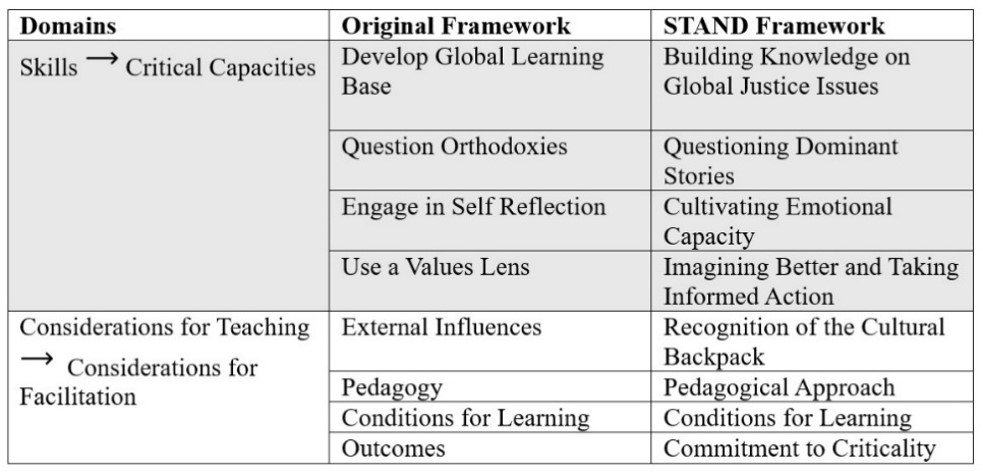
The adapted STAND framework is available in full on their website. While critical thinking was the lynchpin of the project, the final framework represents STAND’s GCE approach, not a framework solely for critical thinking development. Rooted in the organisational values of global justice, equity, critical thinking, sustainability, collaboration and diversity, the approach focuses on developing four core critical capacities which are nurtured in every programme and activity that STAND offers. Capacities build on each other but are not developed in linear order.
Building knowledge on global justice issues
Understanding the historical, economic, political, and cultural forces that shape the world including root causes of challenges and questions of power. It also encourages making connections across issues, linking past and present, local and global contexts, and personal experiences with wider systems. It invites learners to value diverse perspectives and remaining open to learning, unlearning, and new ways of understanding.
Questioning dominant stories
Cultivating the ability to recognise and challenge dominant narratives that shape our understanding of the world, especially those that normalise injustice or unsustainability by questioning their origins, impacts, and whose voices are excluded. It encourages learners to examine their own social positions and consider how they may reinforce or disrupt these narratives. This capacity also invites deeper empathy by engaging with multiple perspectives and embracing the complexity and nuance that come with seeing through others’ experiences.
Cultivating emotional capacity
Developing the emotional resilience needed to engage with difficult knowledge, helping learners to stay present with challenging emotions and deepen their capacity for honest, meaningful conversations. It also encourages reflection on personal values, recognising how they shape our responses and support more grounded and compassionate engagement with others. Finally, this capacity invites deep listening and dialogue over debate, fostering empathy, curiosity, and more constructive engagement with differing perspectives.
Imagining better and taking informed action
Imagining new possibilities beyond global crises, fostering the sense of agency in shaping a more just, equitable, and sustainable world. It encourages telling new, hopeful stories and recognising personal strengths to build confidence in contributing to change. It invites the development of skills that are necessary to take informed, collective action, grounded in a deep understanding of the issues.
Considerations for facilitation (the how)
The framework recognises that the degree to which these four capacities can be developed depends on how educators show up throughout the learning process, as summarised in these ‘considerations for facilitation’:
Pedagogical approach
The approach is grounded in the traditions of critical pedagogies which see education as transformative. It focuses on participation and dialogue, and creativity and experiential learning. It cultivates a practice of engagement to remain present with emotions as a foundation for more reflective dialogue.
Conditions for learning
The approach is based on the recognition that the relational and physical dimensions of a learning environment shape the quality of learning. As such STAND invests in building caring, respectful connections with learners and creating welcoming physical learning environments to enable respectful and critical dialogue.
Commitment to criticality
At the onset of programmes and activities, a shared commitment to critical engagement is established with learners. This active intentionality for sustained critical engagement provides an important foundation for the development of the four critical capacities.
Recognition of the ‘cultural backpack’
The approach recognises that both learners and educators bring diverse experiences, values, and perspectives that shape their engagement with learning. Reflective consideration of these ‘cultural backpacks’, on the part of both educators and learners, inform the design and facilitation of inclusive and responsive learning environments.
Some of the core concepts which underpin STAND’s framework include a commitment to criticality (problem-posing, ideology critique, unpacking power); systemic analysis (root causes, structures, interdependencies, leverage points); emotional capacity (holding complexity, discomfort, hope/agency, solidarity); collective praxis (dialogue, deliberation, action; collaboration; accountability); and transformative learning (perspective shifts; cycles of reflection). While STAND did not develop a planning tool like in the original framework, they have developed a facilitator pack which is continuously tweaked and used to inform the delivery of all their programmes and activities. Within this pack, each of the capacities are illustrated with examples, and the considerations include sample activities which could be used by facilitators. While each facilitator will have their own approach, they are encouraged to design their session with consideration of STAND’s framework.
One way the framework is implemented is through STAND’s global issues course, a six-week course delivered by STAND in collaboration with contracted facilitators. The development of the framework focused on how this course is framed, including using the first workshop to anchor the following five sessions. Interactive activities that encourage and emphasise the importance of critical engagement conclude with a ‘commitment to criticality’ pledge that each learner takes. They ‘Choose a C’ (from: commitment, creativity, care, connection, and courage) and share how they intend to engage in the space and with their peers, explore the concept of the (and their) cultural backpack, and spend time connecting with their peers. This focus on relationship and community building is presented as being essential to a conducive learning environment and, subsequently, effective action-taking.
The facilitators that facilitate on the subsequent sessions, use the opening fifteen to twenty minutes of each session to remind participants of the commitment to criticality, the focus on the ‘cultural backpack’ and an invite them to ‘Choose a C’. The subsequent ninety to one hundred minutes is topic focused, approached through the lens of the four capacities. The final, sixth session focuses on action taking (this year’s final workshop was called: ‘What if we build better futures together?’). Participants home in on one of the issues covered in the previous weeks that concern them the most and consider and plan for their own roles, responsibilities, skillsets, and capacities for taking action in relation to that issue. This final session, and others like it on other STAND programmes, ensures that the framework enables not just learning about the meta-crisis but equips people with the skills and dispositions necessary to respond to it.
A post-evaluation asks students to comment on their ability to ‘engage critically’. Future programme surveys are being developed to align closely with intended capacities and considerations, enabling more systematic tracking of learning and impact.
Table 2: Changes made in the STAND framework
Findings: organisational and educational outcomes
While the framework produced through this project does not represent a significant conceptual or pedagogical shift from previous practice, the ‘Get Critical’ project enabled STAND to develop a shared language around their educational approach and produce a focused framework to guide programme coherence across their diverse activities. As one staff member highlighted in the final focus group ‘we were doing criticality but not with intentionality’. The word intentionality came up repeatedly with staff to describe the shift in focus that developing the framework brought for them. It enabled ‘just making sure it’s [criticality] always there’, which was significant for them as an organisation, as articulated by another staff member who stated that ‘because we could do so many things with our audience, but this is what we want. This is what we've agreed on’. The emphasis on criticality which was brought through this project enabled staff to make deliberate choices which focused on what they considered most important as an organisation. Not only was the emphasis on criticality an important outcome, but the interpretation of criticality which was embedded in the framework demonstrated a commitment to critical pedagogy and critical GCE in its intertwining of affective and cognitive domains. This approach was appreciated by the students who reviewed the framework who praised ‘the combination of emotionality and criticality… you don’t really see that a lot… you can be logical while being emotional and caring’.
A significant contributing factor for STAND in initiating this project was a desire to reflect on how their educational approach could support them in responding to the meta-crisis. While acknowledging that education is a slow process, and that being a justice education focused organisation, and not a single-issue organisation, makes it difficult to publicly take a stand on all local and global geopolitical events, the framework has supported them in placing an emphasis on making a difference. As outlined above, the focus on their critical capacities enabled the inclusion of sessions focused specifically on action in their global issues course. This is also evident in their Changemakers Academy, their Ideas Collective, and in the direction of their STAND news site, all of which take a focus on action and linking with campaigns and activities in the wider civil society GCE sector. Furthermore, not only has the framework impacted on work with their participants but has impacted organisational culture; STAND have introduced ‘activism hours’ to enable staff to use paid work time to engage in action that is meaningful to them. In outlining how the framework enabled these changes, one staff member shared that ‘engagement for us is not only traditional “action” it is also critical thinking and a general way of engaging with the world’.
The framework development process helped STAND identify gaps in terms of skills and knowledge needed to deliver on their agreed framework. When discussing their use of the framework during the focus group interview, staff identified navigating difficult knowledge and questioning dominant narratives as an area which they want to cultivate more. This conversation reflected a ‘sticking point’ for some staff as they navigated what ‘difficult knowledge’ meant to STAND, and how they wanted to incorporate this idea into their work. One staff member articulated that they felt as an organisation they were ‘maybe unconsciously a bit resistant to polarising views in the same room because we’re so concentrating on, we're so community-based and we're so into safe, safe, warm, comfortable spaces’, sharing that they felt ‘that challenge is still unmet for holding really difficult conversations’. However, another staff member challenged this, proposing that they felt ‘that some of our spaces are made so comfortable that the difficult conversations occur, but they don't feel like difficult conversations’, they went on to share examples of where conversations could have been acrimonious but instead were conducted in a respectful curious manner, which they attributed to the educational approach modelled by staff. The process was, therefore, not punitive in identifying gaps, but transformative in highlighting areas for further exploration, and enabling disagreements, uncertainty and resistance within the process.
The process engaged in also enabled a deepening of collective collaborative reflexivity amongst the staff through the adoption of a community of practice style approach to reinforcing reflective practice as an organisation. They described the process they underwent in adapting the original framework, sharing that they put their ideas on the wall in a shared space in the office, that they looked at elements of the framework for a long time before making decisions; ‘I don't think our putting them into a framework was immediate. I think there was a lot of meditating on them at first’. This approach demonstrated a willingness to sit with ideas and give the time needed for authentic reflection, showing a commitment to a non-linear reflective enquiry approach in line with Freirean praxis. Although there was recognition that time was needed for meaningfully reflective work, the length of time which the project took (two years) also presented as a challenge in the process: ‘I thought the process was too long. If I went to another organisation and they said, oh, should we do a critical thing? I'd say, yeah, great, but let's do it in six months, not two years’. The project was not initially envisioned to take two years, but due to funding and other contextual factors, it was extended. This extended timeframe was seen to dilute the energy and enthusiasm for the process, with the suggestion that if it was shorter ‘it would feel more dynamic then, if it was only six months’. There exists a tension, therefore, between time needed for an authentic Freirean praxis approach, and the impact which an extended project can have on organisational morale and engagement.
The team also demonstrated an ability to be selective, to recognise also what elements of the original framework did not work for them. This demonstrated organisational knowledge, trust, and confidence in their approaches: ‘it's just... It [the Planning Tool] didn't seem that helpful for us. … We don’t feel the need to think about it or formalise it, operationalise it because it's kind of happening. So, it would be pointless to spend time analysing that’. Not only was this reflective approach demonstrated through the process but was also seen to be built into the final framework which participants in the facilitator focus group praised: ‘There’s space in it for self-reflection… and weight given to that gives it value’.
A significant organisational and educational outcome for STAND was the enhanced ability to track, measure and report on the impact of their programmes. As outlined by staff ‘organisationally and structurally it has helped to operationalise how we monitor the impact we are having’. Through the development of a comprehensive and cohesive framework to guide their work, they were enabled to develop monitoring and evaluation tools to match which will ultimately inform their educational reflection process, programme development, reporting and advocacy work within the sector by giving them a research-backed framework as a structure. Furthermore, the structured approach is a helpful tool for their specific context in providing a framework to share with external facilitators they employ to ensure continuity across programmes and sessions. During the final focus group, when discussing the impact of the new framework, one staff member stated that ‘this is actually really practical. It's not a rule book. It's just a sort of set of guidances for new staff or for external facilitators who are doing sessions’. This led to a critical reflective conversation about how best they can operationalise the framework to harness this potential while still aligning with STAND’s educational beliefs and the practices of staff: ‘I have a few questions just around the how of doing this… tools, lesson plans… standardisation…what does criticality look like in practice?’. This conversation demonstrated a willingness to engage with the uncertainty still felt by some, and the potential limitations of the framework in the context of real-world implementation. Even during an interview, the ongoing commitment to taking a reflective approach to pedagogy development was evident.
Discussion: implications for GCE theory and practice
The findings from this study illustrates that critical GCE frameworks become transformative when educators engage in Freirean praxis, including collective reflection and action that surface assumptions, redistribute epistemic authority, and reorient educational practice (Freire 1970; hooks 1994; Cochran-Smith and Lytle, 2009). The findings demonstrate that intentional framework adaptation can operate as Freirean praxis, reshaping not only pedagogical tools but organisational cultures and identities (Freire 1970; Cochran‑Smith and Lytle, 2009). By integrating systems thinking, decolonial critique, and emotional capacity (Zembylas, 2015), the adapted STAND framework exemplifies a multi-dimensional form of critical GCE. Indeed, the STAND framework represents a rare attempt to operationalise a synergy between systems literacy, decolonial vigilance, and affective-critical learning, responding to long-standing critiques that GCE tends to depoliticise global injustice (Stein, 2017). Furthermore, the intentional cultivation of emotional capacity embedded within STAND’s framework aligns with calls for GCE to address the affective dimensions of encountering injustice, including discomfort, ambivalence, and hope (Zembylas, 2015).
The adaptation process itself demonstrated Laurillard’s (2012) principle that pedagogical design is iterative, evidence-informed, and systemic, and Fullan’s (2016) view that educational change succeeds only when meaning-making is shared across the organisation. By showing how an NGO adapted a framework to align with its organisational mission, this study offers a model for context-responsive GCE design, strengthening Bourn’s (2020) call for NGOs to cultivate clearer, more coherent pedagogical identities. Indeed, in sharing both the process and outcomes, STAND offer a replicable example for other NGOs seeking to align their pedagogies with justice‑oriented aims. This case adds to GCE scholarship by illustrating how framework adaptation can foster a community of practice, cultivate a culture of inquiry, strengthen professional identity, and produce more context-responsive, ethically grounded global learning practices.
Conclusion and recommendations
This article shares a worked example of framework adaptation as Freirean, systemic, affect‑aware praxis that strengthened both pedagogy and the organisation. The adaptation process STAND underwent represents not just a technical tweak, but organisational learning that reoriented pedagogy and relationships. The move from focusing on implementation of pre-established organisational goals to the co-creation of a living framework surfaced both organisational and individual assumptions and values and enabled an interrogation of both. In facilitating this transformation, dialogue emerged as a critical ethical imperative. Furthermore, the process represented a process of significant organisational learning for STAND. The co-developed redesigned framework became an infrastructure for enabling coherence, quality, and a reflective culture, not just facilitating pedagogy and curriculum development.
The findings suggest that the most transferable aspect of this project lies not in the framework produced, but in the process through which it emerged. The use of dialogical, iterative, and critically reflective practices demonstrates how Freirean praxis can be operationalised within organisational settings. For other practitioners, this highlights the value of engaging in context-specific, collective inquiry as a means of translating abstract principles of critical GCE into grounded and meaningful pedagogical approaches. Indeed, findings point to strong recommendations for other educators around the importance of building time for collective reflection and professional development to enhance pedagogy and progress organisational coherence. Awareness of the affective dimension of pedagogical reimagination and collective design should be embedded as a design requirement rather than an add-on when engaging in this work. The process and positive findings of this project gave rise to a wider ‘Get Critical’ project which includes educators from a wide variety of backgrounds and settings all working to adapt the original framework to their own contexts. This research will enable comparative studies across contexts, to establish what are the core components of criticality which educators retain as essential to GCE. Further research would enhance our understanding of the long-term impact of organisational framework development. There would be merit in tracking the impact of the implementation of the newly developed STAND framework including exploring longitudinal learner impact.
References
Andreotti, V (2006) ‘Soft versus critical global citizenship education’, Policy and Practice: A Development Education Review, Issue 3, Autumn, pp. 40-51.
Andreotti, V (2009) ‘Global education in the ”21st century”: Two different perspectives on
The “post”-of postmodernism’, International Journal of Development Education and Global Learning, Vol, 2, (2), pp. 5-22.
Bourn, D (2015) The Theory and Practice of Development Education: A Pedagogy for Global Social Justice, Abingdon: Routledge.
Bourn, D (2020) ‘Introduction’ in D Bourn (ed) The Bloomsbury Handbook of Global Education and Learning, London: Bloomsbury Academic, pp. 1-9.
Capra, F and Luisi, P L (2014) The Systems View of Life: A Unifying Vision, Cambridge, MA: Cambridge University Press.
Cochran-Smith, M and Lytle, S L (2009) Inquiry as Stance: Practitioner Research for the Next Generation, New York: Teachers College Press.
Finlay, L (2002) ‘“Outing” the researcher: The provenance, process, and practice of reflexivity’, Qualitative Health Research, Vol. 12, (4), pp. 531-545.
Freire, P (1970) Pedagogy of the Oppressed, New York: Continuum.
Freire, P (1974) Education for Critical Consciousness, London: Bloomsbury Publishing.
Fullan, M (2016) The New Meaning of Educational Change, New York: Teachers College Press.
Golden, B (2025) Critical Thinking for Global Citizenship Education: A Conceptual Framework. Springer Nature.
hooks, b (1994) Teaching to Transgress, New York: Routledge.
hooks, b (2010) Teaching Critical Thinking: Practical Wisdom, New York: Routledge.
Jaramillo Gómez, D L, Álvarez Maestre, A J, Parada Trujillo, A E, Pérez Fuentes, C A, Bedoya Ortiz, D H and Sanabria Alarcón, R K (2025) ‘Determining factors for the development of critical thinking in higher education’, Journal of Intelligence, Vol. 13, (6).
Kemmis, S (2019) A Practice Sensibility: An Invitation to the Theory of Practice Architectures, Singapore: Springer Nature.
Laurillard, D (2012) Teaching as a Design Science: Building Pedagogical Patterns for Learning and Technology, London and New York: Routledge.
MacCallum, C S (2014) Sustainable Livelihoods to Adaptive Capabilities: A Global Learning Journey in a Small State, Zanzibar, London: University College London.
McCloskey, S (2026) ‘Pedagogical Responses to the Meta Crisis: The Role of Development Education’, Policy and Practice: A Development Education Review, Issue 42, Spring, pp. 1-18.
Mezirow, J (2006) ‘An overview on transformative learning’ in J C P Sutherland (ed) Lifelong Learning, London and New York: Routledge, pp. 40-54.
Sfard, A (1998) ‘On two metaphors for learning and the dangers of choosing just one’, Educational Researcher, Vol. 27, (2), pp. 4-13.
Shor, I (1992) Empowering Education: Critical Teaching for Social Change, Chicago: University of Chicago Press.
Spivak, G C (1999) A Critique of Postcolonial Reason: Toward a History of the Vanishing Present, Harvard University Press.
Stein, S (2017) ‘The Persistent Challenges of Addressing Epistemic Dominance in Higher Education: Considering the Case of Curriculum Internationalization’, Comparative Education Review, Vol. 61(S1), pp. 25-50.
Ten Holter, C (2022) ‘Participatory Design: Lessons and Directions for Responsible Research and Innovation’, Journal of Responsible Innovation, Vol. 9, (2), pp. 275-290.
Timmermans, S and Tavory, I (2012) ‘Theory construction in qualitative research: From grounded theory to abductive analysis’, Sociological theory, Vol. 30, (3), pp. 167-186.
Zembylas, M (2015) ‘“Pedagogy of discomfort” and its ethical implications: the tensions of ethical violence in social justice education’, Ethics and Education, Vol. 10, (2), pp. 163-174.
Brighid Golden is Assistant Professor in Global Citizenship Education at Mary Immaculate (MIC) College, Ireland, and represents MIC on the national DICE (Development and Intercultural Education) Project Network. She is the author of Critical Thinking for Global Citizenship Education: A Conceptual Framework (2025, Palgrave MacMillan and available in open access at: https://link.springer.com/book/10.1007/978-3-031-89642-2) and editor of Curious Teachers, Critical Classrooms (2023, Dublin: DICE Project). She is also the host of the podcast series Curious and Critical GCE on Spotify. Brighid teaches, researches, and publishes in the areas of global citizenship education, critical thinking, resource development, initial teacher education, and self-study research approaches.
Charlotte Bishop has served as STAND’s Education and Research Manager since 2023. Charlotte brings experience from Amnesty International, Sonairte, Brigit’s Garden, and the Centre for Environmental Justice. In her work with STAND, she also draws on her studies in Anthropology and Environmental Law and in development studies.
Nina Sachau is the executive director of STAND and has an MA in Geography and Postgraduate Diploma from Kimmage Development Studies Centre. She has extensive experience in the civil society sector, having worked, for example, with the Trade Justice Movement in Germany, as Coordinator of Claiming our Future in Ireland and the European Alternative Trade Mandate Alliance. She has also worked as Civil Society Advisor with GIZ, the German Development Cooperation Programme, in Vietnam and worked for GOAL Global in Ireland to develop their Global Citizenship Department before joining STAND in 2021.