





Discourses of Climate Change Denial and Obstruction in a North American Petrostate: Does Climate Change Education Stand a Chance?
 43
43 Development Education: Learning for Transformation
 Click to download
Abstract: A growing international consensus on the importance of equipping citizens with the capacities to respond to climate crises has resulted in proliferating efforts to ‘green’ education, including by global policy bodies like the United Nations Educational, Scientific and Cultural Organisation (UNESCO) and the Organisation for Economic Co-operation and Development (OECD). However, education does not occur in a vacuum; it is shaped, enabled, or constrained by the political and economic contexts in which it unfolds. This article examines how climate change education is curtailed in a petrostate context through a case study of Alberta, Canada, where the state exerts discursive as well as legislative control over education. The Government of Alberta’s Canadian Energy Centre (CEC), or ‘Energy War Room’, has aggressively mobilised messages of climate denial and delay with the purpose of obstructing actions to limit fossil fuel development. By analysing the CEC’s tweets through the ‘discourses of climate obstruction’ framework created by Kinol at al. (2025), we trace the particularities of the petrostate’s climate denial and delay. By promoting fossil fuel-friendly discourses and casting climate advocacy as ideological or even unpatriotic, the CEC sidelines much of the climate change education taking place in schools and communities, making it difficult and increasingly politically dangerous. Only softened versions of climate change education, such as ‘greening’ or gardening as climate change mitigation, are palatable, as they divert attention away from petrostate hegemony. Rather than interrogating anemic forms of climate change education in isolation, we highlight the role of the petro-state in restraining resistance to fossil fuels in climate education. In this, we consider paths for education to solidify the resistance needed to hold the fossil fuel industry and its agents accountable for their role in planetary destruction.
Key words: Climate Change Education; Climate Denial; Discourse; Education Policy; Energy Education; Fossil Fuels; Greening Education; OECD; Petrostate; UNESCO.
Introduction
“Climate change is here. It is terrifying. And it is just the beginning. The era of global warming has ended; the era of global boiling has arrived”. António Guterres, press conference on global temperatures (UN 2023).
A reasoned response to the intensification of climate change toward climate catastrophe would be to learn about its causes and to immediately implement all possible mitigation and adaptation actions. The vital contributions of climate change education in schools, universities, and via local, national and international civil society groups is supported by global frameworks created by bodies such as UNESCO and the OECD. One of the six priority areas for the United Nations Framework Convention on Climate Change (UNFCCC) Action for Climate Empowerment (n.d.), education has seen increasing commitment at the United Nations Conference of Parties (COP) meetings on climate change since the 2022 COP27 meeting in Egypt, which launched the Greening Education Partnership, a whole-of-system approach to climate education. Initiatives such as the Greening Education Partnership support countries to tackle the climate crisis through ‘strong, coordinated and comprehensive action that will prepare every learner to acquire the knowledge, skills, values, and attitudes to tackle climate change and to promote sustainable development’ (UNESCO, n.d.). Education policy bodies have taken up these commitments by making specific recommendations for system-wide climate change education, including recommendations for curriculum, teacher training, and links to communities, as well as methods for monitoring and evaluating progress (e.g. OECD, 2022; 2024; Nusche et al., 2024; UNESCO, n.d.; UNESCO and MECCE, 2024). Focused on individual empowerment, these policies promote education that provides learners with the knowledge, skills, values, and attitudes to engage in climate action. To track country progress and ultimately support mainstreaming of climate education, global policy bodies are developing global indicators that link to Agenda 2030 and Sustainable Development Goal #4 on quality education (UNESCO and MECCE, 2024).
These policies highlight a growing international consensus on the importance of equipping citizens with the capacities to respond to climate crises. However, the implementation of climate change education does not occur in a vacuum (Aykut and Castro, 2017). It is shaped, enabled, or constrained by the political and economic contexts in which it unfolds. This article examines how climate change education, including formal and non-formal, basic, and higher education, is discursively curtailed in a petrostate context through a case study of the petro-state of Alberta, Canada and its current government, the United Conservative Party (UCP), a government that since 2019 has taken a very aggressive and ‘whole government’ approach to supporting the fossil fuel industry while challenging climate science and scientists as needlessly ideological. Canadians experience the climate crisis in intensified flooding, droughts, and some of the world’s fastest rising temperatures (see https://natural-resources.canada.ca/climate-change/national-assessment-process) and devastating wildfires (see https://ciffc.net/). At the same time, the contribution of fossil fuels to gross domestic product (GDP) continues to increase, averaging about 5 percent for Canada, 21 percent for Alberta, and 25 percent for Newfoundland and Labrador (Wang, 2021). The CEC reports that the energy sector’s revenue contribution to Canadian governments between 2000 and 2021 was $755 Billion CAD (CEC, 2023a). Despite this wealth, Alberta demonstrated the characteristics of a petro-state including having the lowest per capita funding for public education of any jurisdiction in Canada (Milne, 2025). A petro-state is considered a nation that is economically dependent on fossil fuel industries. Karl (1997; 1999) and Ross (2012) highlight that petro-states experience weakened governance, economic instability due to the ‘boom and bust’ nature of the global fossil fuel economy, a turn toward authoritarianism to manage conflict between citizens’ needs and growth in fossil fuel development, and ultimately, a diminished focus on and funding of state funded health, education, and infrastructure.
In a petrostate context, the fossil fuel industry does not simply co-exist with education; instead, education is actively reshaped by an increasingly authoritarian petrostate with explicit goals to contain discussion of climate change or influence by non-government organisations or institutions engaging the public in climate or energy justice activities. The Government of Alberta’s Canadian Energy Centre (CEC), referred to as the ‘Energy War Room’, has aggressively mobilised messages of climate denial and delay with the purpose of obstructing actions to limit fossil fuel development. The CEC has taken up social media channels like X/Twitter to actively promote Alberta’s fossil fuel sector and counter climate policy by shaping public discourse. In this study, the interaction of this state generated anti-climate change messaging with education is of primary interest. If there is to be a liveable future on our shared planet, we must understand how petro-politics work to keep fossil fuel industries protected, while citizens are distracted and unable to get the knowledge they need to take action (see for example, King et al., 2023).
To make sense of the nature of CEC’s efforts to influence public discourse about climate change, we conducted a critical policy analysis (Young and Diem, 2018; Diem et al., 2014) of the Alberta government’s CEC through the ‘discourses of climate obstruction’ framework created by Kinol et al. (2025), which enables us to trace the particularities of the petrostate’s climate denial and delay. Critical policy analysis explores power, ideology, and context of policy and policymaking. By analysing the Alberta government’s policy, the CEC website information, and CEC tweets as a central activity in its communication strategy, patterns of discourses are made visible. By promoting fossil fuel-friendly discourses and casting climate advocacy as ideological or even unpatriotic, the CEC sidelines much of the climate change education taking place in schools and communities, making it difficult and potentially politically dangerous. Here, a softened version of climate change education, such as ‘greening’ or gardening as climate change mitigation, is more palatable than a critical examination of the role of fossil fuels in causing and exacerbating climate change, as it diverts attention away from petrostate hegemony. Interrogating anemic forms of climate change education, we consider what it means for education to solidify the resistance needed to hold the fossil fuel industry and its agents accountable for their role in planetary destruction.
Global policy and petro-influence in education
The move to ‘green’ climate change education is a global trend. Recently, COP28 strengthened global climate commitments through a ‘Declaration on the common agenda for education and climate change’ (UNFCCC, 2024), which embedded climate change within Sustainable Development Goal 4 on quality education. Goals for climate change education focus on fostering climate literacy (OECD, 2024), which is predominantly oriented around scientific knowledge of human-induced climate change and the ability to assess and communicate climate information. Recognising a need to move beyond knowledge to action, climate education policies also emphasise individual learner empowerment, including the development of key knowledge, skills, values, and attitudes that foster confidence and motivation towards ‘student awareness, agency and empowerment for climate action’ (OECD, 2022: 2), including through practice of sustainable lifestyles and work within a green economy. Increased treatment of climate change education within global policy is mirrored in exponential growth in research on the topic, as is reflected through a proliferation of systematic literature reviews on climate change education (e.g. Hadiapurwa et al., 2024; Kranz et al., 2022; Monroe et al., 2019; Morrissey and Morrissey, 2024; Nepras et al., 2022; Rousell and Cutter-MacKenzie-Knowles, A., 2020). While some climate education research engages with petro-pedagogy in the classroom, broader petrostate dynamics largely remain beyond view in education research.
In fossil fuel reliant contexts, research increasingly points to the longstanding influence of oil and gas industries over formal education, both basic education and higher education, through means ranging from teacher resourcing to corporate sponsorships (Keary and Chestnut, 2025), naming such influences ‘petro-pedagogy’ (Eaton and Day, 2020; Tannock, 2020). Characterised by greenwashed and techno-optimistic portrayals of the fossil fuel industry, petro-pedagogy downplays anthropogenic causes and the injustices inherent to climate change by presenting so-called ‘balanced’ representations of the climate crisis that emphasise natural causes. Firmly situated within neoliberal logics, petro-pedagogies focus on individualised climate actions at the expense of systemic change, leaving climate-affecting industry practices beyond view through a focus on actions such as cycling, recycling, and other individual behaviours. Fortunately, the hegemony of petro-state politics is not complete, and emerging research recommends more critical forms of climate change education that, for example, pushes back against oil industry actors that use community-focused yet corporate-branded philanthropic educational efforts, like building playgrounds or funding libraries, to shape both formal and non-formal education toward reducing resistance to oilsands developments (see Hoeg, 2020). From a humanities angle, Lowan-Trudeau (2023: 654) encourages applying an absurdist lens to Alberta’s context, which can enable critique and introduce creative possibilities while maintaining humour in the face of the ‘Alberta government’s unconscionable environmentally-related actions’. Such scholarship pushes the boundaries of global ‘greening’ efforts by engaging directly with climate-harming activities of both industry and the state.
However, most of the petro-pedagogy scholarship focuses either on the direct influence of the fossil fuel industry and/or attends to specific sites rather than the broader political climate within which climate education policy is created and enacted. A recent systematic literature review by the authors (Karsgaard and Shultz, 2025) about research at the intersections of fossil fuels and education identifies growth in this research area; however, overall, fossil fuel interests are prioritised in education research according to state economic and workforce development goals and discourses. Despite the intensifying climate crisis, only nine of 89 articles critique the interface of fossil fuels and education. Hodgkins (2008), for example, articulates how the rise of neoliberalism compounds within petrostates to enable infusion of industry propaganda in education. Examining the role of the petrostate in higher education, Adkin (2021; 2023) reveals state influence over politics, cultures, and governance of post-secondary institutions to ensure alignment with petrostate aims. Such studies point to a need to more deeply understand the mechanics of petrostate influence over education if climate change education is to meaningfully take hold. We now turn to an example petrostate, the province of Alberta in Canada, to consider the tensions and restrictions it poses for climate change education.
Alberta as a petrostate: curtailing climate change education
Alberta, a landlocked province in western Canada, has long been dependent on resource extraction. The ‘discovery’ of oil in the early to mid-20th century continues to be celebrated in the province in ways that are part myth and part hard economic realism. The petroculture that surrounds the exploration, extraction, and development of fossil fuel products stretches across the province, infusing its governance. The culture and economics of fossil fuels set Alberta apart from other areas in Canada, and Albertans are more likely than their fellow Canadians to accept unconventional fossil fuel developments (Brunner and Axsen, 2020; see also Government of Alberta, 2025), such as bitumen extraction in the Fort McMurray oilsands development. Situated in the northeast of the province, this development contentiously sits on land governed by Treaty 8, an agreement signed in 1899 during the colonisation of Indigenous land by the government of Britain, which established relations between local Indigenous groups and the Canadian government. The government of the Province of Alberta, the area where most of Treaty 8 land is located, is bound by the national agreements signed even before Alberta became a Canadian province. Included in the Treaty 8 agreement is the right for Aboriginal people to continue their use of the land for subsistence by activities such as hunting, fishing, and the procurement of life’s necessities, and it delineates land reserved for each specific Indigenous group. In this, Indigenous people have rights related to the whole of the land under Treaty 8 with additional rights to the land reserved for their particular Indigenous group (Whose Land, n.d.).
This Treaty is the foundation for negotiations today with the many parties interested in developing the rich and diversely endowed resources within the Treaty agreement. The extraction practices of national and international fossil fuel corporations in the region, and subsequent massive disruption and destruction of the land and the lives of local people, continue to be ongoing points of legal, economic, and social conflict. Like other petrostates around the world, the Government of Alberta has made fossil fuel extraction its main focus for economic development, and destroying land, air, water, and human communities, aptly described as sacrifice zones of extraction, are viewed as necessary if the riches of oil are to be accessed (Juskus, 2023; Lerner, 2010). The benefits of the extraction are for people with jobs in the industry and, most significantly, foreign owners and shareholders, many in companies headquartered in the United States, while the burdens are on Indigenous people (Deranger et al., 2022) and small farmers in rural communities.
Conservative governments:
“which ruled the province continually from 1934 to 2015, and took power again in 2019, draw not only (since the 1990s) upon neoliberal ideology but also upon deep veins of libertarian populism and frontier masculinity associated with the resource-extractive economy” (deSmog n.d., qtd. in Adkin 2023: 2)
Karl (1997) and Ross (2012) found that oil-rich states are more likely to experience authoritarianism, economic mismanagement, corruption, and gender inequality as central to governance structures and processes. Institutions tend to be underdeveloped in petrostates, leading to corruption, weak democratic processes, and instability caused by the underdevelopment of industries other than fossil fuels. Petrostates are vulnerable to world oil prices and in Alberta, like other petrostates, the solution is to increase fossil fuel extraction rather than to look at diversifying the economy. Fossil fuel companies and politicians work together to create fossil fuel-friendly policies such as low taxation, generous subsidies for fossil fuel exploration and development, and minimal environmental regulations that overlook the destructive impacts on land, air, and water.
In recent years, the reality of the climate crisis has become apparent through increased destructive weather events such as floods, droughts, and wildfires, along with global movements to make people aware of the peril of overshooting planetary boundaries by increasing levels of carbon in the atmosphere. The Alberta government, demonstrating how deeply petroculture and petrostate governance are embedded, generally refuses to support these collective efforts to limit climate change-related destruction. In fact, the province makes active efforts to promote oil and gas industries and counter climate policy through disinformation campaigns that shape public discourse.
Canadian Energy Centre Ltd., aka ‘Energy War Room’
The most prominent manifestation of the Government of Albert acting as a petrostate is the recent effort to mainstream pro-oil discourse through its Canadian Energy Centre Ltd. (CEC), also known as the ‘Energy War Room’. In 2019, Jason Kenney, leader of the right-wing United Conservative Party (UCP), created this provincial corporation with an annual budget of $12 million (French, 2022). The CEC worked under CEO Tom Olson ‘to promote Canada as the supplier of choice for the world’s growing demand for responsibly produced energy’ (Canadian Energy Centre Ltd., 2025). More specifically, the goal of the CEC was to actively refute ‘domestic and foreign-funded campaigns against Canada’s oil and gas industry’ (Olsen 2019), using ‘data, stories, and narrative’ (Canadian Energy Centre Ltd., 2021: 3) to ‘fight misinformation related to oil and gas’ (Heydari, 2019) coming from environmental groups and foreign interference. As a crown corporation - a provincial organisation that is structured like a private company and is thus less subject to government oversight - the CEC was not subject to Alberta’s Freedom of Information and Protection of Privacy Act (FOIP Act), which supposedly protects against the very foreign-funded interests the CEC seeks to counter. CEC’s bypass of FOIP raised questions about the lack of public oversight and use of propaganda within the petrostate (French, 2022).
In 2024, after running for five years as a crown corporation, the CEC was rolled back into the provincial government. While critics celebrate this shift, articulating the centre as a waste of taxpayer money, the move was likely more strategic than cost-saving. In June 2024, the Canadian federal government passed the Amendments to the Competition Act (Bill C-59), which included anti-greenwashing legislation that required energy companies to ensure scientific accuracy in any published claims. The Alberta government characterised Bill C-59 as an ‘undemocratic gag order’ (Belliveau, 2024), in keeping with the province’s resistance to federal emissions policies. Such resistance is so strong that Premier Danielle Smith has threatened to invoke the Alberta Sovereignty Act to protect Alberta oil and gas from federal emissions caps (Tran, 2024). By moving the work of the CEC back into the provincial government, therefore, the province could continue to shape public discourse via the CEC’s website, social media accounts, and other campaigns to boost the province’s oil and gas industry without federal interference (Kaufman, 2024).
CEC annual reports reveal a comprehensive suite of web content, campaigns, social media posts, public education, and advocacy efforts to ‘change attitudes about Canadian oil and gas’ (Canadian Energy Centre Ltd., 2023b: 4) in ways that directly oppose the climate science behind global education policy. CEC’s website, the content hub, translates research on oil and gas into public-friendly reports that boost the industry, with a special focus on First Nations, global comparisons, and environmental and economic concerns. In keeping with the CEC’s aim to ‘showcase the leadership of Canada’s oil and gas sector in environmental, social and governance (ESG) performance, and highlight the importance of the oil and gas industry to Canada’s economy’ (Canadian Energy Centre 2022: 8), the CEC website promotes the oil and gas sector’s contributions to environment, economy, and community. Benefits to Indigenous communities are particularly emphasised, where the oil industry is depicted as contributing to economic reconciliation between Indigenous peoples and the state. In addition, through a focused section about oil ‘In Our Lives’, the website uses infographics and stories to intentionally highlight the oil’s inherence to modern life and activities dear to Albertans (Ibid.: 4), from camping to barbecuing, and holiday events to sports activities. Despite the purportedly factual nature of information available in CEC materials, economist Andrew Leach (2019) has drawn on scientific research to rebut many of CEC’s claims. However, the CEC continued to develop content, using Facebook, LinkedIn, YouTube, and X/Twitter to drive viewers to the website (CEC, 2022: 11). It is the X/Twitter account, @CDNEnergyCentre, that is the focus of our study.
Discourses of climate policy obstruction
Corporations in the fossil fuel sector have long mobilised traditional and social media through disinformation campaigns that shape public conceptions of climate and environmental issues and that promote particular climate solutions that are favourable to industry profits (e.g. Carroll, 2021; López, 2022; McKie, 2021; Si et al., 2023). Through their ability to shape public perception, social media campaigns are powerful tools in industry efforts to shape policy debates by establishing political and cultural hegemony through discourse (Ferns and Amaeshi, 2021; Kinol et al., 2025; Kraushaar-Friesen and Busch, 2020; Nyberg et al., 2018). While social media holds participatory, ‘bottom-up’ possibilities for knowledge creation, the carefully crafted nature of fossil fuel campaigns means they are instead locked down, warranting critical analysis of the ‘discursively propagated and disseminated constructs of collective identities’ (KhosraviNik and Zia, 2014: 760) that can become internalised through repeated socialisation online, with implications for climate change education policy.
In this context, we understand the petrostate’s fossil fuel disinformation campaigns as a method of climate education policy obstruction through control of discourse, where fossil fuel actors engage in ‘strategic attempts to undermine and subvert climate policy’ (Kinol et al., 2025: 21). Here, we rely on the work of Kinol at al. (2025: 21) in highlighting industry efforts to shape public discourse via social media ‘with the intention of stopping, slowing, or reversing climate policy or action’. While Kinol at al. focus on discourses of climate policy obstruction within the corporate sector, we extend their framework to education policy obstruction within the petrostate. Here, obstruction is carried out not by industry but by the petrostate itself, as it seeks self-maintenance in the face of strengthened international agreements supporting climate action and education. While the petrostate holds the power to create policy, mounting public pressure may push the petrostate to manipulate discourse to foster consent for a policy agenda. For instance, as a signatory to the Paris Agreement, the Government of Canada actively seeks to mainstream climate change education across the country (ECCC, 2024) in keeping with global ‘greening education’ efforts, including within Alberta. Even as pressure escalates from national and international levels, grassroots mobilisations within Alberta - from Indigenous climate action to youth climate movements - raise the profile of climate education in relation to people’s lived experiences. Discourses of obstruction may therefore be intentionally taken up by the state to foreclose alternatives, limiting public debate and deliberation (Fairclough and Fairclough, 2012: 92) about climate education.
As policy discourses, obstructive discourses hold potential to shape public courses of action (Ibid: 18), including climate action through education policy. Discourses, to some extent, shape what is possible, including through ‘representations of how things are and have been, as well as imaginaries – representations of how things might or could or should be’ (Fairclough, 2023: 458). While the current study does not trace the direct outcomes of obstructive discourses, it unpacks the discursive moves whereby the petrostate defines the current problem of climate change and projects imaginaries for potential futures, which hold implications for what is considered possible or preferable in climate education (Ibid: 459-460).
Critical policy analysis of climate obstruction over X/Twitter
Education researchers have identified the need to understand education policy within its wider context, particularly in understanding how policies restrict or enable particular education possibilities. Education, as one of the state’s responsibilities, is an area where there is often a struggle for generational control of the social, economic, and environmental outcomes for a society. Critical policy analysis (Young and Diem, 2018; Diem et al., 2014) provides a framework for scrutinising the context and policy making procedures through discursive reading and rereading of policies, communication strategies and outputs, and social media engagement.
One pattern within this study’s findings was an overt government effort, both through formal policy and informal messaging, to close discursive sites where pro-climate change action information and activism was or could be circulated in Alberta. Critical analysis of discourses of such obstruction is therefore necessary to unpack the petrostate’s tactics in reinforcing petrostate hegemony, towards understanding the discursive bounds around climate change education policy in Alberta. Critical discourse analysis, in a political sense, seeks to unpack discourse in relation to political and institutional contexts (i.e. of the petrostate) and actors (i.e. of the CEC), along with the particular structure of argumentation in its attempt to ‘convince an audience that a certain course of action is right or a certain point of view is true’ (Fairclough and Fairclough, 2012: 18). Discussion of obstruction must therefore consider both the power behind the discourse, as described in relation to the petrostate of Alberta above, and the power in discourse (Fairclough and Fairclough, 2012; KhosraviNik, 2014; KhosraviNik and Zia, 2014) to shape policy conversations.
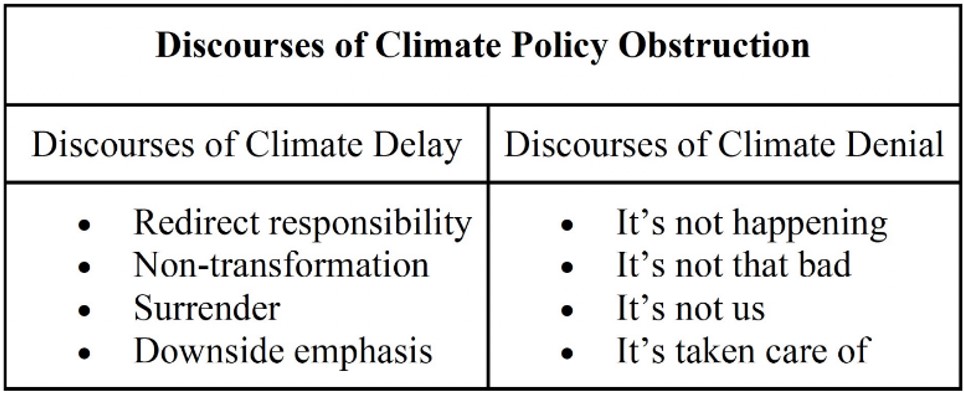
We take up critical discourse analysis in relation to Kinol et al.’s (2025) discourses of climate obstruction to unpack the CEC’s methods of argumentation surrounding climate change and fossil fuel developments. Within a comprehensive framework articulating discourses of climate obstruction (see Table 1), the authors combine Lamb et al’s (2020) discourses of climate delay and Cook’s (2020) discourses of climate denial, identifying a suite of discourses that are intentionally used across fossil fuel-oriented sectors of fossil energy, plastic production, and agrichemicals. Lamb’s (2020) four delay discourses serve to stall action on climate by redirecting responsibility for climate change away from fossil fuel corporations, supporting non-transformative solutions to climate change such as technological innovations like carbon capture and storage, emphasising the disruptive downsides of enacting climate policy, and surrendering to climate change by asserting that it is too late to act. Fossil fuel companies combine delay discourses with four denial discourses, which Kinol at al. adapt from Cook’s (2020) taxonomy, namely: ‘it’s not happening’, or outright climate denial of climate science; ‘it’s not bad’, or denial of the severity of the climate crisis; ‘it’s not us’, or denial of the role of fossil fuels in climate change; and ‘it’s taken care of’, or denial of the need to take action and alter behaviour. Discourses of climate policy obstruction can take a variety of forms, from negative interventions countering fossil fuel regulations to positive messaging that promotes uncritical views of the fossil fuel sector (Kinol et al., 2025: 21). Indeed, discourses of obstruction can adopt even very progressive language and rhetoric without serving those ends (Solomun et al., 2025: 6). Together, delay and denial serve to entrench fossil fuel hegemony through powerful and at times subtle narratives that may pose restrictions to the kinds of climate education policies emerging from the science.
Table 1 Discourses of climate obstruction (Kinol et al., 2025)
X/Twitter provides a site of analysis for government methods of controlling public discourse and by extension climate policy, in keeping with research demonstrating policy obstruction over social media by fossil fuel companies (Gunster et al., 2021; Kinol et al., 2025; Solomun et al., 2025). In relation to discourses of policy obstruction, tweets may be intentionally shared to ‘undermine or subvert climate policy through social media’ (Kinol et al., 2025: 21). Managed according to the CEC’s strategic plan, as reflected in annual reports (Canadian Energy Centre Ltd., 2021, 2022, 2023b), the CEC’s X/Twitter account lends insight into the coordinated effort by the Government of Alberta to influence climate discourse, particularly as the platform is a primary driver to the CEC’s website. Social media discourse is thus not only ideological but also political. The CEC set up its X/Twitter account, @CDNEnergyCentre in October 2019, with a self-identified account location of ‘Alberta’, and the brief descriptor, ‘Fact-based news and research demonstrating that Canada is the world’s energy solution’. At the time of writing, the CEC still posts on X/Twitter regularly.
We harvested all tweets associated with @CDNEnergyCentre using Phantombuster’s Twitter Profile Scraper (n.d.) on 3 October 2022, when the CEC had 10,300 followers. Our harvest resulted in a set of 1,133 tweets from a three-year period (October 2019 to October 2022). Only 27 retweets were present in the set, indicating very little engagement by CEC with other accounts; rather, the account reflects centralised messaging driven by CEC in keeping with the agenda outlined in the annual reports. In our analysis, we excluded the retweets to focus on crafted CEC messaging. We also excluded 61 tweets that had insufficient content to code or were irrelevant, such as those that are simply linked to the CEC website without comment or referencing celebrated holidays. The final corpus therefore contained 1,045 tweets. Reading in full the finalised set of 1,045 tweets, we conducted a discourse analysis by deductively coding all tweets according to Kinol et al’s (2025) discourses of climate obstruction. As we coded, we kept notes on the various ways these discourses were mobilised within the petrostate. A nuanced reading of discourses of obstruction emerging from Alberta’s CEC in the following sections will provide insight into the particular challenges facing climate change education within petrostates, leading to recommendations for climate change education policy.
Findings: The CEC’s discourses of obstruction
Tracing discourses of climate obstruction throughout the CEC X/Twitter account, we see discourses of denial and delay take unique life in relation to the petrostate as described below. Throughout CEC messaging, oil and gas is depicted as a national (Canadian) industry, rather than a provincial (Alberta) one, in efforts to gain further public support across the country. The CEC leverages all discourses of climate obstruction aside from ‘surrender’. A delay discourse that indicates it is too late to act on climate, surrender would not be in keeping with the petrostate’s broader denial of the depth or significance of the climate crisis. Nor would surrender align with the discourses of hard work and innovation that characterise the petrostate, whereby any problem can be solved.
In place of surrender, tweets deny or downplay the urgency of climate change while emphasising the oil and gas industry as a key actor, discursively centering an energy crisis rather than a climate crisis, where the impetus is to get Canadian fossil fuels to market as quickly as possible to meet growing demand. Highlighting how fossil fuels are necessary to everyday life both within and beyond the petrostate, the CEC directs support for the fossil fuel economy over and against other priorities, such as the climate or broader environment. Where climate change is recognised, technology and innovation are highlighted as solutions to green the industry, ultimately maintaining ongoing extraction.
Discourse of denial 1: it’s not happening
Denial that climate change is real (‘it’s not happening’) dominates CEC messaging. Many posts deny climate change by simply not mentioning it, instead naturalising fossil fuel production and consumption far into the future. The necessity of oil in the activities of daily life - including schooling - is often emphasised: ‘When kids go back to school in the fall, it’s oil and gas products that help students and teachers make the grade. Learn more here: https://t.co/9xEdHz7FfB’ (23 September 2022). In many cases, ongoing development of fossil fuels is assumed within any mention of reducing emissions. Other posts directly counter climate activists by naturalising fossil fuelled futures:
“Don’t believe some supporters of the ‘Just Transition’ who that tell you (sic) oil and gas is a sunset sector whose sizeable impact on jobs, GDP and purchase of goods and services can be easily replaced” (https://t.co/jBXx6oqsCC, 8 December 2021).
In this vein, many tweets highlight the benefits of the oil and gas industry to ‘producers, federal and provincial governments and all Canadians’ (26 July 2022). Corporate benefits and climate injustices are ignored as tweets instead highlight the benefits of oil and gas to marginalised groups such as Indigenous communities, new Canadians, and women. Rather than imagining alternative economies that more justly benefit these groups, a singular capitalist oil economy is normalised as the sole method for inclusion and elevation of those marginalised within Canadian society.
Discourse of denial 2: it’s not that bad
In posts denying that climate change is a significant problem (‘it’s not that bad’), the CEC emphasises how, even as some efforts are made to transition from fossil fuels, oil and gas will remain part of the energy mix well into the future. Any calls for divestment or rapid emissions reductions are therefore seen as extreme. Here, education is drawn directly into the conversation, where universities are called to moderation or even support for the fossil fuel sector: ‘Our universities and banks need to reject the activist agenda to divest and instead invest in Canada’s hydrocarbon sector for the good of the economy, the environment, shareholders and everyday Canadians’ (https://t.co/0LqljVq1t7, 13 December 2021). Any stronger climate actions, such as United Nations’ climate commitments or carbon taxes on Canadian citizens, are stated to be overkill, since climate change is not a significant problem in relation to others: ‘The G20 summit before COP26 reached no major agreements on net zero, coal or methane. Why? Because the real world has other problems’ (https://t.co/6spcUlZSkP, 8 November 2021).
While COP meetings are shown to be out of touch with the real world, those who act on climate change are represented as hyperbolic activists; for example, Extinction Rebellion is described as a ‘bizarre group of misfits’ (2 September 2020). In contrast, the CEC highlights the need for a ‘balanced’ approach to emissions reductions, where oil and gas are maintained even as some efforts are made for a green transition.
Discourse of denial 3: it’s not us
Where climate denial takes the form, ‘it’s not us’, the CEC asserts that climate change is indeed happening, but Canadian energy companies are not part of the problem. Such posts celebrate how Canada is a more responsible and ethical producer than other countries, working harder than anyone else to reduce emissions: ‘Did you know that the emissions produced by the planet’s top six polluting coal plants is more than the entire Canadian oil and gas sector?’ (https://t.co/ughoiTjMHW, 22 October 2021). According to the CEC’s logic, because Canada contributes to greening fossil fuel extraction and transport through technological innovations, shutting down Canadian oil and gas would not stop climate change but would instead slow progress, since the industry is part of the solution: ‘From water use and tailings to methane and CO2 emissions, Canada’s oil and gas industry is a global leader with its commitment to responsible development and continuous improvement. Learn more: https://t.co/eJDqewbUEC’ (23 December 2020).
Because ‘Canada is making real and measurable progress in reducing its greenhouse gas emissions intensity’ (12 August 2020) via the fossil fuel sector, the CEC asserts there is no need for Canada to respond to global climate agreements:
“Singling out Canada's oil and gas sector at the UN's climate conference won't make any difference in global emissions. Tell [Canadian Prime Minister] Justin Trudeau that sharing our industry's innovation and leadership WILL move the needle. Send a letter today!” (https://t.co/jlqeb8HAa8, 4 November 2021).
Discourse of denial 4: it’s taken care of
Emphasising the Canadian oil industry’s historic and ongoing efforts to reduce emissions, many posts also reflect the denial frame that ‘it’s taken care of’. More conclusive than ‘it’s not us’, these posts emphasise that no additional efforts are required: ‘For more than a decade, Canada's oil sands producers rolled up their sleeves to achieve real progress in tackling emissions. Spoiler alert -- it's working. Learn how those efforts are paying off here: https://t.co/D8LMeDbXWY’ (2 February 2022). Liquid natural gas (LNG) is frequently celebrated for solving climate issues by replacing high-emitting coal, both within Canada and abroad. Further, environmental victories brought on by the oil industry are recognised:
“How do you improve the world’s largest protected boreal forest? You make it even bigger. And thanks to work by First Nations, government, oil sands producers and forestry companies, it’s now grown to more than twice the size of Vancouver Island” (https://t.co/r5L7VTGzg3, 24 March 2022).
In these ways, the CEC highlights how Canadian oil is already as green and responsible as can be, and it is therefore vital to ensuring secure energy provision for allies such as Europe and the United States. Due to industry successes, the CEC denigrates any efforts by social science researchers to intervene in climate policy:
“Memo to anthropology, religious studies and social justice academics opposed to carbon capture and storage: ‘Please leave economic policy, energy science and the development of new ways to decarbonize the atmosphere to actual subject matter experts’” (https://t.co/JyvxNRzqZ7, 28 January 2022),
In other words: industry knows best. While we might expect such a statement as a branding tool from a fossil fuel corporation, the statement coming from the government again highlights the workings of the petrostate operating on behalf of fossil fuel actors.
Discourse of delay 1: redirecting responsibility
Citing the expertise within Canada’s oil and gas sector, along with Canada’s successes in producing green and responsible oil, the CEC also leverages the delay discourse of redirecting responsibility to countries with higher emissions:
“As a global emitter, Canada only contributes 1.6 per cent of the world’s #emissions. If we just went dark and didn’t emit a single molecule of CO2 and reduced our emissions to zero, China’s growth would eat up that percentage in less than a year” #LNG (https://t.co/v4ZCLaUbMy, 23 April 2022).
Rather than taking responsibility for emissions reductions within Canada, the CEC passes responsibility to other high emitting countries. Further, citing Canada as an ethical producer with a clean human rights record, the CEC diverts attention to autocratic regimes. Pointing towards autocracy elsewhere is a way of slowing divestment movements at home, including within universities:
“Western University staffers want to end all investment in oil and gas. Divestment doesn't reduce demand or reduce emissions. It DOES empower autocratic regimes. Tell Western's Board of Governors to reject divestment demands by sending a letter today!” (https://t.co/tN9xrxazkk, 4 May 2022).
Discourse of delay 2: emphasising the downsides
Prominent with CEC’s X/Twitter communications are posts highlighting the downside of climate policy. Global demand for oil and gas is high, and the CEC emphasises that climate policies will result in Canada missing out on economic benefits that will otherwise go to other oil producers. Further, without profits from the oil and gas industry to fuel energy transition, the CEC asserts, taxpayers will need to bear the cost of the transition to renewables. In other words, a quick drive to net zero will negatively affect the economy, resulting in lost jobs and higher taxes. In an appeal to Indigenous and progressive publics, the CEC declares that Indigenous peoples, in particular, will be harmed by reductions in the oil industry:
“A federal emissions cap and rapid reductions would significantly damage our oil and gas industry, which could derail critical pathways to prosperity for Indigenous people. Tell the federal government its plan will hurt Canadians by sending a letter here: https://t.co/ZijIWtbD3K” (6 September 2022).
Rather than creating positive change, climate action is presented as holding negative consequences for Indigenous communities and workers, who face violence and ‘criminal protests’ by climate and anti-pipeline activists.
Discourse of delay 3: proposing non-transformative solutions
In place of climate action towards swift emissions reductions, the CEC discourse instead promotes delay through a focus on non-transformative solutions. Primary among these is replacing coal with LNG: ‘A new LNG project in the U.S. is required to use Canadian natural gas - as a way to lower green house gas emissions’ (https://t.co/1wLZsmmrLa, 16 December 2020). Investments in renewables, technological innovations, such as carbon capture and storage, and environmental efforts of the fossil fuel sector are celebrated:
“Canada's oil and gas industry invests billions into cleantech innovation. For the oil sands, that’s fueling lower GHG emission intensity, reducing fresh water use, less land disturbance and reducing tailings #cdnpoli #ThroneSpeech2020” (https://t.co/X6kqwfBpoK, 23 September 2020).
Overall, non-transformation discourses position the fossil fuel sector as essential to reducing emissions.
To understand the full impact of these data, it is important to remember that these tweets create a public message coming from a government that holds the responsibility for ensuring the social, environmental, and economic wellbeing of people in their jurisdiction, and providing institutions, such as education, that are key to this wellbeing. In a petrostate, the government is shaped by one key actor: the fossil fuel industry. The tools of government are used to enhance the industry rather than the citizenry as a primary priority. Shaping public discourse enables particular state and non-state actions and forecloses others. In the case of the CEC tweets, the message about climate change is clear.
Climate change education as resistance in a petrostate
Critically analysing state messaging through the ‘discourses of obstruction’ framework is a helpful way to make sense of the various tactics used by the petrostate to entrench fossil fuel hegemony through public discourse and thereby restrict possibilities for climate-forward education policies. Here, deciphering discourses of denial and delay is not merely a matter of unpacking disinformation but recognising the bounds around what is possible and impossible for climate change education within the petrostate. In the face of discourses of obstruction, climate education is significantly curtailed, educators are positioned as resistant, and stronger climate education policies are needed to better support education transformation.
Petrostate discourses of obstruction
While the ‘discourses of obstruction’ framework was developed to decipher industry disinformation, it is also helpful for sensemaking the restrictions facing climate change education within the petrostate. The CEC’s discourses overlap with industry messaging as described by Kinol et al. (2025), but they also obstruct climate education policy by appealing directly to state identity and using existing policy to legitimise industry dominance. CEC posts draw on Canadian exceptionalism and nationalist sentiment, highlighting the state as a driver of innovation, ethical producer, and provider for global energy needs, ultimately placing the state as beyond reproach, including by global climate policy bodies. Here, climate policies are depicted as harming the national economy and expected way of life, rather than supporting the lives of those in places more significantly impacted by climate change. Any opposition is therefore depicted as misguided or even anti-Canadian. Such discourse of course bypasses altogether the fact that Canada is one of the highest emitters per capita on the planet, with a way of life that contributes 19.6 megatonnes of carbon dioxide per capita equivalent compared to 6.3 globally (Government of Canada, 2024). Instead of addressing Canada’s responsibilities to reduce emissions and enact climate justice, therefore, petrostate discourse reinforces the state as a green global citizen in ways that do little to address the causes of climate breakdown (Perry and Sealey-Huggins, 2023).
Discourses of obstruction also create discursive links between the fossil fuel industry and existing state policies, validating ongoing industry dominance while solidifying state power. For instance, CEC discourse celebrates industry benefits to Indigenous peoples as part of meeting Canada’s Truth and Reconciliation Commission (2015) and commitment to a nation-to-nation relationship with Indigenous nations. While reconciliation is a complex process, involving remediation of systemic and historic wrongs (such as land theft and harm to children through educational and social services programmes), the CEC depicts reconciliation in economic terms, whereby the oil and gas industry remediates colonial harms by making Indigenous communities financially independent. Here, industry is celebrated as enacting reconciliation through a slight of hand whereby ‘resource extractivism gets positioned as a form of economic self-determination [for Indigenous peoples] - all despite the fact that the industry and practices are still held firmly within the control of the settler-state’ (Solumun et al., 2025: 13). Rather than pointing to state responsibilities for colonial harms, including those historically and currently caused by fossil fuel developments, or by recognising Indigenous self-determination, the petrostate uses discourses of obstruction to ensure all state relations are governed to the benefit of the fossil fuel industry.
‘Greening’ climate change education as insufficient in the petrostate
Throughout the same period that the CEC has been conducting public education through its website and social media channels, Alberta’s United Conservative Party government has curtailed formal climate education through policy shifts. For example, under the United Conservative Party, Alberta’s education minister supported a panel that sought to counter through formal education what were represented as ‘extremist views’ about climate change through a ‘balanced’ approach that emphasised the value of Alberta’s fossil fuel sector (Bennett, 2020). By April 2024, the Alberta government published a curriculum framework that aimed to ‘teach K-12 students about “Alberta’s reputation as the most ethical producer of oil in the world”’, and ‘the importance of natural resources in enabling and sustaining Alberta’s society and Albertans’ quality of life’ (Government of Alberta 2024; quoted in Local Journalism Initiative, 2024). Such curriculum did not arise in a vacuum; following longstanding links between the Alberta government and the oil and gas industry, which stretch back to the 1950s (Keary and Chestnut, 2025: 11, 19), the curriculum is likely a response to industry lobbying (Amato and Penrose, 2024). In this context, if teachers want to respond to student interests in climate and energy issues and address them through robust educational engagement, they struggle to find resources not created by the oil industry (Lowan-Trudeau and Fowler, 2017: 10). Further, teachers receive pushback from parents and community members when bringing in guest speakers or topics related to renewable energy and climate change (Ibid: 8).
In this obstructive context, the ‘greening’ policies promoted by UNESCO and the OECD may be insufficient where climate change education is positioned in direct opposition to dominant discourse. Within the petrostate, enacting climate change education - whether in policy, curriculum and pedagogy, teacher education, or otherwise - becomes a resistant act. While the current study does not address the lived experiences of those working within educational contexts, it does show the ways climate change educators are discursively positioned by the ‘War Room’ as opponents in a war, opposing what it means to be Canadian, fighting the industry that fuels Canada’s economy, refusing the cultures of consumption that define Canada’s way of life, and negating industry contributions to state goals for reconciliation. To resist is to become, as the CEC puts it, one of the ‘climate crusaders’ or ‘foreign-funded environmentalists’ that the War Room was created to refute.
In this context, while greener, softer, or more ‘balanced’ forms of climate change education that allow fossil fuels to persist may be palatable, it is likely that, within this context, more transformative forms must be hidden. Some greening education policies emerging from bodies such as UNESCO and the OECD may be acceptable within the petrostate, particularly when they remain apolitical and individualised, in keeping with the petro-pedagogical efforts of industry. For instance, school gardening initiatives, advocacy for sustainable consumption, and student empowerment for green careers may be acceptable since these can be promoted while leaving the petrostate intact. Even deciphering climate disinformation may be acceptable, so long as it is positioned as a skill for climate literacy rather than part of a broader effort to enact social change. While such softer forms of climate education offer alternatives to the status quo, they are largely in keeping with neoliberal petro-pedagogies that greenwash fossil fuel industries, falling short of bringing the harder societal and economic shifts necessary to enacting the swift emissions reductions within the petrostate.
Conclusion: transforming petrostate discourse by strengthening climate change education
Within petrostates, educators work against a government that serves the economic interests of the fossil fuel industry over the social, economic, and environmental interests of other businesses, workers, and citizens. The case of the province of Alberta, Canada and the government’s ‘Energy War Room’ provides insight into how discourses of obstruction are mobilised to prevent any limitations on the fossil fuel industry. Further research directly with educators could reveal the challenges of working within a discursive context that curtails their efforts to provide people with the information they need to understand and respond to the role of fossil fuels in causing climate change. However, as much as this petrostate wants their declaration of war to become fossilised in the minds and actions of citizens, we know that discourses, however powerful, are also fluid (see Fairclough and Fairclough, 2012; Fairclough, 2013). Knowledge about climate change is available in abundance from not only current science but people’s own lived experiences. The evidence is in every extreme wildfire, drought, flood, and other record-breaking weather event. The impact of the Energy War Room’s messages will weaken because they are not backed by experience or science - even economic science.
Climate change education plays a key role in transforming discourses of obstruction by directly challenging the fossil fuel industry and petrostate disinformation about the perils of drastically cutting the use of fossil fuels. The message that an economic nightmare will surely follow any decrease in fossil fuel use can be challenged by rearticulating the crises caused by climate change, which are intensified by persistent burning of fossil fuels. There are many examples, mostly outside petrostates, where education, law, and media embed the language of climate mitigation and adaptation, such as land-based movements, transitions to renewable energy, and economic models that are not based on overshooting planetary boundaries. Shifting education is urgent to encourage action towards a future where humans live in ways that repair and sustain life for everyone and everything.
References
Adkin, L E (2023) ‘Cracking Foundations, Contested Futures: Post-secondary Education in Alberta at the End of the Holocene’, Review of Education, Pedagogy, and Cultural Studies, 0 (0), pp. 1–29.
Adkin, L E (2021) ‘10 Petro-universities and the Production of Knowledge for the Post-carbon Future’ in W K Carroll (ed) Regime of Obstruction: How Corporate Power Blocks Energy Democracy, Athabasca, Canada: Athabasca University Press.
Amato, A and Penrose, C (2024) ‘What Alberta wants children taught about fossil fuels’, The Tyee, 12 November, available: https://thetyee.ca/News/2024/11/12/What-Alberta-Wants-Children-Taught-Fossil-Fuels/ (accessed 02 June 2026).
Aykut, S C and Castro, C (2017) ‘The End of Fossil Fuels? Understanding the Partial Climatisation of Global Energy Debates’ in S C Aykut (ed.) Globalising the Climate: COP21 and the Climatisation of Global Debates, London: Routledge, pp. 173-193.
Belliveau, E (2024) ‘Statement in Response to the Government of Alberta’s Attack on Greenwashing Amendments in Bill C-59’, Environmental Defence, available: https://environmentaldefence.ca/2024/05/31/response-to-the-government-of-albertas-attack-on-greenwashing-amendments-in-bill-c-59/ (accessed 02 June 2026).
Bennett, D (2020) ‘Alberta Panel Suggests Schools “Balance” Lessons about Climate Change, Oilsands’, Lethbridge News Now, 29 January, available: https://lethbridgenewsnow.com/2020/01/29/alberta-panel-suggests-schools-balance-lessons-about-climate-change-oilsands/ (accessed 02 June 2026).
Brunner, T and Axsen, J (2020) ‘Oil Sands, Pipelines and Fracking: Citizen Acceptance of Unconventional Fossil Fuel Development and Infrastructure in Canada’, Energy Research & Social Science, Vol. 67, pp. 1-14.
Canadian Energy Centre Ltd (2025) ‘About Us’, available: https://www.canadianenergycentre.ca/about-us/ (accessed 02 June 2026).
Canadian Energy Centre Ltd (2023a) ‘$755 billion: The Energy Sector’s Revenue Contribution to Canadian Governments 2000–2021’, March, available:
https://www.canadianenergycentre.ca/wp-content/uploads/2023/03/CEC-Research-Brief-28-V2-Mar-23-2023.pdf (accessed 03 June 2026).
Canadian Energy Centre Ltd (2023b) ‘Annual Report 2023’, available: https://www.canadianenergycentre.ca/wp-content/uploads/2023/08/CEC-Annual-Report-2022-23.pdf (accessed 02 June 2026).
Canadian Energy Centre Ltd (2022) ‘Annual Report 2022’, available: https://www.canadianenergycentre.ca/wp-content/uploads/2022/09/CEC-Annual-Report-2022.pdf (accessed 02 June 2026).
Canadian Energy Centre Ltd (2021) ‘Annual Report 2021’, available: https://www.canadianenergycentre.ca/wp-content/uploads/2021/08/CEC-annual-report-2021-Final.pdf (accessed 02 June 2026).
Carroll, W K (ed.) (2021) Regime of Obstruction: How Corporate Power Blocks Energy Democracy, Athabasca, Canada: Athabasca University Press.
Cook, J (2020) ‘Deconstructing Climate Science Denial’ in David Holmes and Lucy Richardson, (eds.) Research Handbook on Communicating Climate Change, Cheltenham, UK: Edward Elgar. pp. 62-78.
Deranger, E T, Sinclair, R, Gray, B et al. (2022) ‘Decolonising Climate Research and Policy: Making Space to Tell Our Own Stories, in Our Own Ways’, Community Development Journal, Oxford: Oxford University Press.
Diem, S, Young, M D, Welton, A D, Mansfield, K C and Lee, P L (2014) ‘The Intellectual Landscape of Critical Policy Analysis’, International Journal of Qualitative Studies in Education Vol. 27, (9), pp. 1068-1090.
Eaton, E M and Day, N A (2020) ‘Petro-pedagogy: Fossil Fuel Interests and the Obstruction of Climate Justice in Public Education’, Environmental Education Research, Vol. 26, (4), pp. 457–473.
Environment and Climate Change Canada (ECCC) (2024) ‘Toward a National Framework for Environmental Learning: Discussion Paper’, available: https://www.canada.ca/en/environment-climate-change/corporate/transparency/consultations/national-framework-environmental-learning/discussion-paper.html (accessed 02 June 2026).
Fairclough, N (2013) Critical Discourse Analysis: The Critical Study of Language, Abingdon: Routledge.
Fairclough, N (2023) ‘Critical discourse analysis’ in The Routledge Handbook of Discourse Analysis, Abingdon: Routledge, pp. 11–22.
Fairclough, N and Fairclough, I (2012) Political Discourse Analysis, Abingdon: Routledge.
Ferns, G and Amaeshi, K (2021) ‘Fueling Climate (In)Action: How Organizations Engage in Hegemonization to Avoid Transformational Action on Climate Change’, Organization Studies, Vol. 42 (7), pp. 1005-29.
French, J (2022) ‘Alberta Energy War Room Immune from Freedom of Information Law, Rules Adjudicator’, CBC News, 22 March, available: https://www.cbc.ca/news/canada/edmonton/alberta-energy-war-room-immune-from-freedom-of-information-law-rules-adjudicator-1.6392887 (02 June 2026).
Government of Alberta (2025) ‘Oil Sands’, available: https://www.alberta.ca/oil-sands (accessed 02 June 2026).
Government of Alberta (2024) ‘The Guiding Framework for the Design and Development of Kindergarten to Grade 12 Curriculum’, available: https://open.alberta.ca/publications/guiding-framework-design-development-k-12-curriculum (accessed 02 June 2026).
Government of Canada (2024) ‘Greenhouse Gas Emissions: Drivers and Impacts’, available: https://www.canada.ca/en/environment-climate-change/services/environmental-indicators/greenhouse-gas-emissions-drivers-impacts.html (accessed 02 June 2026).
Gunster, S, Neubauer, R, Bermingham, J and Massie, A (2021) ‘“Our Oil” Extractive Populism in Canadian Social Media’ in W K Carroll (ed.) Regime of Obstruction: How Corporate Power Blocks Energy Democracy, Athabasca, Canada: Athabasca University Press, pp. 197–224.
Guterres, A (2023) ‘UN / Guterres Climate Remarks’, available: https://media.un.org/avlibrary/en/asset/d307/d3075580 (accessed 29 July 2026).
Hadiapurwa, A, Ali, M, Ropo, E and Hernawan, A H (2024) ‘Trends in Climate Change Education Studies in the Last Ten Years: A Systematic Literature Review’, Mimbar Ilmu, Vol. 29, (1), pp. 32-45.
Heydari, A (2019) ‘Jason Kenney Touts $2.84M “War Room” but Provides Few Details’, CBC News, 07 June, available: https://www.cbc.ca/news/canada/calgary/jason-kenney-war-room-calgary-1.5167205 (accessed 02 June 2026).
Hodgkins, A P (2008) ‘A Critical Analysis of Freirean Pedagogy: The Case of Development in Northern Canada’, Journal of Transformative Education, Vol. 6, (4), pp. 302–316.
Hoeg, D (2020) ‘Human and Non-human Tensions in Socioscientific Issues and the Oil Sands in Canada’, Cultural Studies of Science Education, Vol. 15 (2), pp. 415–422.
Juskus, R (2023) ‘Sacrifice Zones: A Genealogy and Analysis of an Environmental Justice Concept’, Environmental Humanities, Vol. 15, (1), pp. 3-24.
Karl, T L (1997) The Paradox of Plenty: Oil Booms and Petro-States, Vol. 26, Berkely: University of California Press.
Karl, T L (1999) ‘The perils of the Petro-state: Reflections on the Paradox of Plenty’, Journal of International Affairs, Vol. 53, (1), pp. 31–48.
Karsgaard, C and Shultz, L (2025) ‘Education as a Petro-Pipeline: Beyond the Limits of Education Research in the Face of Climate Change’, Canadian Journal of Education/Revue canadienne de l’éducation, 48(4), pp. 1225–1257.
Kaufmann, B (2024) ‘Energy “War Room” Shuffled into Government; NDP Claims It's a Sign of Failure’, Calgary Herald, 11 January, available: https://calgaryherald.com/news/politics/energy-war-room-government-ndp-claims-failure (accessed 02 June 2026).
Keary, A and Chestnut, J (2025) ‘Polluting Education: The Influence of Fossil Fuels on Children’s Education in Canada’, Canadian Association of Physicians for the Environment and For Our Kids, available: https://www.forourkids.ca/pollutingeducation (accessed 02 June 2026).
KhosraviNik, M and Zia, M (2014) ‘Persian Nationalism, Identity and Anti-Arab Sentiments in Iranian Facebook Discourses: Critical Discourse Analysis and Social Media Communication’, Journal of Language and Politics, 13, (4), pp. 755–780.
KhosraviNik, M (2014) ‘Critical Discourse Analysis, Power and New Media Discourse: Issues and Debates’ in M Kopytowska and Y Kalyango (eds.) Why Discourse Matters: Negotiating Identity in the Mediatized World, Lausanne, Switzerland: Peter Lang, pp. 287–305.
King, P, Regan, C and Roche, T (2023). ‘Awash in Greenwash’, Policy and Practice: A Development Education Review, Vol 37, Autumn, pp. 142-158.
Kinol, A, Si, Y, Kinol, J and Stephens, J C (2025) ‘Networks of Climate Obstruction: Discourses of Denial and Delay in US Fossil Energy, Plastic, and Agrichemical Industries’, PLOS Climate 4 (1): e0000370.
Kranz, J, Schwichow, M, Breitenmoser, P and Niebert, K (2022) ‘The (Un) political Perspective on Climate Change in Education - A Systematic Review’, Sustainability, Vol. 14, Issue 7, 4194.
Kraushaar-Friesen, N and Busch, H (2020) ‘Of Pipe Dreams and Fossil Fools: Advancing Canadian Fossil Fuel Hegemony through the Trans Mountain Pipeline’, Energy Research & Social Science, Vol. 69, 101695.
Lamb, W F, Mattioli, G, Levi, S, Roberts, J T, Capstick, S, Creutzig, F and Steinberger, J K (2020) ‘Discourses of Climate Delay’, Global Sustainability, 3, e17.
Leach, A (2019) ‘Facts Matter’, 30 December, available: https://web.archive.org/web/20191230172654/http://andrewleach.ca/uncategorized/facts-matter/ (accessed 02 June 2026).
Lerner, S (2010) Sacrifice Zones: The Front Lines of Toxic Chemical Exposure in the United States, Boston: MIT Press.
Local Journalism Initiative (2024) ‘Kids to Learn Alberta Is “Most Ethical Producer of Oil in the World” in School’, CTV News, available: https://www.ctvnews.ca/edmonton/article/kids-to-learn-alberta-is-most-ethical-producer-of-oil-in-the-world-in-school/ (accessed 02 June 2026).
López, A (2022) ‘Gaslighting: Fake Climate News and Big Carbon’s Network of Denial’ in Karen Fowler-Watt and Julian McDougal (eds.) in The Palgrave Handbook of Media Misinformation, Cham: Switzerland: Springer International Publishing, pp. 159–177.
Lowan-Trudeau, G (2023) “‘A good hell”: Absurdist Insights for Environmental Education & Research’, Environmental Education Research, 29, (4), pp. 649–658.
Lowan-Trudeau, G and Fowler, T A (2017) ‘Exploring Sociocritical Perspectives on Renewable Energy Education in Alberta, Canada’, Environmental Education Research, 0 (0), pp. 1–19.
McKie, R E (2021) ‘Obstruction, Delay, and Transnationalism: Examining the Online Climate Change Counter-Movement’, Energy Research & Social Science, Vol. 80, 102217.
Milne, M (2025) ‘Alberta per-student funding still the least in Canada’, ATA News, 18 February, available: https://teachers.ab.ca/news/alberta-student-funding-still-least-canada#:~:text=The%20newest%20release%20from%20StatsCan,standard%2C%20coming%20in%20at%20%2411%2C464 (accessed 03 June 2026).
Monroe, M C, Plate, R R, Oxarart, A, Bowers, A and Chaves, W A (2019) ‘Identifying Effective Climate Change Education Strategies: A Systematic Review of the Research’. Environmental Education Research, 25, (6), pp. 791-812.
Morrissey Gleeson, E and Morrissey, J (2024) ‘Towards a Fit-for-purpose Climate Change Education: A Systematic Literature Review Identifying Core Principles and Potential Barriers’, Environmental Education Research, Vol. 31, Issue 11, pp. 1-54.
Nepraš, K, Strejčková, T and Kroufek, R (2022) ‘Climate change education in primary and lower secondary education: Systematic review results’, Sustainability, 14, (22), p.14913.
Nusche, D, Fuster Rabella, M and Lauterbach, S (2024) ‘Rethinking Education in the Context of Climate Change: Leverage Points for Transformative Change (OECD Education Working Papers)’, Paris: OECD.
Nyberg, D, Wright, C and Kirk, J (2018) ‘Dash for Gas: Climate Change, Hegemony and the Scalar Politics of Fracking in the UK’, British Journal of Management, 29, (2), pp. 235–251.
Organisation for Economic Co-operation and Development (OECD) (2022) ‘Teaching for Climate Action (Teaching in Focus #44)’, available: https://www.oecd.org/en/publications/teaching-for-climate-action_d3a72e77-en.html (accessed 03 June 2026).
Organisation for Economic Co-operation and Development (OECD) (2024) ‘Empowering Young People through Climate Literacy’, available: https://www.oecd.org/content/dam/oecd/en/publications/reports/2024/11/ClimateBrochure_Nov2024_FIN.pdf/_jcr_content/renditions/original./ClimateBrochure_Nov2024_FIN.pdf (accessed 03 June 2026).
Olsen, T (2019) ‘The Canadian Energy Centre Aims to Tell Canada’s Energy Story’, Canadian Energy Centre, available: https://www.canadianenergycentre.ca/the-canadian-energy-centre-aims-to-tell-canadas-energy-story/ (accessed 03 June 2026).
Perry, K K and Sealey-Huggins, L (2023) ‘Racial Capitalism and Climate Justice: White Redemptive Power and the Uneven Geographies of Eco-Imperial Crisis’, Geoforum, Vol. 145, 103772.
Phantombuster (n.d.) Twitter Profile Scraper [Software], available: https://phantombuster.com/automations/twitter/9375/twitter-profile-scraper (accessed 03 June 2026).
Ross, M L (2012) The Oil Curse: How Petroleum Wealth Shapes the Development of Nations, Princeton, NJ: Princeton University Press.
Rousell, D and Cutter-Mackenzie-Knowles, A (2020) ‘A Systematic Review of Climate Change Education: Giving Children and Young People a “Voice” and a “Hand” in Redressing Climate Change’, Children’s Geographies, 18, (2), pp. 191-208.
Si, Y, Desai, D, Bozhilova, D, Puffer, S and Stephens, J C (2023) ‘Fossil Fuel Companies’ Climate Communication Strategies: Industry Messaging on Renewables and Natural Gas’, Energy Research & Social Science, 98, 103028.
Solomun, S, Monroy, I B, Bugiel, J, Chan, E, Gowd, N, Hayes, H A, Jayme, N H, Kim, S, Ross, C and Tollefson, H (2025) ‘Climate Obstruction: On the State and Spread of Climate Disinformation in Canada. The Centre for Media, Technology and Democracy’, available: https://www.mediatechdemocracy.com/climate-obstruction-report (accessed 02 June 2026).
Tannock, S (2020) ‘The Oil Industry in Our Schools: From Petro Pete to Science Capital in the Age of Climate Crisis’, Environmental Education Research, 26, (4), pp. 474-490.
Tran, C (2024) ‘Alberta Plans to Invoke the Sovereignty Act. What Does That Mean?’, Edmonton Journal, 27 November, available: https://edmontonjournal.com/news/local-news/alberta-sovereignty-act-explained (02 June 2026).
Truth and Reconciliation Commission of Canada (2015) ‘Canada’s Residential Schools: Missing Children and Unmarked Burials’, The Final Report of the Truth and Reconciliation Commission of Canada, Vol. 4. McGill-Queen’s University Press.
United Nations Educational, Scientific and Cultural Organisation (UNESCO) (n.d.) ‘Greening Education Partnership’, available: https://www.unesco.org/en/sustainable-development/education/greening-future (accessed 03 June 2026).
United Nations Educational, Scientific and Cultural Organisation (UNESCO) and Monitoring and Evaluating Climate Communication and Education (MECCE) (2024) ‘Education and Climate Change: Learning to Act for People and Planet’, available: https://mecce.ca/wp-content/uploads/2024/06/9823-UNESCO-Climate-Change-and-Education-Paper-First-Edition_WEB.pdf (accessed 03 June 2026).
United Nations Framework Convention on Climate Change (UNFCCC) (n.d.) ‘Action for Climate Empowerment’, available: https://unfccc.int/topics/education-and-youth/big-picture/ACE (accessed 03 June 2026).
United Nations Framework Convention on Climate Change (UNFCCC) (2024) ‘Declaration on the Common Agenda for Education and Climate Change at COP28’, available: https://www.unesco.org/en/articles/declaration-common-agenda-education-and-climate-change-cop28 (accessed 03 June 2026).
Wang, W (2021) ‘The Oil and Gas Sector in Canada: A Year After the Start of the Pandemic, Statistics Canada, https://www150-statcan-gc-ca
Whose Land (n.d.) ‘Treaty 8’, available: https://www.whose.land/en/treaties/treaty8 (accessed 04 June 2026).
Young, M D and Diem, S (2018) ‘Doing Critical Policy Analysis in Education Research: An Emerging Paradigm’ in Chad Lochmiller (ed.) Complementary Research Methods for Educational Leadership and Policy Studies, London, UK: Palgrave Macmillan, pp. 79–98.
Lynette Shultz is Professor Emerita and the former Director of the Centre for Global Citizenship Education and Research in the Faculty of Education at the University of Alberta. She researches epistemic justice, global citizenship, and conviviality to understand how forms of democracy, social justice, and education can support well-being in the face of climate crises. E-mail: Lshultz@ualberta.ca.
Carrie Karsgaard is an Assistant Professor in the Education Department at Cape Breton University, where she teaches in the Master of Education in Sustainability, Creativity, and Innovation. She is Principal Investigator of Learning Collective Worldmaking, a suite of research projects exploring ways to live in creative and relational ways within the planet’s boundaries while simultaneously challenging and repairing harmful systems. E-mail: Carrie_Karsgaard@cbu.ca.