





Education for Social Change: Perspectives on Global Learning
 43
43 Development Education: Learning for Transformation
 Click to download
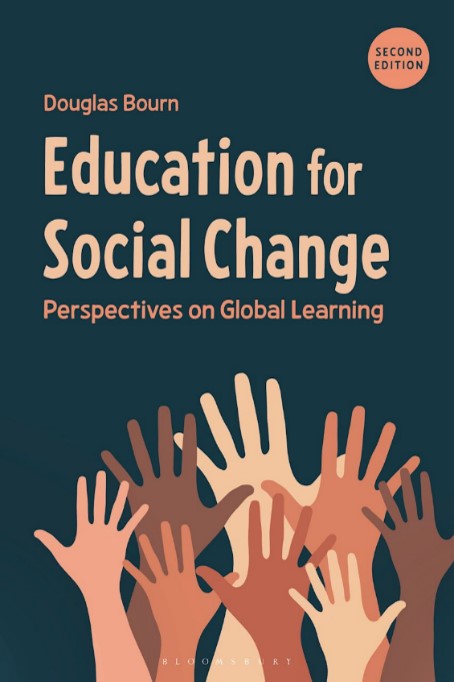
Douglas Bourn (2024) Education for Social Change: Perspectives on Global Learning (2nd ed.), London: Bloomsbury Academic.
 Introduction
Douglas Bourn’s Education for Social Change (second edition) is unapologetically ambitious in both scope and intent. It offers a comprehensive and carefully structured account of how education has been mobilised, historically and in the present, as a vehicle for social change. Building on the first edition, the volume brings together a wide range of traditions, concepts, and practices associated with development education, global learning, global citizenship, peace education, education for sustainability, and transformative learning. Its aim is not modest: it seeks to map the intellectual genealogy of education for social change, to examine its pedagogical implications across sectors, and to situate these debates within national, civil society, and international policy contexts. It is a much-needed and highly valuable contribution to development education scholarship.
This second edition feels particularly timely. It appears at a moment when the need for a pedagogy of hope is not abstract but urgent. Across multiple contexts, educators and learners are grappling with democratic backsliding, intensifying climate and biodiversity crises, renewed militarisation, and deepening social and economic inequalities. Ongoing mass violence and genocide against civilian populations, alongside protracted conflict and famine in Sudan, raise profound questions about the role of education in contexts of structural injustice, colonial legacies, and moral rupture. At the same time, increasingly coercive migration and border regimes in Europe and North America, and the criminalisation of protest and dissent, underline how questions of power, voice, and belonging are being reshaped in troubling ways.
These global dynamics are inseparable from local realities. In Ireland, for example, the housing crisis has exposed the limits of market-driven policy approaches and the social consequences of persistent inequality, particularly for young people, migrants, and marginalised communities. Such contexts challenge educators to connect global structures of injustice with lived experience, and to move beyond abstract notions of citizenship or participation. It is within this landscape that Education for Social Change makes its strongest contribution. Rather than offering simplistic calls to action, the volume insists on education that is historically informed, ethically grounded, and attentive to power. The emphasis on hope throughout the book is therefore not naïve optimism, but a call for critical, collective, and informed engagement at a time when education itself is increasingly contested terrain.
Structure and scope
The volume is organised into thirteen chapters, followed by a substantial concluding synthesis. The opening chapters trace the historical and ideological roots of education for social change, beginning with human rights education and moving through education for democracy, liberation, and socialism. These chapters situate contemporary debates within longer intellectual traditions, drawing on thinkers such as Dewey, Gandhi, Nyerere, Freire, Tawney, and later critical pedagogues. The middle section develops what Bourn frames as a pedagogical architecture for social change, structured around four interrelated domains: social justice, peace, sustainability, and global citizenship, underpinned by transformative learning. Subsequent chapters explore how these commitments are enacted across different educational sites and actors, including teachers, young people, universities, civil society organisations, and international bodies such as UNESCO (United Nations Educational, Scientific and Cultural Organisation), OECD (Organisation for Economic Co-operation and Development), and GENE (Global Education Network Europe).
One of the most striking features of the book is its consistency of structure. Each chapter combines conceptual discussion, policy analysis, research evidence, and illustrative examples of practice, followed by reflective questions. This makes the volume particularly accessible for use in higher education teaching, professional development, and postgraduate study, while still maintaining academic rigour. This is particularly evident in the chapters on teachers and young people, where Bourn moves beyond abstract discussion to consider how educators and learners navigate competing demands in practice. The discussion of teachers as agents of change, for example, highlights the tensions between curriculum constraints, institutional expectations, and the desire to engage critically with issues such as inequality, sustainability, and global justice. These moments, where conceptual framing meets lived educational realities, are among the book’s most effective.
Contributions to the field
A central contribution of Education for Social Change is its capacity to hold together multiple traditions that are often treated separately. Bourn consistently resists reducing education for social change to a single domain as global citizenship or education for sustainable development. Instead, he argues for an integrated approach in which social justice provides the connective tissue across themes. The chapters on social justice and peace education are particularly strong in articulating how pedagogical approaches informed by critical pedagogy move beyond awareness-raising towards questions of power, inequality, and agency. Drawing on Giroux, Freire, Reardon, Galtung, and others, Bourn foregrounds the importance of education that encourages critical engagement, dialogue, and collective responsibility, rather than technocratic or skills-only approaches.
Similarly, the chapter on education for sustainable development avoids a purely instrumental reading of the Sustainable Development Goals. While recognising their policy influence, Bourn engages with critical scholarship that highlights their limitations, including depoliticisation, contradictions around economic growth, and unequal power relations. His discussion of ecopedagogy and systems thinking usefully re-centres sustainability education within broader debates on social transformation. Another important contribution lies in the book’s attention to actors and institutions. Chapters on teachers, young people, universities, civil society organisations, and international bodies illustrate how education for social change is shaped by organisational cultures, professional identities, and political constraints. In particular, the discussions of teachers as agents of change and young people as social actors strike a careful balance between recognising agency and avoiding romanticised or over-burdening expectations.
Policy engagement and institutional legibility
One of the most defining features of Bourn’s work, clearly evident in this volume, is his sustained engagement with policy frameworks and institutional contexts. UNESCO, UNICEF (United Nations’ Children’s Fund), OECD, and European policy initiatives are treated not merely as background influences, but as active shapers of how education for social change is framed, resourced, and evaluated. This policy engagement is both a strength and a point of tension. On the one hand, it lends the book considerable legitimacy and usefulness within formal education systems. Bourn demonstrates how concepts such as global citizenship, sustainability, and peace have gained traction precisely because they can be aligned, however imperfectly, with institutional priorities and international agreements.
On the other hand, the book repeatedly acknowledges the risk that education for social change becomes diluted when absorbed into dominant policy discourses. The analysis is careful and measured, often identifying ‘spaces’ or ‘openings’ within existing structures rather than calling for more confrontational or disruptive forms of resistance. While this reflects a pragmatic engagement with real-world educational contexts, it also raises a question that runs quietly through the book: whether working within these structures ultimately limits how far education for social change can go in challenging them.
Postcolonial and decolonial tensions
An important, if understated, tension running through the book concerns the relationship between education for social change and postcolonial or decolonial critique. Bourn engages substantively with thinkers from the global South, most notably Freire, Nyerere, and Gandhi, and repeatedly acknowledges the enduring influence of colonial power relations. Civil society organisations, youth movements, and global learning traditions rooted in the global South are recognised as key contributors to the field. However, postcolonial and decolonial frameworks are largely treated as important perspectives within the field, rather than as epistemological challenges that fundamentally reconfigure it. The dominant architecture of the book remains grounded in a broadly liberal-progressive tradition that seeks reform, expansion, and critical reflection within existing educational and political structures.
For some readers, this will be a strength. It allows the book to function as a shared reference point across diverse audiences and avoids the fragmentation that can accompany more polarised theoretical positions. However, for those working explicitly within decolonial, abolitionist, or anti-capitalist traditions, the book may feel more cautious than critical. While issues such as colonial legacies and global inequalities are clearly acknowledged, the analysis stops short of fully engaging with the more disruptive implications of decolonial critique - particularly in relation to epistemic justice, settler colonialism, and the structural limits of reform-oriented approaches to education.
Pedagogy, hope, and the question of change
The concluding chapters and final synthesis return to the themes of hope, futures, and pedagogy. Drawing on Freire’s Pedagogy of Hope and futures education scholarship, Bourn argues that education for social change must sustain a forward-looking orientation, even amid crisis and uncertainty. The emphasis on hope is consistent throughout the volume, but it is handled with care. This is not a hopeful narrative in any superficial sense. Rather, hope is framed as a deliberate pedagogical stance, one that insists on the possibility of change while remaining grounded in the realities of conflict, inequality, and uncertainty. At the same time, it raises a persistent and sometimes uncomfortable question within critical education: whether hope can soften the sharper edges of critique. Bourn is clearly aware of this tension, but ultimately positions education as a space for engagement, dialogue, and gradual transformation, rather than rupture. This is a coherent and defensible position, even if some readers may wish for a more confrontational account of change.
Conclusion
Education for Social Change is an impressive, thoughtful, and carefully argued volume. Its strength lies not in advancing a single, dominant theoretical claim, but in its ability to hold together a complex and often fragmented field with clarity, balance, and intellectual generosity. It will be of significant value to academics, educators, postgraduate students, and practitioners working across development education, global citizenship, sustainability, and social justice education.
At a time when education is increasingly drawn into political, economic, and ideological struggles, the book offers a grounded and accessible framework for thinking about its role in social change. At the same time, it leaves some important questions deliberately unresolved, particularly around the limits of policy-aligned approaches and the depth of engagement with decolonial critique. In this sense, the book does more than consolidate the field; it quietly challenges readers to decide how far they are willing to go within it. That tension between pragmatism and transformation, is where its most important contribution lies.
Gertrude Cotter is a lecturer in the School of Education at University College Cork. Her work focuses on global citizenship and development education, critical global justice education, and the role of higher education in addressing inequality, power, and global responsibility. She is Academic Coordinator of the Praxis Project, a university-wide initiative supporting staff and students to engage critically with global justice issues through participatory, creative, and action-oriented pedagogies. Her research interests include critical pedagogy, decolonial and anti-racist approaches to education, North–South partnerships, and the use of creative and arts-based methodologies in teaching and research. She works across community, policy, and higher education contexts, with a strong commitment to ethically grounded and socially engaged scholarship.