





The Antidote: How People-Powered Movements Can Renew Politics, Policy and Practice
 43
43 Development Education: Learning for Transformation
 Click to download
Peter Beresford (2025a) The Antidote: How People-Powered Movements Can Renew Politics, Policy and Practice, Bristol: Bristol University Press.
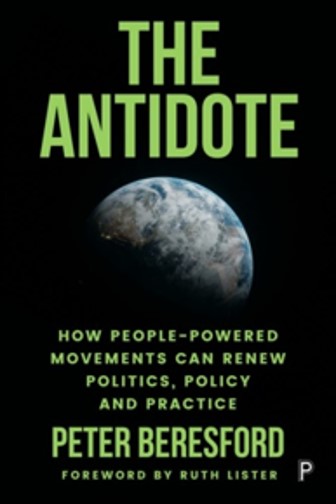 This book offers an antidote to neoliberal, ‘anti-social’ welfare politics and policies in the UK (Beresford, 2025b). It presents a combined critique of neoliberalism and the general rightward shift and failures of politics, together with a critical diagnosis of harmful othering and wasteful welfare cuts. One of the important points made in this book is how neglect of disabled, elderly, young, and minoritised people’s own experiences and knowledge deepens political processes of othering, and stigmatisation of people who are in need of help and support.
Peter Beresford is a social policy professor and key contributor to participatory social research practice in the UK. His advocacy and scholarship centre the experiences and knowledge of disabled people, mental health and other long term service users in social research, public policy and practice. He offers an open account of his personal history as a service user, and involvement in the academic-activist field of Mad Studies which seeks to include people who identify as mad, mentally ill, service user or survivor, or disabled (see, for example, The International Mad Studies Journal, 2026). He is also a Co-Chair in the inclusive and intersectional disabled people’s organisation, Shaping Our Lives (2026).
The book is in three parts: the opening section outlines the anti-social ideology of welfare austerity and failures of formal politics under neoliberalism, opening a gulf between political discourse and the social values that work on the personal level, and that most of us advocate and teach. The second section points to how ‘new social movements’ inform an alternative, grassroots approach and invites us to ‘only connect’. The third and final section sets out a practical programme for building an alternative politics of inclusive connection, starting with what has gone wrong with communication in an age dominated by social media, big tech, and hard-right politics.
The first part begins by discussing neoliberalism’s all-too-familiar consequences, at both individual and global levels. It explains how the gap has widened between formal politics and public understandings, on the one hand, and political and personal values and moralities on the other. Reactionary, right wing populist politics stand as a continuous threat, feeding into, and upon divisive politics. Internalised oppression and its projection, othering, stigmatisation and blame of others feed into, and off, reactionary politics. Neoliberalism promotes competition and ‘aspirational politics’, encouraging individuals to see themselves as better, and others as worse. Neoliberalism’s micro-level effects impact people at the emotional and intimate level, while relying on commodification and exchange relationships to meet individuals’ real needs.
The second part of the book addresses the failures of traditional politics but does not get stuck there. Most of the second part acts on the initial diagnosis, suggesting new routes for a different politics, and learning how to bring about change starting with our own lives, connecting with, and learning from, social movements, holding on to the principle of connecting on equal terms. The third and final part of this book seeks to build a new politics or connection on equal terms. Understanding what tends to go wrong with communication, learning from lived experience and educating for empowerment and change are all key to the achievement of ‘truly inclusive’ communication. These prescriptions seem simple, and none of them are new, but it is a welcome relief to be given permission to return to these sound principles and to connect them in a pragmatic and logical way.
The advice to ‘only connect’, expressed by British modernists and cultural studies scholars at different points in the twentieth century leads to the ‘who’ of connection. Different emancipatory and activist groupings come under the umbrella of ‘new social movements’ to challenge oppression and discrimination, including disabled people, Black civil rights, LGBTQIA (Lesbian, Gay, Bisexual, Transgender, Queer/Questioning, Intersex, and Asexual/Aromantic), and women’s movements. Connecting these movements enables diverse but disparate minorities to become a majority, capable of facing down the current status quo of minority rule by a destructive ‘overclass’. Politics seems driven by communicative failures, media monopolies, and political pandering to the far right. These failures can only be answered with a focus on first-person communication, speaking and listening to each other (Beresford, 2025a:149).
For this journal’s community and its central focus on development education, development and global citizenship education represent the most obvious structured opportunities to implement ‘the antidote’ of interpersonal dialogue and challenge, group discussion, resisting discrimination, and connecting to new social movements for change. What we have been less good at is integrating a critique of how neoliberalism runs in, and through formal education. We have seldom directly challenged the reactionary reforms which have deepened segregation, imposed privatisation, and widened hierarchies of knowledge. Hierarchy and entrenched divisions have reversed previous goals of social mobility that characterised educational systems half a century ago. Curriculum reform has become about micromanagement, rigidly imposed syllabuses, and the turn away from egalitarian education, and back to hierarchical, conformist, ‘banking’ or bucket-filling ideals (Ibid.: 197).
Beresford’s humanistic and connected philosophy of education draws on the liberatory ideas of Fanon and Freire, but also the humane and outspoken, Black and gay writer, James Baldwin (Ibid.: 202). Chapter 15 on education pulls together and expands our familiar tools of critical pedagogy, community development, anti-poverty action, empowerment, consciousness-raising, adult education, critical race theory, participatory learning and research, decolonisation, and women’s and queer studies, drawing them together towards an integrated analysis and inclusive connection.
Prefigurative politics comes about when people learn to work together and when current progressive learning becomes able to move from the private and personal sphere to the political sphere. Beresford questions the conventional charge levelled at new social movements, accusing them of undermining class-based solidarity with fragmented campaigns for particular rights. Returning to the user-led organisation, Shaping Our Lives, Beresford explains how their organisation used research to explore the relationship between diverse involvement and solidarity. Working together meant challenging all forms of discrimination and resisting external pressures to ‘divide and rule’ (Ibid.: 228). Challenging dominant neoliberal politics requires people to come together and to recognise what they have in common, and avoid falling for social division, fear and loathing (Ibid.: 229). Recognising common oppression and developing a common, anti-oppressive solidarity can draw from how new social movements have learned to oppose exclusion and discrimination, together, to fight oppression and stigmatisation, oppose hate crime, and overcome barriers to attain commonality. Since no identity is unitary anyway, recognising overlaps and cross-cutting identities, and building solidarity across them makes more practical sense than retreating to exclusive and fragmented interests.
The author recently shared on social media a hand-drawn sketch of two three-legged stools, side-by-side: the first depicts ‘the three-legged stool of hate and perdition’. The seat of hate and perdition is upheld by three problems: ‘positivist science and research’ that prioritises empiricism and ‘hard facts’ over people’s experiences and feelings, ‘colonisation and white privilege’, and ‘neoliberalism’. The second, contrasting seat of ‘hope and renewal’ is upheld by the ‘legs’ of ‘inclusive involvement’, ‘sustainability’ and ‘decolonisation’. This image encapsulates much of what this book has to offer – a diagnosis of problems that are already familiar to the readership and authors who find community in this journal, and an antidote that many have been looking for – a connected and structural prescription for hope, addressing the pillars of hate directly, while also reconsidering how research can re-centre the experiences of people who are struggling for justice.
Neoliberalism has shown itself to be anti-democratic and politically, economically, and morally bankrupt, while the author argues that sustainability is the most urgent argument for challenging neoliberalism. However, the content of sustainability appears only at the very end of the book and is discussed in a rather schematic way that doesn’t really address substantive environmental concerns. Readers more versed in environmentally-based social action will have to make additional efforts to connect environmental and social justice concerns.
An alternative economy that prioritises looking after each other and the planet we live on ultimately echoes the original concept of sustainable development that emerged half a century ago (World Commission on Environment and Development, 1987). Inclusive connection thus implies a need to work harder to combine social justice and environmental social movements, connecting not only people to people, but also people to planet with non-discrimination, equality and inclusion at the forefront.
References
Beresford, P (2025b) ‘Blog: Finding an antidote for anti-social politics and policy’, Social Policy Association, 8 July, available: https://social-policy.org.uk/news/finding-an-antidote-for-anti-social-politics-and-policy/ (accessed 12 March 2026).
Shaping Our Lives: Inclusive Involvement Matters (2026) available: https://shapingourlives.org.uk/ (accessed 06 July 2026).
The International Mad Studies Journal (2026) available: https://imsj.journals.publicknowledgeproject.org/index.php/imsj (accessed 06 July 2026).
World Commission for Environment and Development (1987) Our Common Future, Oxford: Oxford University Press.
Su-ming Khoo is Professor in Sociology at the National University of Ireland, Galway.