




Che Guevara, Paulo Freire and the Pedagogy of Revolution
 43
43 Development Education: Learning for Transformation
 Click to download
Peter McLaren (2025) Che Guevara, Paulo Freire, and the Pedagogy of Revolution, London: Bloomsbury Academic.
Introdu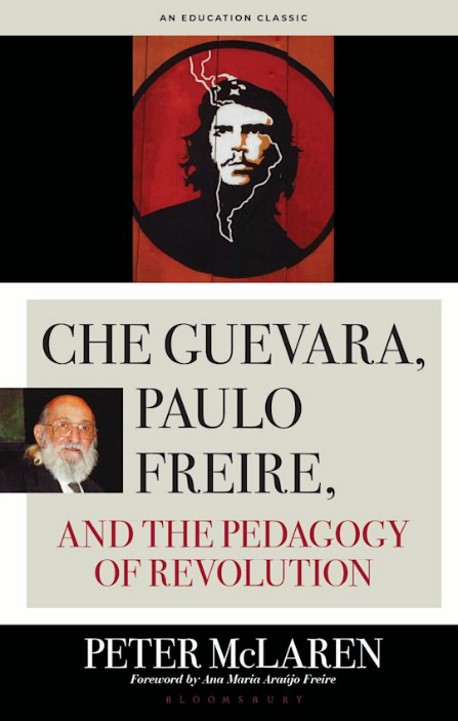 ction
ction
In 2017, Aleida Guevara, the eminent Cuban physician and daughter of the revolutionary leader Che, gave a talk on medical advances in Cuba to a Belfast audience. Surprising to many, her reflections were not about her famous father or the big global politics that has dominated Cuba since the 1930s, but about innovation in healthcare in the global South. Revealing and resolutely developmental, Aleida was following in the footsteps of her father in the sense of duty and service to the vulnerable and exploited. In a world of celebrity and non-truths, governed by billionaires and oligarchs, honesty and a focus on human needs are powerful attributes of human agency.
Peter McLaren’s book on two key revolutionary figures from the twentieth century, Paulo Freire and Che Guevara, gives us this direct reminder of individuals struggling for a better world in a history of inequality and oppression. Starting with the execution of Guevara in Bolivia on 9 October 1967, he navigates his way through Latin American liberation struggles, the Sandinistas, Chiapas, Zapatistas and Mayans, referencing globalisation and neoliberalism along the way. Criticism of wealth injustice is weaved into every page in one way or another. The brutality of pro-Western governments and militias in Latin America in the twentieth century is examined in detail, the horrors of a new colonialism laid bare against the privileges of its apologists and slogans. As with Freire, Guevara is defined by McLaren as a new type of revolutionary agent, moulded by what he saw as ‘a critical, self-reflective agent of social transformation’ (McLaren, 2025: 71). With Che, the creation of the ‘new man’ [new human] was central to a universal revolution of the human experience.
The context and drive
What is brought out in the book is Che’s deep understanding of the role of learning in this. His love of reading as an act of resistance, manifesting itself in his prolific journal writing; teaching literacy classes in the Sierra Maestra, building schools in the Las Villas and reading Faust and other classics to the patients of the Jose J. Puente Leprosarium. Indeed, this ‘educator’ trait is brought out very strongly in the book, where McLaren notes that: ‘The importance of learning was so prominent in Che’s itinerary of the revolutionary that among his last words before he was executed included the remark, “tell Aleida … to keep the children studying”’ (Ibid.: 76). As with Freire, a gift to the poor was the freedom of consciousness that learning could bring, and the lifting of the marginalised from the societal protectorate that globally – and historically - restricted education to the reserve of the elites.
And this educational spirit is where we have the link between the two protagonists in the book, a moral and philosophical link in a shared commitment to humanisation, society, transformation, and praxis - the unity of reflection and action. The methods were different, the circumstances extreme (particularly with Che) but the moral imperative was the same. ‘Che argued that material incentives should eventually be replaced by moral incentives’ (Ibid.: 96). For Freire, a stalwart of the Brazilian liberationist movement: ‘Each word was associated with issues related to existential questions about life and the social factors that determined the economic conditions of everyday existence’ (Ibid.: 143). Guevara pursued armed revolution and Freire championed critical literacy, both ‘options for the poor’. Both aimed to dismantle oppressive structures to cultivate what they recognised as a new social paradigm for humanity. Freire deeply admired Guevara’s leadership style, viewing it as a model of dialogue rather than elite imposition. Both thinkers rejected paternalistic systems, insisting that true liberation requires the oppressed to become active subjects of history, driven by a profound, radical love for humanity. This generated an evolving understanding of critical pedagogy. As McLaren puts it:
“Critical pedagogy and multicultural education need more than good intentions to achieve their goal. They require a revolutionary movement of educators informed by a principled ethics of compassion and social justice, a socialist ethos based on solidarity and social interdependence, and a language of critique that is capable of grasping the objective laws of history” (Ibid.: 101).
Mid-twentieth century Latin America was a crucible of intellectual, educational and political upheaval, defined by a quest to destroy the shackles of military dictatorship, economic dependency, and colonial legacies. Respectively, in Argentina and Brazil, Guevara and Freire emerged from a turbulent and violent context of oppression. They were both products of their circumstances and while Guevara famously and honestly wielded violence to dismantle oppressive structures, Freire utilised critical literacy to dismantle cognitive oppression. McLaren conveys this perfectly: ‘Reading and writing thus became grounded in the lived experiences of peasants and workers and resulted in a process of ideological struggle…’ (Ibid.: 143).
Their developmental ecosystem
Far from being disparate actors on the historical stage – or the products of a commercialist revisionism - Guevara and Freire operated within the same philosophical ecosystem. They shared a radical vision of human liberation that emerged from the revolutionary context of Latin America and they celebrated humanism in its broadest sense. Struggle was their shared meaning in life. Their common goal to bring about shifts in power is a given – that is the nature of politically conscious people - but it was more than that, it was about creating a society that enabled the ontological rebirth of the human character. Peter McLaren, a critical theorist to the core, has been able to bridge their respective contexts, demonstrating that Guevara’s learned insurgency and Freire’s critical pedagogy are two sides of the same coin: a unified ‘pedagogy of revolution’. To draw from the last words of the book, it was a about ‘the transformation of the human heart’ (Ibid.: 204).
This book is a useful reminder of the role of education in development. It gives a good sense of the struggles that highly vulnerable people must go through to have the right to learn, and the dedication needed by teachers to fulfil this hope. The book lights up the lives of two extraordinary characters who have shaped our understanding of Latin America and the context from which they emerged. Overall, the message McLaren brings to our insight into the lives of Guevara and Freire is their steadfast belief in the potential of humanity to change things for the better.
Gerard McCann is Professor of International Studies and Principal Lecturer at St Mary’s University College, Queen’s University Belfast.