



When the World Sleeps: Stories, Words and Wounds of Palestine
 43
43 Development Education: Learning for Transformation
 Click to download
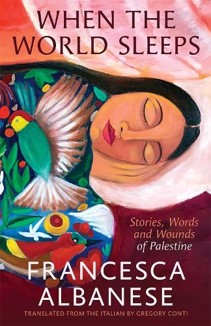
Francesca Albanese (2026) When the World Sleeps: Stories, Words and Wounds of Palestine, Melbourne: Hardie Grant Books.
 Introduction
Francesca Albanese is Special Rapporteur on the situation of human rights in the Palestinian Territory occupied since 1967 and, in the age of genocide which has seen 72,945 Palestinians killed by Israeli occupation forces in Gaza, has become the most visible and principled defender of international humanitarian law. In July 2025, the United States government sanctioned Albanese after she published a report on corporate complicity in ‘sustaining the Israeli settler-colonial project of displacement and replacement of the Palestinians in the occupied territory’ (Albanese, 2025a: 1). With typically forensic detail, Albanese’s report documented how forty-five corporate entities have ‘been implicated in human rights violations and international crimes in the occupied Palestinian territory’ (Ibid.: 3). The US sanctions against Albanese bar her from entering the US and freeze her assets in the country. They also prevent any US-based entity from doing business with her which denies her the use of a credit card (Aljazeera, 2026). These sanctions reflect how effective Albanese has been in documenting corporate and state complicity in Israel’s occupation and colonisation of Palestine. Her work is always framed by the conventions of international law and she has steadfastly defended the rules-based order as countries across the global North have continued to trade with, arm, share intelligence with, and diplomatically support Israel’s occupation of Palestine and genocide in Gaza. The complicity of third states that ‘have enabled long-standing systematic violations of international law by Israel’ was the subject of another Albanese report in 2025 (Albanese, 2025b).
When the World Sleeps is part memoir as it documents her travels through Palestine and the friendships that shaped her evolving knowledge of the territory. It reflects on the ten people who ‘helped me open my eyes to see more clearly and to act for Palestine’ (Albanese, 2026: 222). The book is also a very accessible introduction to the key legal arguments that Albanese has advanced to frame Israel’s occupation of Palestine in international law. It is a book, therefore, that global educators and international development personnel will find useful to inform their own work in this area at a time of great peril for the rules-based order. I set out below the ten chapters and the main legal arguments and insights they carry.
Hind Rajab
Hind Rajab’s story is the first in Albanese’s book and is now known the world over as one of the most egregious crimes perpetrated by the Israeli military in its genocidal campaign in the Gaza Strip. Hind died with her aunt, uncle and four cousins when fleeing the Tel al-Hawa district of Gaza city on 29 January 2024. When their car came under attack from Israeli tanks, Hind was surrounded by her dead relatives with only her cousin, Layan Hamadeh, surviving. When Layan, too, died after calling the Palestine Red Crescent Society (PRCS) for emergency assistance, Hind remained on the phone with PRCS dispatchers for three hours pleading for help. Hind’s final, agonising hours in conversation with the Red Crescent was the premise for a deeply moving and award-winning film called The Voice of Hind Rajab (Ben Hania, 2025). The car in which Hind and her relatives were travelling was riddled with more than 300 bullets despite Israeli soldiers knowing that it was occupied by civilians (Albanese, 2026: 23).
Since this atrocity, Hind’s name has been adopted by a legal foundation, The Hind Rajab Foundation (2026), that is ‘dedicated to the quest for justice in response to the crimes against humanity, war crimes and human rights violations perpetrated by the Israeli state against Palestinians’. Hind’s story is emblematic of how the childhood of Palestinians is being stolen or cruelly curtailed by Israeli occupation forces. A poll of 504 children in Gaza carried out in December 2024 found that ‘96% of children surveyed feel their death is imminent, while 49% have expressed a desire to die’ (Reliefweb, 2024). Albanese reports that Hind’s story is far from unusual. A two-year-old boy, Mohammed Tamimi, was shot in the head while travelling in his father’s car in the occupied West Bank a few months before Hind’s death (Albanese, 2026: 23). Albanese dedicated her third report as UN Rapporteur to children referring to the deprivation of childhood in the occupied Palestinian Territories (OPT) as ‘unchilding’ (Ibid.: 26).
Her report was published before the start of Israel’s genocide which has been an accelerant of childhood suffering with the number of child deaths in Gaza currently 21,283 (OCHA, 2026a). Additional to this total are the children left homeless, without one or both parents, critically injured, starved and diseased, and denied an education for nearly three years (Ibid.). As Albanese was denied authorisation by Israeli authorities to visit the OPT, she organsed online focus groups with children in Gaza and the occupied West Bank to gather testimony of their lived experience under genocide, occupation and displacement. Their greatest fears are dying or losing their parents, being arrested or having their house demolished (Ibid.: 31). ‘The home should be centre of their childhood, a safe haven where they can grow, explore, and dream’ argues Albanese, but in Palestine ‘protection is not found even within the walls of their homes’ (Ibid.: 33). The silent unseen epidemic that attends the horrors visited on Palestinian children is trauma and the mental health scars that can last a lifetime and persist through successive generations. As Albanese suggests, the violence that is suffered by Palestinians ‘is not only physical but psychological’ (Ibid.: 35). Yet, she was struck, too, by the ‘strong sense of discipline, resilience and mutual respect’ in the focus groups with Palestinian children and praised the support networks that pervade Palestinian society (Ibid.: 38-39).
This chapter on childhood also reflects on the violence visited on Israeli children who, according to the Israeli philologist, Nurit Peled-Elhanan, quoted by Albanese are:
“educated from an early age to fear and suspect the other, to normalise violence, to perpetuate a worldview based on racial domination and oppression, shared by the ideology of their political leaders and often even by their own parents” (Ibid.: 42).
As Freire recognised, the ‘great humanistic and historical task of the oppressed (is) to liberate themselves and their oppressors as well’ (Freire, 2005: 44). Therefore, central to the liberation of Israeli society from the oppressive worldview through the lens of apartheid, domination and lawlessness is the liberation of the Palestinians. Children and young people are central to that endeavour and it is imperative that the unbearable human rights abuses visited on Hind Rajab and so many other Palestinian children are never repeated.
Experiencing the realities of occupation
Chapters two and three reflect on Albanese’s period of employment with the legal team in the United Nations Relief and Works Agency (UNRWA), the UN agency for Palestinian refugees, when she lived in the Old City of Jerusalem. As a divided city in which history is appropriated and misappropriated for contemporary political ends, Albanese (2026: 47) was able to lift the veil of ‘archaeological propaganda’ in the amiable and knowledgeable company of Abu Hassan the owner of Alternative Tours. Through Abu Hassan, she became a witness to the oppression of Palestinians who are subjected to four legal identities; those with Israeli citizenship in Israel (Palestinians of 1948); residents of East Jerusalem without Israeli citizenship; Palestinians in the West Bank and Gaza where they hold Palestinian National Authority (PNA) identity cards but are de facto controlled by Israel (Ibid.: 49). These identities dictate their legal status, access to services and freedom of travel. Albanese and her partner, Max, travelled with Abu Hassan across the West Bank and discovered how the legal status of Palestinians under occupation impacts their daily lives in terms of rights to employment, education and housing, and the severe restraints imposed on the exercise of their rights.
By contrast with the more reserved Abu Hassan was the more effusive George, a Palestinian engineer who befriended Albanese in Jerusalem and helped her navigate the Old City’s ‘impassable boundaries of apartheid’ and ‘oppressive tension’ (Ibid.: 71). George and Abu Hassan helped her see the city through ‘fresh eyes’, not so much as tour guides but friends and travel companions who saw tourism not as ‘cultural fusion’ but the appropriation of Palestinian culture (Ibid.: 77). She learns about how the permit system helps maintain apartheid with residents of the West Bank only able to access Jerusalem with Israeli permits that are rarely issued. The permit system ‘separates Palestinians from each other’ and isolates ‘them from their lands and families’ (Ibid.: 83).
Anti-Semitism and anti-Zionism
Albanese’s book is in many ways a tribute to the legal scholars who have informed and evolved her positions on the colonisation of Palestine. Chapter five is dedicated to Alon Confino, an Italian Israeli university professor who introduced Albanese to the use of the International Holocaust Remembrance Alliance (IHRA) working definition of anti-Semitism which has conflated anti-Semitism with ‘criticism of the State of Israel and its policies’ (Ibid.: 89). This conflation risks associating all Jews with the State of Israel when there are many Jewish activists who campaign for a free Palestine (Jews Network for Palestine, 2026). As the Palestinian-American academic, Rashid Khalidi (2025) wrote: ‘The IHRA definition deliberately, mendaciously and disingenuously conflates Jewishness with Israel, so that any criticism of Israel, or indeed description of Israeli policies, becomes a criticism of Jews’. The IHRA working definition conflates anti-Semitism with criticism of Zionism, the political ideology that is driving the colonisation of Palestinian land and the apparatus of apartheid that attends it. The dangers of this include the failure to ‘focus on the real anti-Zionism that is repugnant and still exists’ (Albanese, 2026: 90). Regrettably, twenty-five of the twenty-seven European Union states have adopted the IHRA working definition which is increasingly becoming a benchmark for assessing anti-Semitism despite a co-author of the IHRA working definition repudiating its uses (Khalidi, 2025). Worryingly, it has also been adopted by companies such as the airline Lufthansa which brings it into the workplace. Albanese quotes E. Tendayi Achiume, the UN Rapporteur on racism who described the IHRA definition as contributing ‘to violations of human rights, including freedom of expression, right to assembly and political participation, among others’ (Ibid.: 96).
This chapter raises an issue of critical importance for the international development sector, particularly regarding its response to the genocide in Gaza. Albanese (Ibid.: 102-103) stresses that for too long the Palestinian issue has been:
“reduced to a humanitarian crisis, instead of being dealt with as a political issue to be resolved in accordance with international law. To confine ourselves to giving aid without addressing the structural causes of the crisis is to perpetuate injustice by normalising it, rather than doing everything possible to eradicate it”.
Addressing the Gaza genocide as a humanitarian issue will do nothing to fundamentally address the politically motivated annexation of Palestinian land and genocidal violence visited on Palestinians in Gaza and now Lebanon (OCHA, 2026b). Only the enforcement of international law will prevent the further erosion of the rules-based order implemented at the end of the Second World War and predicated upon multilateralism and the universal application of human rights.
Apartheid
Chapter six is dedicated to Ingrid Jaradat Gassner, an Austrian national who was a co-founder and former director of the Badil Resource Center for Palestinian Residency and Refugee Rights based in the occupied West Bank. Ingrid was also a co-founder of the Boycott Divestment Sanctions (BDS) movement in 2005 which is led by Palestinian civil society with the aim of urging action that pressures Israel to comply with international law. Inspired by the South African anti-apartheid movement, BDS (2026) ‘upholds the simple principle that Palestinians are entitled to the same rights as the rest of humanity’. Albanese uses this chapter to recall the Dunnes Stores’ workers who came out on strike in 1984 in solidarity with Black South Africans subjected to a system of apartheid imposed by the National Party government between 1948 and 1994. Inspired by the Dunnes Stores’ workers, Ireland became the first Western country to impose a total ban on the import of South African goods. The BDS movement is calling for a similar ban on Israeli imports, as well as disinvestment from the Israeli economy and sanctions on the Israeli government. Given the assessment of Israel as an apartheid state by Amnesty International, B’tselem and Human Rights Watch, Albanese (2026: 125) argues that the BDS movement ‘must be supported in every possible way’. Investing in the Israeli economy. she argues, ‘may have an implication or connection with the occupation and exploitation of Palestinians and their resources, and thus become a de facto act connected to criminal conduct’ (Ibid.: 125).
Chapter seven discusses the toxic media coverage of the Gazan genocide through the story of Ghassan Abu Sitta, a British surgeon who worked extensively in Gaza’s hospitals during the genocide and then found himself under attack by the British establishment. In return for sharing his experiences of the genocide on social media, he was suspended by the General Medical Council for being deemed unfit to practice medicine. His suspension was lifted for lack of evidence and the complaint against him shown to be politically motivated. Ghassan described Israel’s genocidal project as like an iceberg with only the tip visible and the media apparatus enabling it rarely seen (Ibid.: 140). Ghassan was told by BBC journalists that he was on a list of those no longer to be interviewed by the corporation with the clear inference that when the message becomes uncomfortable then the messenger needs to be silenced. Ghassan’s reports on the use of white phosphorous and repeated amputations carried out on minors injured in Israeli strikes sat uncomfortably with media efforts to frame the genocide as a ‘conflict’ (Ibid.: 144). Ghassan also shared stories of the targeting of health workers in Gaza with some of his colleagues tortured, sexually abused and killed in custody. A health worker in Gaza is two-and-a-half-times more likely to be killed by the Israelis (Ibid.: 145-146) with the UN reporting that 1,700 health workers were killed between 7 October 2023 and 7 October 2025 (OCHA, 2026a). ‘What can we do to stop all of this?’, asks Albanese.
“How long will it go on while the world seems to be sleeping a stone-cold sleep and cannot keep its eyes open in the face of this wound that is as large as an entire people, this wound that no one seems to want to soothe or heal?” (Albanese, 2026: 147).
Forensic architecture
Eyal Weizman is the Director of the research agency, Forensic Architecture, based at Goldsmiths in the University of London. Through the use of spatial analysis and architectural tools, Forensic Architecture can reconstruct crimes and human rights abuses against Palestinians such as the murder of Hind Rajab and her family. In chapter eight, Albanese discusses how Weizman’s spatial analysis reveals how ‘Israeli colonies in the West Bank were strategically designed so that colonisation could create territorial fragmentation’ (Ibid.: 154). The network of permanent and temporary checkpoints in the West Bank, the construction of the separation wall and the separate road network for Palestinians are designed to restrict movement and prevent a contiguous Palestinian state. As Albanese argues: ‘it is evident that Israel has used architecture and geography as tools of power to consolidate its control over the Occupied Palestinian Territory’ (Ibid.). Eyal Weizman applied the tools of Forensic Architecture (2024) to create a ‘Cartography of Genocide’ based on the collection of data ‘related to attacks on civilians and civilian infrastructure by the Israeli military’. It found that Israel’s military conduct in Gaza indicates ‘a systematic and organised campaign to destroy life, conditions necessary for life, and life-sustaining infrastructure’ (Ibid.). This genocide, argues Weizman, ‘does not start from scratch … but (is) grafted onto preexisting structures and mechanisms’ (Ibid.: 160). Weizman is one of many Israeli academics cited in Albanese’s work for distinguished and courageous analysis and condemnation of Israel’s genocide.
Art as resistance
The beautiful cover of Albanese’s book seen above is the work of Malak Mattar, a talented artist who left Gaza on 6 October 2023 to take up a master’s programme in London at a leading school of visual arts. Malak’s story is told in chapter nine and is shared by many Gazans who have had the agony of family members left behind in Gaza where everyday brings the risk of death or life-changing injury. Eventually her family managed to find refuge in Egypt but they shared the guilt of the survivor leaving loved ones behind, both the living and the dead. Malak’s father urged her to ‘paint our lives, our struggle, all that we are going through’ and her work is realising that goal (Ibid.: 181). The ‘language of art’, argues Malak, ‘is the most powerful language against all forms of dehumanisation’ (Ibid.: 180).
Chapter ten deals with the issue of trauma and healing, told through the work of Gabor Maté, a Canadian doctor and psychotherapist with Hungarian origins. He is the author with Daniel Maté of The Myth of Normal: Trauma, Illness and Healing in a Toxic Culture (Maté and Maté, 2022) which was reviewed by Caroline Murphy (2025) in Policy and Practice. Trauma is a critical issue for Palestinians who have been exposed to generations of conflict, forced displacement and now genocide. As Albanese writes: ‘trauma – especially when it occurs through a lack of emotional regulation – can also be interpreted in an intergenerational or collective perspective’ (Albanese, 2026: 185). Trauma can be internalised by an entire group and ‘feed a continuous sense of threat and mistrust in their collective view of the outside world’ (Ibid.: 185). She adds that minimising trauma can prevent the achievement of healing, particularly in regard to the ‘memory and pain of a genocide’ (Ibid.: 189).
The final chapter is reserved for Albanese’s partner Max, with whom she has journeyed through Palestine and shared the pain and stress of US sanctions and external pressure. Max and their daughter filed a lawsuit on Francesca’s behalf to have US sanctions against her lifted. This resulted in a temporary injunction, but she has since been returned to a list of state sanctioned individuals (Aljazeera, 2026). This is clearly a legal battle set to continue which is imposing intolerable pressure on their family. Francesca pays this tribute to Max: ‘Thank you for supporting me in these burdensome years, always encouraging me to persevere’ (Albanese, 2026: 216). Despite the opprobrium directed at Albanese and her family, she ends her book on a message of hope:
“hope can and should, also become a predisposition, a habit: something that we consider indispensable and to which we are also attached that we cannot do without it, beyond any logic or reasoning” (Ibid.: 218).
This reminds us that Paulo Freire considered one of the tasks of the progressive educator to ‘unveil opportunities for hope, no matter what the obstacles may be’. ‘Without a minimum of hope, we cannot so much as start the struggle’ (Freire, 1994: 3).
When the World Sleeps is ultimately an invocation to rouse ourselves from inertia, hopelessness and despair and actively engage with the causes and effects of Israel’s genocide in Gaza which has now spread like an untreated cancer to southern Lebanon. This book provides a useful access point to the genocide by guiding us through the legal, colonial, spatial, psychological, historical and humanitarian dimensions and consequences of Israel’s settler-colonial project in Palestine. As promised by the author in the preface, every story in the book ‘offers a different, complementary lens from which to view the ongoing genocide and the global missteps that brought us to this point’ (Ibid.: vxiii). It does not demand a deep and prior knowledge of the occupation of Palestine and will reward both readers coming to this question for the first time and those already equipped with a degree of understanding of the issue. Indeed, it could be a useful launching point for a deeper dive into the colonisation of Palestine given the number of literary references and recommendations it carries. The book reflects all the qualities of its author – erudite, legally expert, engaging, courageous - and always worth your time.
References
Albanese, F (2025a) ‘From economy of occupation to economy of genocide: Report of the Special Rapporteur on the situation of human rights in the Palestinian territories occupied since 1967’, UN General Assembly, Ref: A/HRC/59/23, 2 July, available: https://docs.un.org/en/A/HRC/59/23 (accessed 25 June 2026).
Albanese, F (2025b) ‘Gaza genocide: a collective crime: Report of the Special Rapporteur on the situation of human rights in the Palestinian territories occupied since 1967’, UN General Assembly, Ref: A/80/492, 20 October, available: https://docs.un.org/en/A/80/492 (accessed 25 June 2026).
Aljazeera (2026) ‘US returns Palestinian rights expert Francesca Albanese to sanctions list’, 28 May, available: https://www.aljazeera.com/news/2026/5/28/us-returns-palestinian-rights-expert-francesca-albanese-to-sanctions-list (accessed 25 June 2026).
Ben Hania, K (2025) The Voice of Hind Rajab, available: https://www.watermelonpictures.com/films/the-voice-of-hind-rajab (accessed 09 June 2026).
Boycott Divestment Sanctions (BDS) (2026) available: https://bdsmovement.net/ (accessed 23 June 2026).
Forensic Architecture (2024) ‘A Spatial Analysis of the Israeli Military’s Conduct in Gaza since October 2023’, 25 October, available: https://forensic-architecture.org/investigation/a-cartography-of-genocide (accessed 24 June 2026).
Freire, P (2005) Pedagogy of the Oppressed, Continuum: New York.
Freire, P (1994) Pedagogy of Hope: Reliving Pedagogy of the Oppressed, London: Bloomsbury.
Jews Network for Palestine (2026) available: https://jewishnetworkforpalestine.uk/ (accessed 23 June 2026).
Khalidi, R (2025) ‘I spent decades at Columbia. I’m withdrawing my fall course due to its deal with Trump’, The Guardian, 1 August, available: https://www.theguardian.com/commentisfree/2025/aug/01/columbia-historian-rashid-khalidi-open-letter (accessed 23 June 2026).
Maté, G and Maté, D (2022) The Myth of Normal: Trauma, Illness and Healing in a Toxic Culture, London: Penguin Books.
Murphy, C (2025) ‘The Myth of Normal: Trauma, Illness and Healing in a Toxic Culture’, Policy and Practice: A Development Education Review, Vol. 41, Autumn, pp. 178-185.
OCHA (2026a) ‘Reported impact snapshot: Gaza Strip’, 3 June, available: https://www.ochaopt.org/content/reported-impact-snapshot-gaza-strip-3-june-2026 (accessed 09 June 2026).
OCHA (2026b) ‘Flash Update #37 - Escalation of hostilities in Lebanon’, 22 June, available: https://reliefweb.int/report/lebanon/lebanon-flash-update-37-escalation-hostilities-lebanon-22-june-2026 (accessed 26 June 2026).
Reliefweb (2024) ‘Death feels imminent for 96% of children in Gaza, study finds’, 12 December, available: https://reliefweb.int/report/occupied-palestinian-territory/death-feels-imminent-96-children-gaza-study-finds (accessed 09 June 2026).
The Hind Rajab Foundation (2026), available: https://www.hindrajabfoundation.org/ (accessed 09 June 2026).
Stephen McCloskey is Director of the Centre for Global Education and Editor of Policy and Practice: A Development Education Review.