



Freire in European Global Citizenship Education: Critical Aspirations, Coloniality and the Work of Supplementation
 43
43 Development Education: Learning for Transformation
 Click to download
Abstract: The legacy of Paulo Freire’s work has significantly shaped educational discourses worldwide, including global citizenship education (GCE). In European contexts, Freirean pedagogy frequently grounds critical pedagogy commitments in GCE policy and practice. However, questions remain regarding how Freire’s concepts are taken up, and whether their selective and ahistorical application may reinforce a Eurocentric perspective in GCE scholarship. This study employs critical interpretative synthesis, combining bibliometric and reflexive thematic analyses, to examine the uptake of Freire’s work in recent European conceptualisations of GCE (2015–2025). We trace citations to Freire’s published works to identify the function of Freirean pedagogy in conceptual frameworks and analyse moves to reinterpret, elaborate, critique, displace, and/or draw on other theories and concepts to reorient and complement conceptual arguments. Our findings indicate that Freire is frequently presented as a grounding and legitimising source for critical pedagogy; subsequent conceptual developments sometimes re-politicise debates and foreground approaches to GCE that are more attuned to questions of positionality, and that explicitly address colonial legacies in European contexts. We argue that these conceptual shifts expose tensions in the uptake and mobilisation of Freirean pedagogy within European GCE. The study calls for deeper epistemological analysis in drawing on Freire’s work and interrogating European enunciative positions to understand oppression, transformation and social change.
Key words: Global Citizenship Education; Global Learning; Development Education; Paulo Freire; Critical Pedagogy.
Introduction
Living and working under Brazil’s authoritarian regime in the 1950s and 1960s, Paulo Freire was concerned with the education of rural and urban workers, as well as with the widespread linguistic and political illiteracy in the country. Drawing on Marxist thought and the liberation theology movement (McLaren and Jandrić, 2018), Freire developed a groundbreaking pedagogical framework that transformed education globally (Ferreira et al., 2025; Ramalho, 2022). In Europe, Freirean pedagogy revolutionised global citizenship education (GCE) by offering an understanding of the political nature of knowledge while emphasising the emancipatory potential of education (Coelho, Caramelo and Menezes, 2018). To this day, the continued uptake of Freire’s work sustains his influence in the field, informing policy (UNESCO, 2015), academic events (Reilly and Liddy, 2021), special issues (e.g. da Trindade, Robertson and Torres, 2024), edited books (e.g. Bourn and Tarozzi, 2023), and other academic publications (e.g., Bourn, 2020; Eten Angyagre, 2024; Torres and Yan, 2022). In a climate of deeply concerning global crises, this uptake has included efforts to recentre Freire’s concept of hope within GCE in global North academic contexts (e.g. Bourn and Tarozzi, 2023; Bourn, 2023; Finnegan and d’Abreu, 2024; Römhild, 2023; Schwittay, 2023) and educational settings.
Freire’s work is unquestionably a cornerstone of critical approaches to GCE. This prominence, however, warrants critical attention and reflection on how Freire’s work has been taken up in Euro-Western contexts. Giroux (2024, paragraph 27) argued that scholars and educators can strip Freirean pedagogy of its transformative potential by stepping over their ‘own complicity in producing and maintaining specific injustices, practices, and forms of oppression that deeply inscribe the legacy and heritage of colonialism’. Tuck and Yang (2012: 20), writing from Canada’s settler-colonial context, argued that referring to Freire’s work in contexts with a colonial history, without addressing it, represents a move to innocence that is unlikely to challenge deeper colonial legacies of stolen land and racial structures. Tuck and Yang explained that the broad categories of oppressed/oppressor can be used to signal criticality and a concern with social justice without requiring (global North, white, middle-class) critical scholars to position our/themselves as the oppressor. These concerns draw attention to the specific historical and ongoing effects of colonialism that have been (re)produced through GCE in Europe (Coelho, Caramelo, and Menezes, 2018; Eriksen and Stein, 2022). As such, this article examines how European GCE scholarship engages with Freire’s ideas. Specifically, it analyses the extent to which and how scholars engage with and supplement Freire’s ideas in ways that attend to their own enunciative positions and acknowledge colonial legacies, complexities and potential complicity in harm. In doing so, the aim here is to contribute to the European Declaration on Global Education’s call for a GCE that is concerned with supporting individuals to critically reflect on the world and their place within it, while also acknowledging the role of colonial legacies in shaping contemporary global challenges (GENE, 2022: 3).
We begin by outlining the theoretical framework informing the research, followed by the methodological approach to the data collection and analysis. We then present and discuss the findings, considering the implications for further research in the field aiming to address coloniality. For brevity, we use the term ‘Freirean pedagogy’ as a concise reference to the range of concepts and theoretical developments articulated across Freire’s extensive body of work in education. This includes Pedagogy of the Oppressed, Pedagogy of Hope, Pedagogy of Freedom, Pedagogy of the City, and Pedagogy of the Heart, among others. Here, the term is used as shorthand to facilitate discussion within the limits of this article rather than simplifying or homogenising Freire’s pedagogical thinking and the implications of his work in broader sociopolitical debates.
Theoretical framework
In an influential intervention in GCE, Vanessa Andreotti (2006) distinguished between soft and critical GCE in response to charity-based approaches and in an effort to centre coloniality in education about global issues. Soft approaches, she argued, position white, middle-class global North individuals as benevolent saviours, stepping over their/our implication in causing and sustaining the very issues they/we were meant to be ‘resolving’. A critical approach, by contrast, explicitly recognises colonial legacies at the root of global problems and individual complicity in harm as a starting point for conversations in education (Andreotti, 2006). We refer to these colonial legacies as coloniality, drawing on Mignolo’s body of work (see e.g. Mignolo and Walsh, 2018). Coloniality describes a system of oppression through a range of intersecting social structures (e.g. racism, capitalism, heteropatriarchy, environmental destruction) established in Europe and globally imposed from the 14th century, rooted in and sustained by Euro-Western control over knowledge production. And individual complicity in harm refers to the ways in which individuals are not only implicated in causing and exacerbating global issues (Andreotti, 2006) but are also invested in and benefit from coloniality, which has historically privileged white, middle-class, heterosexual, global North males (see e.g. Wynter, 2003). These dynamics are particularly relevant to GCE, where efforts to address global inequalities may themselves remain implicated in the colonial relations they seek to challenge.
With the centrality of GCE in international policy (i.e. Sustainable Development Goals, target 4.7), scholars in the field became increasingly concerned with the ubiquity of soft approaches in practice, which felt increasingly inadequate to address the urgency of mounting global challenges (e.g. war, rise of the far right) and deepening social inequalities (e.g. Goren and Yemini, 2017). These concerns led to a proliferation of GCE typologies which sought to name and critique mainstream (soft) approaches and articulate an oppositional alternative that offered a critical understanding of GCE, informed by a concern with social justice and a commitment to challenging the status quo (Pashby et al., 2020). Nevertheless, Pashby et al (2020) found that critical GCE ‘types’ conflated what are quite different theoretical positions and methodological approaches within a single critical GCE category. This conflation appears to confuse the discourse around what critical GCE is, waning its conceptual strength when it comes to addressing coloniality and complicity in the system under critique.
More recently, and arguably to clarify the discursive orientations informing conceptualisations of critical GCE, Andreotti (2021) revised her seminal typology to include three approaches: soft, critical, and otherwise. In this new typology, Andreotti (Ibid.) reworked her definition of critical GCE as an approach that ‘feels right’ and is explicitly informed by a Freirean pedagogical approach, concerned with recognising systems of oppression and fostering advocacy for, and solidarity with, marginalised groups. Andreotti (Ibid.) then defined GCE otherwise as starting from a recognition of systemic violence, unsustainability, complicity in harm, and colonial legacies. This approach is concerned with developing the maturity and stamina to sit in and with the complexities, tensions, and nuances that come with facing current global crises from a position of non-innocence and developing complex and contradictory advocacy relations. We find this distinction significant in that it appears to speak directly to the conflations that Pashby and colleagues (2020) identified in their meta-review of typologies and the concerns raised by wider education scholars around the limited ways in which Freire’s work is taken up when it comes to addressing and responding to coloniality.
In framing this study, we recognise that no single theoretical lens can fully account for the complexity of situated GCE research and practice. Each perspective is inevitably partial and limited. Thus, we recognise that it is necessary to draw on multiple approaches to better capture the field’s multifaceted nature (Stein, 2018). Nevertheless, and in line with Andreotti’s GCE otherwise, we are committed to an approach to critical GCE that, from its situated and partial stance, explicitly addresses coloniality and individual complicity in its harmful systems of oppression (e.g. racism, capitalism, heteropatriarchy, environmental destruction). From this position, we read references to Freire’s work in GCE literature, seeking to capture how his pedagogy is mobilised and/or supplemented in ways that promote approaches to GCE otherwise.
Methodology
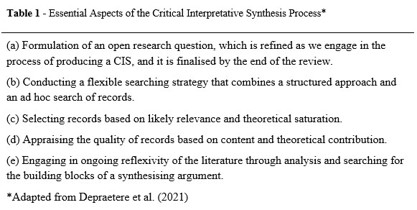
We adopted the critical interpretative synthesis (CIS) method (Depraetere et al., 2021; Dixon-Woods et al., 2006) to review European GCE literature citing Freire’s published works. The CIS approach examines implicit assumptions and conceptual gaps in existing literature, thereby supporting theoretical and conceptual development of the topic or question being researched. In this case, we used a CIS to examine implicit assumptions and articulate the implications for conceptual frameworks in European GCE scholarship that draws on or intends to build on Freirean pedagogy. In contrast to systematic reviews, CIS prioritises flexible protocols and interpretive analyses over an aggregative approach that summarises evidence (Table 1). In our case, we aimed to deepen our engagement and understanding of how and why conceptual frameworks in critical GCE literature situated in Europe cite Freire’s published works.
We examined an extensive body of GCE literature from European contexts to identify scholarship that was fully or partially grounded in Freire’s conceptual framework. The research questions guiding the synthesis evolved in response to our analysis and emerging reflections: first, what is the function(s) of citations to Freire’s published work in conceptual framings of GCE literature situated in Europe? And second, in what ways do authors develop or supplement the theories and concepts supporting Freirean pedagogy through their conceptual frameworks?
Research positionality
As we look for the recognition of positionality, we ought to start with our own. The first author is a Mexican woman living and working in England, and she has full-time employment in the evaluation sector dedicated to appraising educational programmes. Her prior research and evaluation work predominantly employ Western onto-epistemological paradigms and traditions, sometimes finding the opportunity to critically explore their limitations. The second author is a Portuguese woman, who currently lives and works in England (both countries with devastating colonial histories and legacies) and has a permanent contract at a university. Her research has examined the possibilities/limitations brought by centring coloniality in conceptualisation of GCE. The third author is a Colombian man living and working in Mexico. His research focuses on the relationships between science education, culture, and politics. Our ongoing interaction with Eurocentric onto-epistemological assumptions across personal and professional spheres has meant that we have benefited from its gifts and contributed to replicating systems of oppression. We also acknowledge that modern/colonial traditions inform the CIS method and the PRISMA-ScR guidance. With this piece, we aimed to mobilise these modern/colonial research tools to support efforts to challenge dominance of modern/colonial epistemologies in GCE. We also recognise that the languages we speak – English, Spanish and Portuguese – are entangled with colonialism and will necessarily leave out a vast body of work that remains unintelligible to us as researchers.
Search, screening, and selection protocol
To mark the influence of UNESCO’s endorsement of GCE in target 4.7, we searched for and analysed research (i.e., articles and scholarly essays) between 2015–2025, piloting and conducting our study in line with the PRISMA-ScR framework for scoping reviews (Tricco et al., 2018). First, a researcher screened titles, abstracts, and full texts in two stages against predefined criteria (Table 1, b): the relevant field (i.e., GCE, development education, global learning, and other adjectival educations), publication period, cultural context, language (English, Portuguese, and Spanish), and citations to Freire’s published works. We removed duplicates and inaccessible files. Two researchers refined the final sample (Table 2).
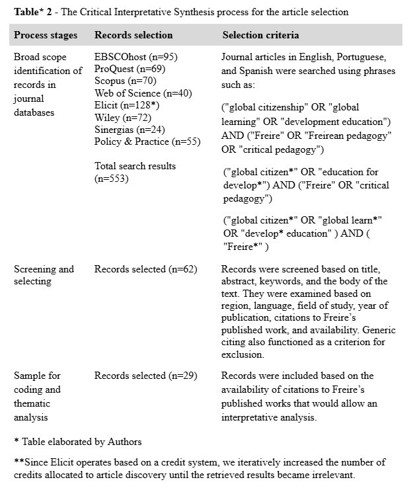
We initially included manual searches from Sinergias: Educational Dialogues for Social Transformation and Policy and Practice: A Development Education Review to complement the traditional database search processes (i.e., Table 1, c). At this point, we also searched the database of the International Journal of Development Education and Global Learning; however, the platform’s limited search and filtering functionality would have required manual screening of a large unfiltered set of records, which was not feasible within the resources allocated to the review.
Analysis
Our analysis started with identifying citations to Freire’s work in the sample and defining the function of the conceptual claim(s) attached to each citation (see prior application of this method in Benavides Lahnstein and Peñaloza Jiménez, 2022). The descriptive analysis continued by tracing whether Freire’s contributions were contextualised, elaborated, reinterpreted, critiqued, or displaced. In doing so, we identified whether the citations to his work served as background information about the field, a legitimising voice or symbolic figure of critical pedagogy, and if they provided an ongoing conceptual foundation in the articles. Thus, when Freire’s publications were cited to define transformation, oppression, praxis or other concepts, we followed the development of theoretical frameworks to understand how those concepts were contextualised, left unexplored, elaborated, reinterpreted, critiqued and/or displaced. We then examined if these developments functioned as supplements, recognising when the conceptual frameworks of studies in the sample described and applied additional theories or concepts to bridge gaps or meet goals that Freirean pedagogy could not achieve on its own, or not without creating epistemological tensions (Trifonas, 2000).
Findings and discussion
Overall, we examined twenty-nine GCE articles. The final sample is available from the corresponding author on request; please see the authors’ biographies for contact details. The list includes empirical, conceptual, practitioner-oriented, and policy-focused articles from a range of education levels and contexts (e.g. teacher education and community-led projects). Sixteen articles were empirical, nine were conceptual or theoretical in nature, and four were classified as practice accounts. Twenty-four studies are qualitative, although two articles employed mixed methods, and three are meta-studies (reviews). Nearly all articles were written in English, with one written in Portuguese.
Enunciative geo-political context
Twelve articles are from Ireland. We had three articles situated in Spain and three in the United Kingdom. Two were from The Netherlands and two from Portugal. We also had a single article from Northern Cyprus and one from Italy. Three articles included various European Union (EU) countries, and two articles comprised the EU as a whole. Importantly, the studies did not generally situate Freire’s ideas within the historical and political conditions from which they emerged, nor did they address the tensions that arise when applying his ideas in Europe. Except for one of the studies which stated that ‘… the implementation of Freire’s pedagogy in the global North might be considered somewhat incongruous’ (de Vries, 2023: 36). Although it is common practice in academic scholarship to adopt concepts without a full historical and geo-political contextualisation, de Vries’ (2023) point interrupts this somewhat taken-for-granted practice. And, for us, it reinforced the need to be explicit about the tensions that arise in citing Freire’s work from places of enunciation that shaped/are shaped by coloniality and uneven relations of power.
Interestingly, it is perhaps not only Freire’s work that can appear as universally applicable across geopolitical contexts. In fact, Freire’s own experiences can be presented as evidence of that applicability. Specifically, one article argues that GCE can challenge the ‘we’/‘other’ dichotomy underpinning exclusionary migration discourses in Europe through the notion of ‘oneness’ (de Angelis, 2022: 59, drawing on Ramalho, 2020). Freire’s experience as a political refugee and as a symbolic figure for oneness is used to advocate for harmonious relations between migrants and host societies: ‘In this context, by adopting a Freirean perspective, the quality of tolerance is indispensable both for the host society and for migrants in order to welcome each other’ (de Angelis, 2022: 59). However, the persuasive appeal of unity here, partly championed by an account of a period in Freire’s life, deviates from the still pressing questions about how diversity is portrayed and taken up in GCE (Pashby, 2012). Furthermore, conceptualising GCE through lofty and universal principles, without attending to local and global colonial histories, can arguably risk romanticising Freire’s experience of exile. And, at the same time, obscure the historically and geographically situated conditions that shape both the possibilities for hospitality as well as the unequal power relations through which hospitality is granted, negotiated, or denied.
Theoretical and moral positioning
In curating the sample, we identified many peripheral citations to Freire’s work that appeared to work as something of an epistemic password or a shorthand for social justice. A tradition can be foundational and critically interrogated; however, when Freire functions primarily as shorthand for social justice, citations can signal a critical orientation but without necessarily entailing critical engagement with the ideas being mentioned. We also noticed that the most common practice in the research reviewed was breaking down individual concepts and selectively applying Freire’s pedagogical framework. While this might suggest a clear outline for using Freire’s work, it can blur distinctions between concepts that have distinct roots and purposes. For example, conscientização (or critical consciousness), which involves reflection on one’s position within socio-economic structures and is oriented toward autonomous engagement in political and transformative action, can become closely associated with critical thinking skills (e.g., Golden, 2023; O’Brien and Cotter, 2018). Critical thinking, in broad terms, is a common construct that travels across educational discourses and contemporary curriculum designs but does not necessarily carry the same political and transformative commitments. When these conceptual distinctions remain underexplored, authors risk depoliticising Freire’s work and that of those who worked with or inspired him. We recognise that a deeper engagement and discussion of Freire’s work is not always accessible, feasible, or relevant for every study. Our aim here is therefore not to prescribe the extent to which individual studies should engage with Freire, but to encourage greater reflexivity about how and why his work continues to be used in European GCE literature, especially when the global issues examined in GCE might also be explored through alternative conceptual frameworks.
The literature also points to efforts to engage Freire’s work alongside other theoretical contributions. Authors drew on a range of other sources, and in some instances engaged in what we identify as acts of supplementation, discussed in the following section. Forty per cent of the articles reviewed referring to contributions by Vanessa Andreotti. While we understand that this engagement can extend the conceptual resources through which Freirean ideas are considered, at times, authors conflated the potentially complementary yet distinct theoretical positions of the two scholars. In a few instances, Freire was also suggested or explicitly positioned as an important influence on Andreotti’s work (e.g. Bourn, 2021). These findings were interesting in the context of our theoretical framework and Andreotti’s (2021) own explicit demarcation between her theoretical positioning – emerging from a postmodern and post/decolonial traditions – and Freire’s – emerging largely from critical theory, pragmatist and Marxist traditions (see e.g. Au, 2017; Beltrán-Llavador, 2024). Overlooking these distinctions may foreclose opportunities to examine the tensions, overlaps and synergies across the two theoretical positions.
Supplementing Freirean pedagogy in conceptualisations of GCE
Beyond instances of potential conflation between Freire and Andreotti’s theoretical positions, engagements with other theoretical traditions also involved more explicit acts of conceptual supplementation. Over half of the authors (fifty-five per cent) in the sample relied on theories and concepts beyond a Freirean pedagogy to shape their argument. In some cases, these theoretical tools played a more prominent role than Freire’s work. Such conceptual tools in GCE conceptual frameworks were usually introduced to encourage recognition of colonial legacies, Eurocentrism, structural marginalisation and taken-for-granted assumptions about social justice-related issues. For example, Daly and Farrelly (2023) describe a pedagogical bootcamp for youth workers which supplemented Freire’s pedagogy of hope with pedagogy of ambiguity, pedagogy of discomfort, and pedagogy of compassion, mainly drawing on the earlier contributions of Vanessa Andreotti and her colleagues. Thus, Freire’s work was often used as a starting point for discussions that were subsequently developed through other conceptual tools and traditions, including postcolonial and decolonial theory.
Across the studies that supplemented Freire’s work, we identified two broad patterns: (i) conceptual extension, where additional frameworks were used to elaborate or deepen ideas already present in Freirean pedagogy, and (ii) conceptual reorientation, where supplementary frameworks shifted the analytical focus towards concerns, traditions and assumptions that sat beyond Freire’s original and explicit theoretical commitments. The first shift – conceptual extension - is exemplified in Beltrán-Llavador’s (2024) study, where Paulo Freire’s concept of ‘inédito viável’ (‘untested yet feasible’), primarily drawn from pedagogy of hope, is supplemented through dialogue with Ernst Bloch’s principle of hope and notion of the ‘not yet’, Hannah Arendt’s ideas of thinking, action, and responsibility, Hartmut Rosa’s concept of resonance, Axel Honneth’s theory of recognition, and UNESCO policy discourses concerning the global commons and a renewed social contract for education. In this case, it seemed to us that detail and depth were provided without necessarily doing the additional work of addressing gaps (i.e. recognising coloniality and complicity in harm) or re-orienting the conceptual focus. Across similar examples, we sometimes found that this dialogue between theoretical perspectives still did not, however, elicit the tensions, assumptions and positionalities that shape these different intellectual traditions and those of the authors.
An example of the second kind of supplementation features in Saúde, Zarcos and Raposo (2018). The authors place the concepts of banking education and problem-posing/solving education within a ‘pedagogy of intervention’ and include the notion of reflexivity posed in the project ‘Through Other Eyes’ (TOE) by Vanessa Andreotti and Lynn Mario de Souza in 2008. This approach to reflexivity comprises four dimensions that can deepen the problem-posing approach: learning to unlearn – ‘making visible the origins and hidden agendas of taken for granted concepts’, learning to listen – ‘perceive the effects and limitations of one’s perspective’, learning to learn – ‘learning to situate oneself and others and to compare, contrast and juxtapose conceptual models’, and learning to reach out – ‘apply/adapt/situate/re-arrange this learning to one’s own context’ (Andreotti and de Souza, 2008: 4).
We observed another example in de Vries (2020), where conscientização and justice-oriented praxis are initially recognised as essential Freirean concepts in critical GCE before the focus shifts towards intersectional feminism and post/decolonial scholarship. Her argument problematises power structures and how mainstream GCE can neutralise intersectionality into ‘diversity’. In this case, de Vries supplements popular elements of Freirean pedagogy with intersectional theory, elaborating on positionality, lived experience, counter-narratives, alongside a sophisticated web of theoretical developments and pedagogical orientation. These examples of supplementation recognise what is missing (e.g. a focus on positionality and the need for alternative perspectives) or what may lack centrality in Freirean pedagogy. It is also a reorientation which favours a partial but necessary displacement of Freire’s work, one that is open to alternative engagements with coloniality and alterity in European contexts.
A third example of the second kind of supplementation as re-orientation is presented by Walsh (2020) who, drawing on Jordan Flaherty’s work, examines how GCE may reproduce saviourism and hero narratives. Walsh (2020) situates human agency within historical processes via Freire yet foregrounds reparational citizenship education as a pedagogical response. Walsh elaborates on Tim Huijgen et al.’s (2017) historical consciousness and perspective-taking, Nancy Fraser’s theorisation of social justice, Vanessa Andreotti’s critique of GCE and Michalinos Zembylas contributions to the pedagogy of discomfort. In this case, Walsh (2020) draws on Freire to establish a critical orientation for agency which is followed by argumentative trajectories that more directly interrogate saviourism, Western subject formation, and structural injustice in Europe.
While also not addressing the overlaps and tensions across theoretical positions, nor reflecting on Freire’s theoretical limitations, the second form of supplementation moves closer to the kind of reflexive engagement that encourages us to question our continued reliance on Freire as a primary point of reference for social justice and change of the status quo. By drawing on a wider range of conceptual frameworks, these studies open additional ways of understanding GCE and its practices. They encourage greater attention to the assumptions that shape our conceptual choices and analyses. They prompt us to interrogate and seek to understand the forms of oppression and inequality that may be less visible in European GCE scholarship through a Freirean lens. In doing so, they invite us to engage with theoretical perspectives that speak more directly to the complexities of European GCE educational and policy contexts.
Conclusion
This study set out to examine how Freire’s work is mobilised within European GCE scholarship and to explore if/how scholars supplement Freirean pedagogy with other theoretical tools. Our analysis suggests that Freire continues to function as a foundational reference point for critical GCE, frequently serving as a source of theoretical legitimacy and a shared vocabulary around social justice in education. In reaching for this theoretical shorthand, however, the literature reviewed does seem to substantiate Giroux’s (2024) concern about decontextualised, ahistorical, and peripheral references to Freire’s work. While signalling a commitment to social justice, scholarship in the field can often step over reflections around what it means to adopt (and potentially adapt) Freirean pedagogy in geopolitical contexts with colonial histories and legacies, complexifying conceptualisation of hope and advocacy for the oppressed, by recognising our own (e.g. white, middle-class, European) implication in oppression. To be clear, we do not mean to negate scholars’ commitments to challenging the status quo and promoting social justice, but to highlight how critical aspirations can coexist with limited interrogation of our enunciative position. In this way, our study shows that the adaptation of Freirean pedagogy in GCE situated in Europe is not simply a matter of theoretical uptake but an opportunity to recognise tensions and to productively engage with them through post/decolonial scholarship or otherwise.
As we recognise the important work Freire does in evoking social justice and the richness of his conceptual framework, we found that articles supplementing his ideas with other theoretical tools offered a more robust approach to address the complexities, tensions and difficult engagements that come with explicitly addressing coloniality and individual implication in harm. Supplementation was particularly helpful when it reoriented the focus of analysis to issues that are not central to Freirean pedagogy, e.g. through including concepts like intersectionality (recognising not only economic but also racial, gender, and other power structures) and positionality (recognising how one fits in/benefits from/is oppressed by the same structures). Still, rather than deciding on what kind of supplementation critical GCE should take, falling back into the trap of universally projecting one theory, the contribution of this article lies in showing how critical GCE scholars work within/extend/re-orient Freire’s work through supplementation. As such, we reinforce that the question is not whether Freire should remain relevant to GCE, but how his work is mobilised, from where, by whom, and to what ends.
References
Andreotti, V (2006) ‘Soft versus Critical Global Citizenship Education’, Policy and Practice: A Development Education Review, Vol. 3, pp. 40-45, available: https://www.developmenteducationreview.com/issue/issue-3/soft-versus-critical-global-citizenship-education (accessed 06 July 2026).
Andreotti, V de O (2021) ‘Depth Education and the Possibility of GCE Otherwise’, Globalisation, Societies and Education, Vol. 19, No. 4, pp. 496-509.
Andreotti, V and de Souza, L M (2008) Learning to Read the World Through Other Eyes, Derby, UK: Global Education Derby, available: https://developmenteducation.ie/media/documents/Learning_to_Read_the_World_Through_Other.pdf (accessed 29 July 2026).
Au, W (2017) ‘The Dialectical Materialism of Paulo Freire’s Critical Pedagogy’, Reflexão e Ação, Vol. 25, No. 2, pp. 171-195.
Beltrán-Llavador, J (2024) ‘A Praxis of Hope: Lessons from the “Untested Feasibility” for Twenty-First Century Education’, Globalisation, Societies and Education, Vol. 22, No. 1, pp. 53-62.
Benavides Lahnstein, A I and Peñaloza Jiménez, G (2022) ‘Using Lucie Sauvé’s Environmental Education Typology: A Systematic Synthesis of Citations’, Environmental Education Research, Vol. 28, No. 3, pp. 335-353.
Bourn, D (2020) ‘Educación Global y Desarrollo y Habilidades Globales’, EDUCAR, Vol. 56, No. 2, pp. 279-295.
Bourn, D (2021) ‘Pedagogy of Hope: Global Learning and the Future of Education’, International Journal of Development Education and Global Learning, Vol. 13, No. 2, pp. 65-78.
Bourn, D (ed.) (2023) ‘Global Citizenship as a Pedagogy of Hope’, International Journal of Development Education and Global Learning, Vol. 15, No. 1, pp. 1–3.
Bourn, D and Tarozzi, M (eds.) (2023) Pedagogy of Hope for Global Social Justice: Sustainable Futures for People and the Planet, London: Bloomsbury Academic.
Coelho, D, Caramelo, J and Menezes, I (2018) ‘Educação para o Desenvolvimento na Era Global: Possibilidades de uma Leitura Pós-Colonial’, Educação, Sociedade e Cultura, Vol. 53, pp. 97-119.
Daly, S and Farrelly, A (2023) ‘Youth Work as Transformative Education: A Reflection on the National Youth Council of Ireland’s Pedagogical Bootcamp’, Policy and Practice: A Development Education Review, Vol. 37, Autumn, pp. 138–151.
da Trindade, A Robertson, S L and Torres, C A (2024) ‘Introduction to special issue: Paulo Freire – global educator’, Globalisation, Societies and Education, Vol. 22, No. 1, pp. 1–6.
de Angelis, R (2022) ‘Global Education and Migration in a Changing European Union’, Policy and Practice: A Development Education Review, Vol. 34, pp. 55-78.
de Vries, M (2020) ‘Enacting Critical Citizenship: An Intersectional Approach to Global Citizenship Education’, Societies, Vol. 10, No. 4, pp. 1-19.
de Vries, M (2023) ‘Civic Action Within Global Citizenship Education as an antidote to Despair’, Policy and Practice: A Development Education Review, Vol. 37, pp. 28-55.
Depraetere, J, Vandeviver, C, Keygnaert, I and Beken, T V (2021) ‘The Critical Interpretive Synthesis: An Assessment of Reporting Practices’, International Journal of Social Research Methodology, Vol. 24, No. 6, pp. 669-689.
Dixon-Woods, M, Cavers, D, Agarwal, S, Annandale, E, Arthur, A, Harvey, J, Hsu, R, Katbamna, S, Olsen, R, Smith, L, Riley, R and Sutton, A J (2006) ‘Conducting a Critical Interpretive Synthesis of the Literature on Access to Healthcare by Vulnerable Groups’, BMC Medical Research Methodology, Vol. 6, Article 35.
Eriksen, K G and Stein, S (2022) ‘Good intentions, colonial relations: Interrupting the white emotional equilibrium of Norwegian citizenship education. Review of Education’, Pedagogy, and Cultural Studies, 44(3), 210–230.
Eten Angyagre, S (2024) ‘Development Education and Decolonising International Partnerships in Higher Education’, Policy and Practice: A Development Education Review, Vol. 39, pp. 87-100.
Ferreira, E B, Teixeira Garcia, M L, Sabadini, M de S and Delboni, T M Z G F (2025) ‘Social-Environmental Crises and Critical Pedagogy in Brazil’, Globalisation, Societies and Education, pp. 1-12.
Finnegan, W and d’Abreu, C (2024) ‘The Hope Wheel: A Model to Enable Hope-Based Pedagogy in Climate Change Education’, Frontiers in Psychology, Vol. 15, Article 1347392.
Giroux, H A (2024) ‘Rethinking Paulo Freire and Postcolonialism in the Age of Disposability’, Counterpunch, available: https://www.counterpunch.org/2024/12/06/rethinking-paulo-freire-and-postcolonialism-in-the-age-of-disposability/ (accessed 06 July 2026).
Global Education Network Europe (GENE) (2022) ‘European Declaration on Global Education to 2050’, Dublín: GENE, available: https://www.gene.eu/ge2050-congress (accessed 06 July 2026).
Golden, B (2023) ‘Promoting Democratic Values in Initial Teacher Education: Findings from a Self-Study Action Research Project’, Policy and Practice: A Development Education Review, Vol. 36, Spring, pp. 34–58.
Goren, H and Yemini, M (2017) ‘Global Citizenship Education Redefined – A Systematic Review of Empirical Studies on Global Citizenship Education’, International Journal of Educational Research, Vol. 82, No. 1, pp. 170-183.
McLaren, P and Jandrić, P (2018) ‘Paulo Freire and Liberation Theology: The Christian Consciousness of Critical Pedagogy’, Vierteljahrsschrift für wissenschaftliche Pädagogik, Vol. 94, No. 2, pp. 246-264.
Mignolo, W D and Walsh, C E (2018) ‘On decoloniality: Concepts, analytics, praxis’, Duke University Press.
O’Brien, S and Cotter, G (2018) ‘Critical researchers “of and for our times”: exploring student teachers’ use of critical multicultural and development education frameworks in their professional research papers (PRPS)’, Policy and Practice: A Development Education Review, Vol. 26, pp. 74-105.
Pashby, K (2012) ‘Questions for Global Citizenship Education in the Context of the “New Imperialism”: For Whom, By Whom?’ in V Andreotti and L de Souza (eds.) Postcolonial Perspectives in Global Citizenship Education, New York and London: Taylor & Francis.
Pashby, K, da Costa, M, Stein, S and Andreotti, V (2020) ‘A Meta-Review of Typologies of Global Citizenship Education’, Comparative Education, Vol. 56, No. 2, pp. 144-164.
Ramalho, R R (2022) ‘Analytical model of the pedagogy of the oppressed: systematization of the Paulo Freire’s Method’, Revista Brasileira de Educação, Vol. 27, pp. 1-23.
Reilly, P and Liddy, M (2021) Looking Back and Looking Forward: Conversations on Paulo Freire’s Influence on Global Development Practice, Maynooth: Maynooth University, available: https://mural.maynoothuniversity.ie/id/eprint/15913/1/Freire%20Conference%20FINAL%20040522.pdf (accessed 06 July 2026).
Römhild, R (2023) ‘Learning Languages of Hope and Advocacy: Human Rights Perspectives in Language Education for Sustainable Development’, Human Rights Education Review, Vol. 6, No. 1, pp. 9-29.
Saúde, S, Zarcos, A P and Raposo, A (2018) ‘Empowering More Proactive Citizens through Development Education: The Results of Three Learning Practices Developed in Higher Education’, Policy and Practice: A Development Education Review, Vol. 27, Autumn, pp. 109–126.
Schwittay, A (2023) ‘Teaching Critical Hope With Creative Pedagogies of Possibilities’, Pedagogy, Culture & Society, Vol. 33, No. 1, pp. 85-103.
Stein, S (2018) ‘Rethinking Critical Approaches to Global and Development Education’, Policy and Practice: A Development Education Review, Vol. 27, Autumn, pp. 1-13.
Torres, C A and Yan, L (2022) ‘Paulo Freire and the State-of-the-Art of the International Journal of Lifelong Education’, International Journal of Lifelong Education, Vol. 41, No. 6, pp. 651-665.
Tricco, A C et al. (2018) ‘PRISMA Extension for Scoping Reviews (PRISMA-ScR): Checklist and Explanation’, Annals of Internal Medicine, Vol. 169, No. 7, pp. 467-473.
Trifonas, P (2000) ‘Derrida and Rousseau: Deconstructing the Ethics of a Pedagogy of the Supplement’, The Review of Education/Pedagogy/Cultural Studies, Vol. 22, No. 3, pp. 243-265.
Tuck, E and Yang, K W (2012) ‘Decolonization is Not a Metaphor’, Decolonization: Indigeneity, Education and Society, Vol. 1, No. 1, pp. 1-40.
UNESCO (2015) Global Citizenship Education: Topics and Learning Objectives, Paris: UNESCO, available: https://unesdoc.unesco.org/ark:/48223/pf0000232993 (accessed 06 July 2026).
Walsh, G M (2020) ‘Challenging the Hero Narrative: Moving Towards Reparational Citizenship Education’, Societies, Vol. 10, No. 2, Article 34.
Wynter, S (2003). ‘Unsettling the coloniality of being/power/truth/freedom: Towards the human, after man, its overrepresentation – An argument’. CR: The New Centennial Review, Vol. 3, No.3, pp. 257-337. Available: https://muse.jhu.edu/article/5163
Ana I. Benavides Lahnstein works as an Evaluation and Research professional at STEM Learning and is a tutor at the Open University in the UK. Her research is spread across nodal points between science education, environmental and sustainability education, and global citizenship education. She has also explored how school curricula and educational programmes in formal and non-formal settings support science learning for educators and young people. Correspondence: Benavides.lahnstein@gmail.com.
Marta da Costa is a Senior Lecturer at Manchester Metropolitan University, where she teaches in the School of Education. Her research aims to explore how post and decolonial theory can inform epistemic reflexivity in critical Global Citizenship Education research and teaching from within European education contexts.
Gonzalo Peñaloza is a researcher at the Centre for Research and Advanced Studies of the National Polytechnic Institute, México. He holds a PhD in Teaching, History and Philosophy of Sciences (Universidade Federal da Bahía, Brazil) and a PhD in Science Education (Universidad Distrital, Colombia). His research seeks to understand how science education contributes to critical thinking, and how biology education interacts with culture, politics and society.