





Hospicing Modernity: Facing Humanity’s Wrongs and the Implications for Social Activism
 43
43 Development Education: Learning for Transformation
 Click to download
Vanessa Machado de Oliveira (2021) Hospicing Modernity: Facing Humanity’s Wrongs and the Implications for Social Activism, Berkley: North Atlantic Books.
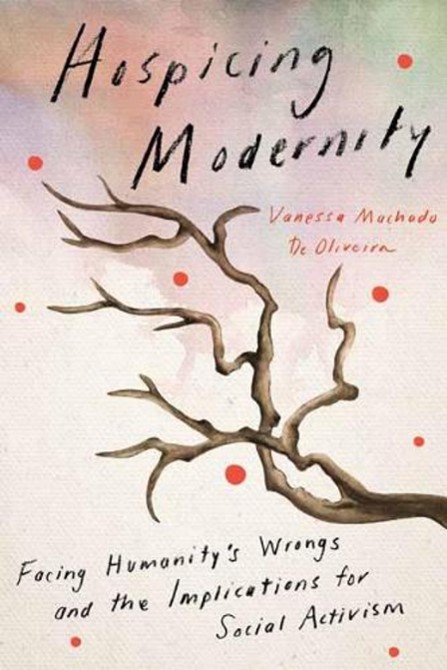 Vanessa Machado de Oliveira Andreotti’s ‘Soft versus critical global citizenship education’ (Andreotti, 2006), originally published in this journal, has become a landmark text in development education. Beyond this seminal work, Andreotti has continuously contributed a wide range of pedagogical tools, often in the shape of metaphors or social cartographies, to the field. These invite and support educators, researchers and policymakers to identify and critically reflect on the individual and collective narratives, as well as the absences and denials, that frame our understanding and practice of development education. No other scholar has shaped the field as profoundly, and Hospicing Modernity is a compilation of many of these tools, alongside new ones, grounded in deeply personal stories and guided by the pedagogical creativity Andreotti is known for. Reflecting the teachings she herself received from her grandmothers, Andreotti signs this book with her maiden name, as Vanessa Machado de Oliveira.
As the ‘House that Modernity Built’ crumbles, this book is a companion for sitting with, working through and caring for a system while it dies ‘within and around us’ (Machado de Oliveira, 2021: xxii). It is especially aimed at those of us involved in low intensity, low risk and low stakes struggles:
“if you have the time, energy and literacy necessary to read this book, you fit this category (…) we have a choice to show up or not, to become visible or not, to be arrested or not, to take risks or not” (Ibid.: 52).
However, Machado de Oliveira warns against reading this book, if the reader is still strongly invested in saving modernity and protecting themselves from confronting the unsustainability of the system as well as our complicity in the harm that it causes. This is certainly not a book concerned with inspiring hope and offering solutions to the problems we face. In Machado de Oliveira’s words, ‘if you are looking for strategies that will make you feel good, look good, and move forward, and if you know that this is what you need right now, do not read this book’ (Ibid.: 40).
If readers do choose to proceed, they will find a book divided into two parts: the first one – ‘Warm-up/ Prep Work’ – lays the conceptual and self-reflexive grounding for the teachings that follow in the second – ‘Hospicing Modernity’. However, readers are not instructed to follow a linear reading of the chapters and, arguably, the prep works starts in the first sentence of the Preface. Following Carl Mika (2017), Machado de Oliveira states that language ‘worlds the world’. As an alternative to western modern understandings of storytelling – where stories are seen as instruments of communication that represent, analyse and prescribe ‘reality’ – Machado de Oliveira, invites readers to recognise stories as living entities that emerge from, shape and produce our experiences of the world. Stories travel, transform and are transformed through the bodies, places and relationships they encounter. In this way, Machado de Oliveira’s invitation is not to read and think about, but to ‘dance with’, the personal and collective stories she shares in this book. This is a call for active and reflexive engagement, not just with our head, but also with our heart, senses and body.
‘Who the heck is modernity?’
Through storytelling, Machado de Oliveira, traces, pulls at and unravels modernity, showcasing its limits and harmful side effects, as well as the tensions, contradictions and nuances inherent to existing in and (at least partly) through this system. Machado de Oliveira defines modernity as a single story of forward, rife with promises of safety, success and ever amounting health and wealth that are contingent on civilisation, scientific advancements and technological progress. This single story is rooted in ontological hierarchical separability – difference and distance between humans and nature (human exceptionalism based on logocentrism) and within humans (based on whose bodies and cultures have the capacity to reason in a legitimate way). This single story of progress, through Euro-western epistemic structures, institutions, discursive practices and material forms of violence, has established modernity as the only possible way to create and share meaning and relate to other beings in the world. Drawing on Aníbal Quijano (2000), Machado de Oliveira refers to modernity/coloniality to elicit the violent systems of oppression on which modernity is built, including colonialism, racism, dispossession, destitution, and environmental destruction.
The story of separability, according to Machado de Oliveira, is the fault line on which the system stands and responsible for its collapse. She argues that perceiving ourselves as separate from nature and other beings affects us cognitively, affectively, relationally and even metabolically. It disconnects us from ourselves, from others and from the consequences of our actions, while numbing us to what is happening within and around us. In response, we seek fulfilment through participation in modernity's games of individuation and consumption. Furthermore, a belief in separability comes with an arrogant sense of superiority that informs our attempts to categorise, manage and control the world in our own image, while dismissing alternative ways of being and knowing that arise from different contexts, bodies and cultures. Yet, despite this sense of superiority, Machado de Oliveira argues modernity is infantilising. Deeply invested in the system’s comforts and promises of security, health and wealth, we cultivate a fear of uncertainty and a need for a sense of control and continuous reassurance. We learn not to look too closely at the harms we are complicit with, and, when we do look, we seek guarantees that our own sense of self will remain untroubled and our livelihoods undisturbed.
Modernity’s ubiquity and deep roots in our individual and collective imaginary mean that alternative perspectives can only be read in a way that mimic modernity’s worlding of the world, severing these stories from their ontological roots. One of the main contributions of this book is to render modernity/coloniality visible – naming its promises, harmful consequences and our investments in it – thus helping us to denaturalise it. But the book also enables us to reflect on where we stand geopolitically, socio-economically, racially and culturally; and how this position determines our experiences of modernity/coloniality as well as the questions we are able to ask and the answers we are willing to give.
Critiques of and from within the system, including those centred on redistribution, recognition and participation, can function as stories that ultimately reinforce rather than disrupt it. Machado de Oliveira argues these political mobilisations are helpful in terms of gaining ‘access to institutions, social mobility, markets, and platforms for voice and power’ (Ibid.: 182), therefore reducing the harms caused by modernity. Although expanding the system and including more people in it, these approaches are limited because the system is built on coloniality, and coloniality is also required for its expansion (Ibid.: 19). Nevertheless, finding alternatives to the system is not an option available at present, according to Machado de Oliveira, because we are too deeply socialised in modernity’s stories and, therefore, only able to (re)produce different versions of it. Even if we could imagine an alternative, Machado de Oliveira maintains we are not ready to voluntarily face our denials nor relinquish the comforts and benefits modernity affords us. As such, more knowledge about the problem, however counter hegemonic, is not going to solve it, and neither are our good intentions.
It is only when the system finally collapses, and we are forced to interrupt our harmful desires and investments in modernity, that we will be ready to confront it and confront ourselves. As Machado de Oliveira puts it:
“Before anything different can happen, before people can sense, hear, relate, and imagine differently, there must be a clearing, a decluttering, an initiation into the unownable; and a letting go of desires for certainty, authority, hierarchy, and of insatiable consumption as a mode of relating to everything” (Ibid.: 235).
As such, this book is about doing our homework (or perhaps our shitwork, as Machado de Oliveira puts it) that will help us hospice modernity. To hospice modernity is to sit with/in a system in decline; to care for and learn from it; to grieve it while befriending death. As we prepare for this inevitability, Machado de Oliveira argues we need to develop the stamina, discernment, accountability and responsibility that we need to do the work that needs to be done while the house crumbles. For this, we must adopt a position of ‘humility, honesty, humour and hyper-self-reflexivity’ (Ibid.: 24) and this is what Machado de Oliveira models in this book.
Implications for development education
Development education is strongly concerned with educational and advocacy work in support of political mobilisations around redistribution, recognition and participation. This work has been, and continues to be, essential to challenge global/local power inequalities and support the upholding of human rights across borders, breaking the barriers raised by the dominant groups that benefit from their undermining. This work is, as Machado de Oliveira maintains, essential and limited. Because of the fault lines in the system (around hierarchical separability, capitalist consumption, and the privileging of certain bodies and cultures) and its approaching expiration, this work will become increasingly more complex and challenging. Machado de Oliveira argues that dominant groups in society will continue to hoard resources, forcing marginalised groups to compete against each other, for example through scapegoating. Modern/colonial institutions will take in those who have been historically excluded but not change, so that the only option becomes assimilation into the system but not true recognition or meaningful participation. These are not problems development education can solve itself.
In a field where developing critical perspectives, identifying solutions and mobilising people to take action is central, Machado de Oliveira presents us with a predicament, rather than a problem to solve. This book stops us in our tracks and asks us to turn our critical orientation inward. This is not instead of but alongside the work we are doing. It shares stories and raises questions we might want to dance with: what happens when we start from the recognition that we are complicit with, and often reinforce, the very issues we are trying to address? What framings of our present problems and images of the future inform our actions? And what desires and denials are we attempting to protect in the process? How is our relationship with counter-hegemonic knowledge keeping us from doing the work that needs to be done? As we fight to resist coloniality, can we fight our own resistance to an honest, humble, humorous and hyper-reflexive confrontation with ourselves?
References
Andreotti, V (2006) 'Soft versus critical global citizenship education', Policy and Practice: A Development Education Review, Vol. 3, Autumn, pp. 40-51.
Machado de Oliveira, V (2021) Hospicing Modernity: Facing Humanity’s Wrongs and the Implications for Social Activism, Berkley: North Atlantic Books.
Mika, C (2017) Indigenous Education and the Metaphysics of Presence: A Worlded Philosophy, Oxon: Routledge.
Quijano, A (2000) ‘Coloniality of Power and Eurocentrism in Latin America’, International Sociology, 15(2), pp. 215-232.
Marta da Costa is a Senior Lecturer in the School of Education at Manchester Metropolitan University. Her research lies at the intersections of Global Citizenship Education and Environmental and Sustainability Education, and is concerned with centring colonial legacies at the root of Eurocentric epistemological frameworks in education, drawing on postcolonial and decolonial theoretical perspectives.