





Fragments of Victory: The Contemporary Irish Left
 42
42 Pedagogical Responses to the Meta Crisis: The Role of Development Education
 Click to download
Oisín Gilmore and David Landy (eds.) (2025) Fragments of Victory: The Contemporary Irish Left, London: Pluto Press.
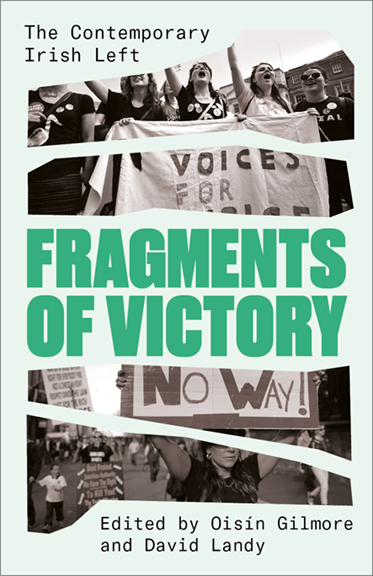 This is an engaging and clear-eyed reflection on the political and activist left in the period of austerity in Ireland following the 2008 financial crisis. It is the story of a fractious political left often engaged in bitter internal disputes and a uniform political right ‘with near universal support for neoliberal politics’ (Gilmore and Landy, 2025: 9). The book assesses how the political left and civil society responded to the imposition of austerity as part of a bailout to the Irish state by the Troika of the International Monetary Fund (IMF), European Commission and European Central Bank. The launch of a successful campaign to oppose water charges was one of the ‘fragments of victory’ in this period that effectively combined community organisations with trade unions and left political representatives in a united movement called Right2Water. The book reflects on the lessons to be learned from this period and is described by the editors as a ‘work of recollection, deliberation, debate, provocation and analysis’ (Ibid.: 23). As Gilmore and Landy suggest:
“It is by studying the struggles, conflicts and possibilities of our present and our recent past that we can work out where we stand and, from there, where we might advance in the future” (Ibid: 19).
The intensity of campaigning and the sheer exhaustion that attends activism over an extended period often precludes the possibility of reflection and analysis of lessons that can be learned going forward. Gilmore and Landy, for example, argue that the ‘left has failed to build lasting political institutions’ that could help sustain the mobilisation of communities and social movements in future endeavours (Ibid.: 3). So, this book, despite its acknowledged limitations, has a lot to offer readers interested in advancing the leftist values of social justice, diversity and equality. These are the values of global education and practitioners from the sector will find the book useful in learning from the leftist campaigns that have resonated with communities in Ireland. The book also attains added interest as its publication coincides with the election of an Irish president, Catherine Connolly, who campaigned on an unapologetic socialist agenda for a ‘new Republic’ and won with a resounding majority receiving 63.4 percent of the vote (RTE, 2025). Is this a harbinger of more electoral success for the political left in Ireland? What are its implications for global educators and how the sector communicates with the public? They are issues worthy of further debate.
Austerity and water charges
Between 1990 and 2003, the Irish economy underwent a remarkable transformation from poor, peripheral status to becoming the poster economy for neoliberalism in Europe. Ireland’s ‘Celtic Tiger’ economy was predicated on attracting foreign direct investment in high-end sectors particularly pharmaceuticals, information technology and financial services. Ireland’s open economy positioned itself mostly toward the export sector with its largest market in the United States. It enjoyed an ‘annual gross domestic product (GDP) growth rate of 9.4% between 1995 and 2000’, one of the highest in the world (Peters, 2025). But as an open and highly deregulated economy, Ireland was particularly vulnerable to the 2008 global financial crisis when it lost its economic sovereignty as a result of a banking collapse fuelled by a speculative property boom that left the sector sitting on a pile of unsustainable debt. The Fianna Fáil-led government responded to the crisis with a complete bailout of the banks financed by a loan of €67.5 billion borrowed from the Troika. The EU-IMF bailout came with demands for austerity including water charges that was opposed by a national campaign for the Right2Water which mobilised hundreds of thousands of people to participate in mass demonstrations. The Right2Water campaign was hugely effective in combining mass protests with the blocking of the installation of water meters and a call for the non-payment of bills which reached a peak of 73 percent (Gibney, 2025: 57).
The campaign succeeded because it had support from some of the political parties and independent representatives in the Dáil (the Irish parliament), the organisational skills of five of Ireland’s 48 trade unions and the grassroots mobilisation of community groups. Together these three ‘pillars’ created a formidable campaign that forced the government to scrap water charges in 2016. Dave Gibney, who was heavily involved in the campaign and wrote the chapter on water charges in Gilmore and Landy’s edited text, emphasised the importance of political economy education by trade unions to the success of Right2Water. He found that the unions had abandoned these more politicised education courses during the economic boom and neglected the ‘need for collective solutions to workers’ problems and focused almost entirely on individualised solutions’ (Ibid: 58). So, when the economy collapsed in 2008, ‘many workers had no idea what had happened’ as they lacked the critical consciousness and political content that unions used to provide (Ibid). As Gilmore and Landy (2025: 9) put it, the ‘labour movement in Ireland had been muzzled by social partnership’ agreements between the unions with government and the Irish business and employers’ confederation. This ensured trade unions did not engage in potentially disruptive industrial action and maintained a business-friendly environment for corporate investors.
Another highly effective campaign in this period was that for the repeal of the eighth amendment of the Irish constitution to open the way for legislation allowing abortion in certain circumstances. The Abortion Rights Campaign was a grassroots all-volunteer group that had the support of a coalition of political organisations and NGOs and successfully secured a referendum on the eighth amendment in 2018. The Abortion Rights Campaign joined an umbrella group called ‘Together for Yes’ that secured 66 percent of the vote in the referendum on 25 May 2018 when Ireland became one of the first countries to provide abortion through local GP services (O’Carroll and Ni Chuagáin, 2025: 79). The success of the repeal the eighth campaign followed another major social reform when a referendum on legalising same-sex marriage was carried by a 62 percent majority in 2015 (Gilmore and Landy, 2025: xiv). The success of the abortion and same-sex marriage referenda were indicators of a changing Ireland from a socially conservative to a more plural and secular society. However, political change has been more glacial as this book suggests.
A divided left and unified right
Since Ireland’s partition more than a century ago with the north of Ireland remaining part of the United Kingdom, the political system in the south of Ireland has been dominated by two centre-right parties, Fine Gael and Fianna Fáil. These parties emerged from the pro- and anti-treaty forces that fought in Ireland’s civil war in 1923 over a treaty with Britain that partitioned the island. Ideologically, the parties became increasingly interchangeable and in the Celtic Tiger period both were committed to the economic model driven by securing foreign direct investment for the export market which increasingly integrated the Irish economy into the orbit of the United States both politically and economically. The buoyancy of the Celtic Tiger years ensured the left stayed in the political margins, but this began to change post-austerity when the left republican Sinn Féin and Trotskyist People Before Profit parties started making significant gains in local and general elections in 2011 and 2016. The soft left Labour and Green parties have occasionally entered coalition governments with the political right and have paid the price at the ballot box for supporting austerity measures while in power which means Ireland remains the only ‘democracy in western Europe where a socialist or social democratic party has never led a government’ (Ibid.: 3).
Fragments of Victory has a two-part structure with part one focused on campaigns (anti-austerity, water charges, abortion and housing) and part two on organisations (mostly political parties and trade unions). From a global education perspective, part one’s focus on political education, organising campaigns, building alliances and public engagement will probably be of greater interest and relevance. This section certainly suggests a role for global educators in working with communities on anti-austerity issues, supporting community education programmes and campaigning on social justice issues. Recent issues of Policy and Practice have indicated a deepening sectoral unease at global education silences on social and economic justice issues (Wheatley, 2024; Murphy, 2024; O’Toole, 2024; Khoo, 2024). And, interestingly, Landy (2025: 30) makes the point that non-governmental organisations in the period of austerity played a negligible role of ‘quiescence and acquiescence’. In a similar fashion many trade unions failed to mobilise their members during the austerity period either because of their relationship with the Labour party which was in government between 2011 and 2016, or because of social partnership agreements. Gilmore’s conclusion depressingly finds that trade union density is lower today than it was in 2007 and ‘no lasting form of working-class self organization has emerged’ (2025: 177-178). This in turn has weakened worker education and the capacity of trade unions to respond to the multiple challenges assailing us at present including the rise and growing public disorder of the far-right, online racism and hate speech, homelessness and the power of corporations.
The large social movements that emerged in the post-2008 austerity period were often highly effective in sustaining campaigns and large-scale mobilization but:
“have failed to identify an avenue through which society might be changed, and given this, they have failed to develop a mass political consciousness around the capitalist nature of our society or around what needs to be done to change it” (Ibid.: 183).
And yet there are reasons to be optimistic about the future. Catherine Connolly’s presidential campaign platformed climate justice, housing, the cost-of-living crisis, Irish neutrality, anti-racism, LGTBQ+ rights, feminism and the genocide in Gaza (Connolly for President, 2025). These issues resonated with the electorate, particularly young people who were energised by her campaign and the idea of a more inclusive society. And in the November 2025 New York mayoral campaign, the democratic socialist candidate, Zohran Mamdani, won with more than half the vote standing on a platform that included free public buses, reduced childcare costs, increasing the minimum wage and the corporate tax rate and opening city-owned grocery stores to subsidise food costs (Goodwin, 2025). They are two very different political contexts, but the Connolly and Mamdani campaigns showed that progressive policies can win elections if communicated with clarity and targeting social needs. Can these campaigns put down the political roots needed to inspire and sustain other candidates from the political left? It remains to be seen but at the very least they offer hope for the prospects of progressive political change on both sides of the Atlantic.
Conclusion
Fragments of Victory revisits a painful period in Irish history which caused severe suffering for workers most vulnerable to the economic collapse such as those employed in the construction sector which virtually ground to a halt post-2008. The National Suicide Research Foundation (NSRF) in Ireland found that ‘the rate of male suicide by the end of 2012 was 57 per cent higher than it would have been if the recession had not happened’ (O’Connell, 2025). Many families in Ireland continue to carry the loss of those years, particularly those that lost a loved one and the main economic provider. It is important, therefore, that we reflect on the causes of the financial crisis, the impact of austerity, and how the political and activist left responded. To that end, Fragments of Victory is a useful foundation for more fulsome treatments to come on the political and activist left with a broader sweep of sectors in civil society and a wider timeframe. This short book acknowledges the issues that it omitted including anti-racism, LGBT+ rights, environmentalism and international solidarity. It also confined itself to the south of Ireland when an all-island approach would be essential to a follow-up publication given the growing discourse on all-island politics (Harvey, 2025; Department of the Taoiseach, 2025).
A future treatment of the left would also have to assess the enormous and sustained public activism in Ireland aroused by Israel’s genocide in Gaza which has undoubtedly shifted the dial in terms of public consciousness on Palestine and influenced a mostly unified approach to the issue from the political left. It should also reflect on the 14-year presidency (2011-2025) of Michael D. Higgins, which has re-defined a largely ceremonial position to make it more overtly critical of government policies, particularly those on housing and neoliberalism (Leahy, 2023; Fletcher, 2023). The Higgins presidency is a surprising omission in Fragments of Victory, as it has been the one constant beacon of leftist support and success in an otherwise challenging period for the political left in Ireland.
But it is in its coverage of the activist left in Ireland that Fragments of Victory really scores. There is valuable learning here in how communities on the frontlines of austerity came together with NGOs, trade unions, and civil society movements to fashion effective campaigns for social justice. Global educators reading this book should reflect on how they can engage with the campaigns to come that will inevitably attend the poly-crisis breaking across our world.
References
Connolly for President (2025) available: https://www.catherineconnollyforpresident.ie/ (accessed 12 November 2025).
Department of the Taoiseach (2025) ‘Keynote address by Taoiseach Micheál Martin: A new phase of the Shared Island Initiative’, 10 April, available: https://www.gov.ie/en/department-of-the-taoiseach/speeches/keynote-address-by-taoiseach-miche%C3%A1l-martin-a-new-phase-of-the-shared-island-initiative/ (accessed 19 November 2025).
Fletcher, L (2022) ‘President criticises Irish housing as “our great failure”’, RTE News, 15 June.
Gibney, D (2025) ‘Water Charges’ in O Gilmore and D Landy (eds.) Fragments of Victory: The Contemporary Irish Left, London: Pluto Press, pp. 46-62.
Gilmore, O (2025) ‘Conclusion’ in O Gilmore and D Landy (eds.) Fragments of Victory: The Contemporary Irish Left, London: Pluto Press, pp. 176-194.
Goodwin, G E (2025) ‘What to know about Zohran Mamdani and what he wants to do as New York City mayor’, BBC News, 5 November.
Harvey, C (2025) ‘A united Ireland is a shared island’, Éire Nua, Spring 2025(9).
Khoo, S (2024) ‘Response to Policy and Practice Call on Development Education Silences: Reflections on a Pedagogy of Non-Silence – Resisting the Politics of Hopelessness’, Policy and Practice: A Development Education Review, Vol. 39, Autumn, pp. 145-158.
Landy, D (2025) ‘Anti-Austerity Struggles 2008-13’ in O Gilmore and D Landy (eds.) (2025), Fragments of Victory: The Contemporary Irish Left, London: Pluto Press, pp. 29-45.
Leahy, (2023) ‘President condemns “obsession” with economic growth’, Irish Times, 28 April.
Murphy, C (2024) ‘Development Education and Palestine: Confronting the Non-Response’, Policy and Practice: A Development Education Review, Vol. 39, Autumn, pp. 136-144.
O’Connell, J (2025) ‘Young CMAT saw Bertie and the bankers’ handiwork’, The Irish Times, 19 July.
O’Carroll, A and Ni Chuagáin, M (2025) ‘Abortion’ in O Gilmore and D Landy (eds.) (2025), Fragments of Victory: The Contemporary Irish Left, London: Pluto Press, pp. 63-82.
O’Toole, B (2024) ‘The Silences of Global Citizenship Education: A Concept Fit for Purpose?’, Policy and Practice: A Development Education Review, Vol. 39, Autumn, pp. 171-183.
Peters, K (2025) ‘Celtic Tiger: Ireland's Economic Boom Explained (1995-2007)’, Investopedia, 4 September.
RTE (2025) ‘Presidential Election 2025’, 25 October, available: https://www.rte.ie/news/presidential-election/results/#/national (accessed 10 November 2025).
Wheatley, K F (2024) ‘Regrettable Silences and Future Directions in Development Education’, Policy and Practice: A Development Education Review, Vol. 39, Autumn, pp. 34-52.
Stephen McCloskey is Director of the Centre for Global Education and editor of Policy and Practice: A Development Education Review.