



Tackling Impact Evaluation in Development Education: The Case of Sinergias ED
 42
42 Pedagogical Responses to the Meta Crisis: The Role of Development Education
 Click to download
Abstract: This article reflects on the activities of the Sinergias ED project, a development education (DE) initiative in Portugal, that supported alternative approaches to impact assessment amid the growing financialisation of public policies. Launched in 2013 through a partnership between the Centre for African Studies of the University of Porto (CEAUP) and Gonçalo da Silveira Foundation (FGS), the project aimed to create collaborative learning spaces between civil society organisations (CSOs) and higher education institutions (HEIs), promoting participatory action research and co-production of knowledge. Sinergias ED questions power asymmetries and the monopoly of academic knowledge, seeking to value an ecology of knowledges through a community of practice, a scientific journal, and various peer learning initiatives. Within a context dominated by linear, results-based approaches to impact assessment, the project experimented with participatory methods, including with Theory of Change (ToC) and systematisation of experiences. These instruments allowed exploration of complex, cumulative transformations at individual (micro), relational (meso), and institutional (macro) levels.
The article raises questions about how the transformative potential of collaborative DE initiatives can be understood and assessed. It considers the tensions between linear evaluation tools and the emergent, relational, and metabolic nature of learning and transformation experienced in the Sinergias ED project through the image of a DE ecosystem. It suggests that capturing the nuances of DE impacts may require methodologies that embrace plural perspectives, extended temporality, and reflexive practices. These methodologies contribute not only to an understanding of DE initiatives but also inform impact assessment practices within public policy, supporting evidence-based approaches that account for both measurable outcomes and subtler, relational dimensions of social transformation.
Key words: Development Education; Impact Evaluation; Social Transformation; Neoliberalism; Public Policies.
Introduction
In Portugal, development education (DE) is a key pillar of foreign policy coordinated by the Ministry of Foreign Affairs (CICL, 2022). Since 2009, a national strategy for development education has been approved and implemented (IPAD, 2009). It is a strategy designed by a broad range of government, public institutions and CSOs operating in several domains, including those recognised as non-governmental development organisations (NGDOs). Following a 2012 report identifying a lack of national research in DE, the Centre for African Studies of the University of Porto (CEAUP) and the NGDO Gonçalo da Silveira Foundation (FGS) launched Sinergias ED in 2013. Now in its fifth funding cycle with Camões, IP (CICL, 2022), the Portuguese public institute that oversights and funds DE, the project facilitates knowledge co-creation between higher education institutions (HEI) and civil society organisations (CSO).
Adopting a critical DE framework (Andreotti, 2014), Sinergias ED challenges power asymmetries and academic monopolies by promoting an ecology of knowledges (Santos, 2007). It operates through three lines of action: regular meetings and collaborative work involving sixty members of Sinergias ED in a community of practice; collaborative knowledge production, notably through the journal Sinergias – Educational Dialogues for Social Change (CEAUP and FGS, 2014) with nineteen issues published to date and also through research papers and reports; and peer training and exchange of practices, notably summer schools, webinars, in-person seminars and international meetings. This article examines how the project’s monitoring and evaluation (M and E) reflects participatory action research and alternative impact assessment amid the growing financialisation of public policy. It is divided into five parts: political context, the construction of the Sinergias ED’s M and E system, the collaborative development of a transformational theory, the challenges of validating this theory, and a conclusion.
Financialisation of social policies and impact assessment
The emergence of Sinergias ED coincided with the effects of the 2008 international financial crisis and the subsequent 2011-2014 ‘troika’ (European Commission, European Central Bank and International Monetary Fund) intervention in Portugal. This period was defined by the Economic and Financial Assistance Programme (EFAP) agreed between the Portuguese government and this three-headed hydra, which can be seen as a very concrete form of the organisational materialisation of the three-headed hydra of modernity proposed by Mignolo (2011: 46). The EFAP enforced financial austerity, radical cuts in public investments and expenditures, and increased fiscal pressure on work and consumption, resulting in economic and social strain (Rodrigues and Silva, 2015: 1). In 2012, the annual funding mechanism for DE projects promoted by CICL was suspended as a consequence of this austerity (Marques et al., 2025: 16).
Notwithstanding the rising poverty and unemployment rates, the ‘Portugal Social Innovation’ policy was initiated in 2014 with the objective of establishing a social investment market. This started to shift social, educational, and health services towards a more competitive model involving CSOs alongside business and financial agents. Supported by €150 million of European Union (EU) funding, this pioneering initiative within the European context (Almeida and Santos, 2018) followed a neoliberal logic (Parente, Marcos and Quintão, 2017) through four key initiatives: ‘Capacity Building for Social Investment’ preparing CSOs to engage with investors; ‘Partnerships for Impact’, aimed at scaling up socially entrepreneurial initiatives or social start-ups; ‘Social Impact Bonds’ with the focus of using private investment to finance standardised social services; and ‘Social Investment Funds’, aimed at establishing credit guarantees for CSOs (Quintão and Martinho, 2018).
Under this framework, impact assessment became paramount. Funding became increasingly tied to pre-defined indicators and ‘pay-for-success’ models, leading to the rise of technical methodologies that quantify and monetise impact, such as Social Return on Investment (SROI). In addition, a fragile evaluation culture persists in Portugal. Measuring social impact remains a highly technical task that often exceeds the capacity of CSOs. In this context, impact indicators and their measurement methodologies have become unavoidable mechanisms of control, creating a market for consultancy services, often unfamiliar with CSOs’ cultures. Nevertheless, social innovation approaches have exerted, until now, only a negligible influence on the DE sector in Portugal, in which Sinergias ED operates. Throughout its history, Sinergias ED has maintained a degree of autonomy from the neoliberal onslaught of public policy financialisation. With continuous support from CICL’s DE funding mechanism, the project has prioritised: experimentation as an inherent value; collaborative learning processes and outcomes; and long-term collaborative and dialogic relationships between individuals from CSOs and HEIs (Quintão and Pereira, 2024).
The financialisation of public policy and the pressure for impact assessment are global trends from which the DE sector is not immune (IDEA, 2011; 2025). While impact measurement is a legitimate tool for CSOs’ self-regulation and public policy efficacy, significant questions remain and there is an absence of consensus at theoretical and methodological levels (OECD, 2023). How can these impact evaluation practices be developed within CSOs and public policies? More specifically, how can they be implemented in the DE sector?
Monitoring and evaluation within the Sinergias ED project
Since 2013, Sinergias ED has tried to accommodate in its monitoring and evaluation framework both quantitative and results-based instruments, as well as qualitative and heuristic ones that could narrate and describe the experiences of the participants. The logical framework is used to monitor the performance and outputs of activities, providing data for biannual evaluation meetings and annual reports for CICL, as well as for external evaluations at the end of each funding cycle.
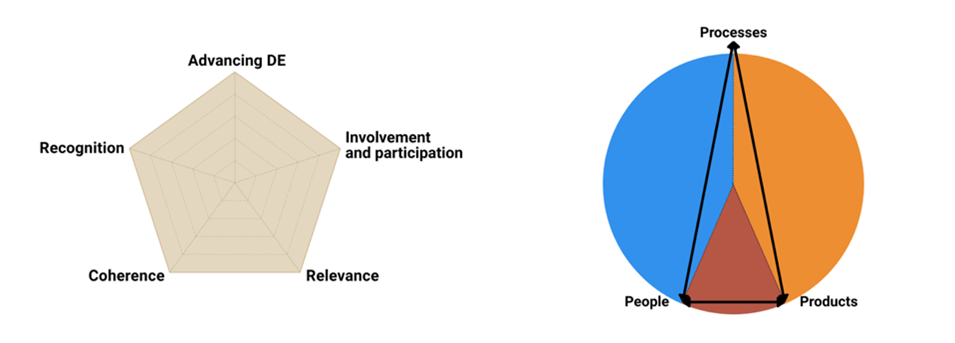
Following the 2016 external evaluation of Sinergias ED (Martins, 2016), a pentagonal visual tool was introduced in the M and E framework to reinforce quality assessment and to adopt a less productivist approach to outcomes. This tool evaluates five key criteria on a 1 to 5 scale: national and international recognition; advancement of DE in terms of conceptual, methodological and praxis knowledge; DE practitioners’ involvement; sector relevance; and coherence with DE principles. In 2020, the third funding cycle’s evaluation report (Pereira, 2021) introduced the 3P Triangle. This visual instrument has since been used to analyse and evaluate how project performance and outputs support and balance People, Processes and Products (Quintão and Pereira, 2024). It shifted the focus toward a more holistic M and E process and created an opportunity to question and reflect on the relevance of products in the project.
Figure 1: The pentagonal quality assessment tool and the 3P triangle from Quintão and Pereira, (2024: 20)
In terms of qualitative and heuristic instruments, Sinergias ED embraced participatory action research and the systematisation of experiences to evaluate project outcomes. Drawing upon Latin American popular education (Holliday, 2018), this methodology creates meta-reflexive spaces where participants construct shared narratives concerning the project’s history and the changes it fostered in terms of individual and collective learning outcomes, as well as institutional transformations. A key tool in this process is the ‘timeline’, used to reconstruct significant memories and lived experiences. It allows us to understand the project through a diachronic lens, rather than a synchronic one that overvalues productivity. Previous participatory systematisations (Sinergias ED, 2016; 2018; Martins and Marcos, 2021; Rosa and Franco, 2023) highlighted the project’s reflexive nature and the vital impact collaboration between HEIs and CSOs had for participants. By 2021, approaching its tenth anniversary, the project’s monitoring and evaluation collaborative working group (M and E CWG), that comprises members from the project team but also community members, decided to focus on implementing an impact assessment. This transition aimed to explore methodologies through a critical lens, questioning the neoliberal financialisation of public policies with its impact assessment requirements.
To facilitate this, the project team commissioned the researchers responsible for the previous evaluation reports, who had transitioned from external evaluators to active members of the Sinergias ED community, to collaborate in the design and facilitation of an impact assessment. These evaluators were already used to collaborative work and to questioning, in terms of evaluation practices, the traditional epistemological and methodological distances between external evaluator and critical friend, or between the researcher/evaluator and the object of analysis. This new phase, launched in 2021, was grounded in a Theory of Change framework.
Devising a heuristic impact assessment process: from Theory of Change to Practice of Transformation
The ToC provides a framework for hypothesising how desired change occurs over time. Characterised by a logical, deductive nature, it identifies causal relationships between activities and outcomes while outlining underlying assumptions. While rooted in a systemic paradigm that demands flexibility and complex thinking, ToC has increasingly been co-opted by neoliberal logic. In both Portuguese and international contexts, it is often used for rigid project designs where funding depends on pre-defined impacts. This application frequently conflicts with DE principles, which require emergent learning and continuous redesign.
From the outset of the impact assessment process, a fundamental question emerged concerning the nature of the theory of impact that was being co-created with the Sinergias ED community. The question that arose pertained to the categorisation of the ToC as either an ex ante theory of change, hypothesising future possible impacts, or an ex post theory systematising the impact of the project’s actual DE practices and experiences over a ten-year period. The ex post theory was presumed to better facilitate the integration of a heuristic approach with the monitoring and evaluation practices and the critical perspectives linked to an ecology of knowledges. Consequently, an alternative approach was devised: a Practice of Transformation (PoT). This was collectively conceptualised through a combination of participatory workshops and focus groups, with the Sinergias ED community, participant observation, and document analysis of M and E instruments and reports. This collective enquiry was based on two questions: (i) which intermediary outcomes do we identify and perceive as expectable (e.g. tangible outcomes such as inspiring methodologies integrated into our educational practices, different attitudes or a different way of creating intellectual outputs)?; (ii) which impacts do we identify and perceive as expectable (e.g. long-term changes with an institutional and structural dimension)? (Quintão and Pereira, 2024: 27).
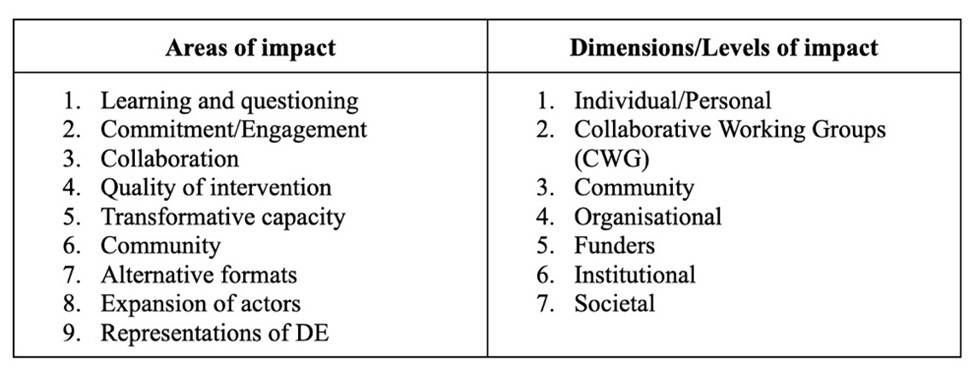
Firstly, a conceptual matrix of the PoT was outlined based on the inputs gathered from the workshops and focus groups. This matrix included objectives, activities, outputs, outcomes, impacts and indicators. It identified four primary impacts: (i) reinforcement of collaborative DE training and transformative practices in Portugal; (ii) scientific DE knowledge co-production involving CSOs and HEIs; (iii) testing alternative forms of knowledge co-creation to challenge power asymmetries between research and action; and (iv) influencing DE institutional and public policies. To capture ‘varying degrees of depth, complexity and intersectionality’ (Ibid.: 29–30) the M and E CWG added nine areas and seven dimensions to the matrix, as shown in Table 1. Rather than a linear flowchart, a system map was created to visualise the PoT. Although this reflected deep collective meta-reflection, the matrix and the map were found insufficient to fully communicate the project’s impacts, prompting a second analytical approach.
Table 1: Areas of impact and dimensions/levels of impact identified in the PoT matrix (Quintão and Pereira, 2024: 29-30)
Mapping a relational ecosystem based on DE synergies: the Sinergias ED’s Transformational Theory
At Sinergias ED, a core debate centres on the tendency to overvalue products while undervaluing processes, which risks commodifying education and knowledge. Sinergias ED counters this by nurturing collaborative spaces for ‘viable novelties’ (Freire, 2010). The project’s PoT relied on a linear, cause-and-effect matrix that failed to capture transformative relationships. To remedy this, the M and E CWG reconstructed the PoT into Sinergias ED’s Transformational Theory (Quintão and Pereira, 2024: 47–48), integrating the 3P triangle and longitudinal qualitative evaluation data. Drawing on Kolb and Kolb’s (2013) experiential learning, the Sinergias ED’s Transformational Theory recognises that impact occurs through recursive experiential spirals. Unlike linear, results-based approaches, these spirals are often erratic, requiring time across micro, meso and macro levels. This ‘digestive, cumulative, metabolic process’ (Quintão and Pereira, 2024: 47-48) views DE practices as part of a larger ecosystem based on an organic cycle: genesis – growth – blossoming – decay – decomposition – humus - new genesis.
The experiential spiral perspective triggered the search for other forms of thinking, perceiving and visualising change. Inspired by the work of Andreotti et al. (2019: 9) with social cartographies that can be used as palimpsestic pedagogical tools to trigger conversations, Figure 2 visually summarises this organic perspective of the Sinergias ED’s Transformational Theory based on a vision of a metabolic DE ecosystem. This ecosystem is based on collaborative synergies that are cyclic, slow, digestive and transformative, rather than incremental, developmental or progressive as a positivist scalability perspective would suggest. The cycle is as follows: genesis – growth – blossoming – decay – decomposition – humus - new genesis, and so on. Its main purpose is to sustain life ‘in the face of the structural inequalities that fracture the balance of humanity and the planet’ and to counter ‘the interests of commodified and financialised economic systems’ (Quintão and Pereira, 2024: 48).
Figure 2: A visual systematisation of Sinergias ED’s Transformational Theory created by the Monitoring and Evaluation Collaborative Working Group and inspired by Quintão and Pereira, (2024: 48)

This DE ecosystem functions across three interconnected levels: organisms/living things (micro level); the environment/abiotic factors controlling the structure of the ecosystem (macro level); and the nutrient cycles and energy flows (meso level) connecting the micro and macro levels.
At the micro level, DE practitioners from HEIs, CSOs, schools and government bodies drive the ecosystem. This level focuses on individual impact: the (re)generation of knowledge, skills, and worldviews. As an assumption, we recognise that practitioners are free individuals united by a desire to co-produce knowledge, where diversity is vital for the ecosystem. What knowledge, skills, attitudes, feelings, perceptions, behaviours, experiences and worldviews are being (re)generated or reinforced?
The meso level represents the collaborative, mutualistic interactions that produce results greater than the sum of their parts. It focuses on transformative spaces that produce (re)generative learning and knowledge. These act as experimental laboratories for participatory action research and professional development. From this ecosystemic perspective, educational practices, learning and co-created knowledge are nutrients that must be digested and break down into products/resources to sustain life. As Quintão and Pereira (2024: 55) argue, a product’s transformative potential depends entirely on the transformational capacity of the process that generated it. Therefore, products/resources should not be delinked from processes, but rather understood as a small part of a digestive process that gives materialisation to co-created knowledge that supports our praxis. As an assumption, we recognise that a thriving ecosystem requires a regulatory structure to manage the balance of People-Processes-Products, supported by diverse funding mechanisms. To address impact assessment at this meso level, different questions must be raised: what are the components of a transformative educational practice and product? What DE synergies exist between individuals and their organisations? What resources, knowledge and educational practices are being digested by the organisations in this ecosystem? What DE synergies and interdependencies exist between different organisations? How can products nurture this DE ecosystem and its relationships? Which relationships act as stressors on the ecosystem?
The macro level encompasses the social, economic, political, cultural and epistemological contexts. It involves public policies, funding, the relationship between the state and civil society but also the epistemological structures that sustain our societies and civilisation. A macro level that prioritises isolated products, (a neoliberal approach) creates a competitive environment that weakens solidarity. At this level different questions arise as to understand impacts: which institutions defend and advocate for DE? What public policies exist in this sector? What funding mechanisms exist to support DE? How is our civil society structured and organised? How does our welfare state understand its relationship with civil society? How do civil society organisations understand their relationship with the state? What worldview do we create as a civilisation in relation to education, development and well-being?
Linking this theoretical framework with data from former project evaluations revealed three primary impact areas. Firstly, there are the transformative in-depth impacts on people. Thus, ‘Recognition of new learning, knowledge and methodologies; application of this learning in professional contexts; and expressed willingness and need to remain engaged’ (Pereira and Quintão, 2024: 53) are some of the indicators of impact that have emerged. The changes and transformations that occur at a micro level within the ecosystem are further reinforced, deepened and digested as people continue to engage and reflect on their learning. As a participant in the Sinergias ED community study carried out by Fernandes and Pereira indicated:
“Sinergias is a space of ongoing learning and one of the most stable and reliable processes in my professional development. The project has a very practical way of working. It conveys the idea of other forms of knowledge and knowledge production. It invites us to question what knowledge is and who produces it. How can we value this knowledge? I believe we try to put all this into practice. We learn to think together, which is different from learning alone. And we gain things that are sometimes difficult to express: the complexity of thought. The idea of complexity Edgar Morin spoke of is deeply embedded in the project’s very practice” (Fernandes and Pereira, 2020: 27).
Secondly, at meso level, the Sinergias ED community has emerged as an aggregated impact indicator of diverse transformative processes and products. The community ‘has generated a density of meaningful relationships and networks that endure beyond the activities of the Sinergias ED project itself’ (Pereira and Quintão, 2024: 54). New collaborations between organisations in terms of research, new projects between CSOs and HEIs to integrate DE in the higher education system, and pedagogical, research and intellectual resources have been created based on those transformative processes. The co-created products, such as the scientific journal Sinergias or research papers, ‘reach the “hands” (or the “minds”) of those who are distant from, or unfamiliar with, the Sinergias ED project’ (Pereira and Quintão, 2024: 55), (re)generating the DE ecosystem. As two participants in the Sinergias ED project indicated:
“As a research centre, we were very interested in establishing dialogue with NGOs, because this represents a connection between two territories that are often misunderstood by one another. This rapprochement helps dispel many fears, on the one hand within academia and, on the other, within civil society. It concerns languages, notions of time, and the kinds of knowledge produced” (Fernandes and Pereira, 2020: 26-27).
“When people ask me what to read, I direct them to the Sinergias website. It legitimises a framework of higher education that is not always easy to establish. There are principles - academic ones, but also those related to the free dissemination of knowledge as a global public good - of sharing, trust-building, acceptance of difference, and networking. These confer upon the project a sense of consolidation, a path that already seems to be leaving its mark” (Ibid.: 27).
Thirdly, Sinergias ED’s ‘quality is recognised at national and international levels’ (Quintão and Pereira, 2024:54). This can be supported by institutional and political impact indicators such as the project’s ability to continuously attract national and international funding. For example, the number of communications and presentations made in political and academic events where Sinergias ED is presented as an inspiring practice in DE and the collaboration of the journal Sinergias with other European global education and learning scientific journals. As two participants mentioned:
“Sinergias is a quality project in DE. It provides what was missing in Portugal: conceptual reflection and depth. Indicators such as the journal, the articles, the participants, the academics and invited experts - all those involved - make this quality evident” (Ibid.: 28).
“There is greater access to specialised information on DE. Previously, there were no bibliographic references in Portuguese; there was an association of DE with other things that are not DE because it was difficult to access information. Sinergias has brought the possibility of having a DE reference framework in Portugal. People have new ways of working. They can discover new concepts, new research platforms, new networks - not only at the national level, where they were already present - but also in international contexts and other international journal networks” (Ibid.: 28).
Validating Sinergias ED’s Transformational Theory and its impacts
In July 2025, a new phase of the impact assessment process began to test and validate the theory created and to collect and analyse indicators for the outlined impacts. Data from several sources from the project monitoring and evaluation system, going back to 2013, is being processed through quantitative tools to map and characterise people, processes, and products involved, including those specific to the journal Sinergias. This will be complemented by qualitative analysis of Sinergias ED evaluation reports (Martins, 2016; Gomes and Quintão, 2018; Fernandes and Pereira, 2020; Quintão and Pereira, 2024) and participants’ discourse and the findings will be published in a commemorative issue of Sinergias in July 2026. Additionally, between 2026 and 2027, and to ensure a robust, multi-perspective approach, the impact assessment will also involve external stakeholders. This will include consulting CSOs and HEIs on organisational changes, DE students on the journal’s bibliographic impact, and broader political actors on project awareness. These findings will generate an article, infographic outputs, and in-person and online sessions to discuss them.
Conclusion
In a neoliberal political context where the Theory of Change often serves as a financialisation instrument, the Sinergias ED project reimagined it as a collaborative strategic device. Since 2023, this shift has fostered a dialogue between the existing monitoring and evaluation system and the ToC, resulting in the Sinergias ED’s Transformational Theory. Currently undergoing validation, this framework explores how DE practitioners, engaged in the project, develop critical perspectives and how collaboration between HEIs and CSOs create alternative learning spaces that drive individual, organisational and structural transformation. This process revealed four primary (re)generative tensions that serve as vital sources of learning.
On a first level, the tension between a linear and progressive interpretation of change, based on a horizontal fluxogram, and the ecosystemic and digestive vision of transformation, based on a spiraled system mapping perspective with loops and multiple feedbacks. The social cartography and the biological metaphor potentiated different ways of understanding how transformation can occur, and from a linear approach, a shift was made towards a metabolic one. Secondly, the tension between the time and participatory processes required to achieve transformation and the technical and financial mechanisms available for planning, managing and assessing this transformation. Systemic change requires long-term, participatory processes, while funding favours short-term, product-oriented cycles. To foster social transformation, project management and financial mechanisms must shift to prioritise long-term collective action over immediate outputs.
At a third level, the tension between the ex ante and ex post uses of the Theory of Change. In the case of Sinergias ED, the impact assessment process began when the project celebrated its tenth anniversary. Consequently, the ToC was used from an ex post perspective and the project moved beyond monitoring to a metareflection on how experiential collaborative cycles generate alternative ways of thinking, doing and being. It became a tool to advocate for the transformational potential of collaboration between HEIs and CSOs in the field of DE. This was only possible due to a robust M and E system that balanced qualitative and quantitative indicators. Instead of demanding rigid ex ante ToC as a condition for funding, governments and other stakeholders should invest in long-term, ex post impact assessments. This could lend support to anti-hegemonic perspectives, which are becoming increasingly necessary in today's neoliberal political context. The CICL’s role in supporting the impact created by Sinergias ED over ten years has been fundamental. In a political context of advancing neoliberalism, will the Portuguese DE sector continue to have the freedom to experiment and innovate before the long-term impacts are formally proven?
Furthermore, Sinergias ED’s ecosystemic and multi-level approach to DE impact assessment requires technical tools that can grasp complexity, characterise interdependencies and different types of relationships, and facilitate a rhizomatic analysis of causes and consequences. This approach highlights the tension between individual and collective agency and structural change. The individual lens on impacts cannot be the only perspective considered. A relational lens is needed to shed new light on the complexity of human agency and social transformation.
A new phase of the Sinergias ED impact assessment began this year, involving reflection on and experimentation with various indicators in order to test and validate the developed theory. It is crucial to observe, investigate and capture empirical evidence of the transformative potential of DE initiatives, as well as their impact on practitioners, learners, organisations and institutions. Such an examination is necessary in order to establish and justify the intrinsic value of DE in contemporary societies, both nationally and globally. In particular, possible cause-and-effect relationships must be explored in depth (IDEA, 2025). However, this task is already revealing new tensions. How can we create indicators that express changes in people’s perceptions of life, time, and their profession? How can an indicator express the socio-emotional process of living with the tensions generated by DE processes that focus on uncertainty and critical thought? How can we characterise, understand, and describe the relational dimension of learning spaces and their impact? Can artistic expressions offer new insights into understanding, living, and being and serve as indicators? Do we risk falling into the 'trap' of 'indexing the world' (Machado de Oliveira, 2021: 21) and reproducing modern/colonial mechanisms that prioritise objective, unambiguous language over the complex reality of social transformation?
References
Almeida, F, and Santos, F (2018) ‘Portugal inovação social: na encruzilhada dos tempos’, Cooperativismo e Economía Social, Vol. 39, Vigo: Universidade de Vigo, pp. 443-462.
Andreotti, V (2014) ‘Educação para a Cidadania Global – Soft versus Critical’, Sinergias - diálogos educativos para a transformação social, Vol. 1, pp. 57-66.
Andreotti, V, Stein, S, Susa, R and Collective Gesturing towards Decolonial Futures (2019) ‘Da casa construída pela modernidade ao micélio saudável’, Porto: Sinergias - diálogos educativos para a transformação social, Vol. 8, pp. 9-19.
Camões Instituto da Cooperação e da Língua (CICL) (2022) ‘Portuguese Development Cooperation Strategy 2030’, available: https://www.instituto-camoes.pt/images/img_noticias2022_1/ECP2030_Triptico_EN.pdf (accessed 9 December 2025).
CEAUP (Centro de Estudos Africanos da Universidade do Porto) and FGS (Fundação Gonçalo da Silveira) (2014) Revista Sinergias – Diálogos Educativos para a Transformação Social, ISSN 2183-4687, Porto: Sinergias ED.
Fernandes, I and Pereira, S (2020) ‘Sinergias DE Community Study - Learning from the Experience of Building, Deepening and Strengthening the Sinergias DE Community’, Porto: Sinergias ED.
Freire, A (2010) ‘Inédito Viável’ in D Streck, E Redin, E and J Zitkoski, J (eds.) Dicionário Paulo Freire, Belo Horizonte, Brazil: Autêntica.
Gomes, M and Quintão, C (2018) ‘Avaliação externa do Projeto Sinergias ED: fortalecer a ligação entre investigação e ação na Educação para o Desenvolvimento em Portugal’, Porto: Sinergias ED and A3S.
Holliday, O (2018) La sistematización de experiencias: prácticas y teoría para otros mundos posibles, Bogotá: Fundación Centro Internacional de Educación y Desarrollo Humano (CINDE).
IDEA (Irish Development Education Association) (2025) ‘Theory of Impact for Global Citizenship Education – Overview’, available: https://irp.cdn-website.com/9e15ba29/files/uploaded/Theory+of+Impact+Overview.pdf (accessed 9 December 2025).
IPAD (Instituto Português de Apoio ao Desenvolvimento IP) (2009) ‘National Strategy for Development Education 2010-2015’, available: https://doi.org/10.1787/270c7194-en (accessed 9 December 2025).
Kolb, D and Kolb, A (2013) ‘The Kolb Learning Style Inventory 4.0: Guide to Theory, Psychometrics, Research and Applications’, Researchgate, available: https://www.researchgate.net/publication/303446688_The_Kolb_Learning_Style_Inventory_40_Guide_to_Theory_Psychometrics_Research_Applications (accessed 10 February 2026).
Machado de Oliveira, V (2021) Hospicing Modernity: Facing Humanity’s Wrongs and the Implications for Social Activism, Berkeley: North Atlantic Books.
Marques, H, Cardoso, J, and Fernandes, S (2025) ‘Implementação de estratégias de Educação para o Desenvolvimento e Cidadania Global (EDCG) em Portugal - oportunidades e desafios’, Global Education Time, available: https://www.globaleducationtime.eu/portugal/wp-content/uploads/sites/4/2025/07/Portugal_WP1_PTVersion.pdf (accessed 20 January 2026).
Martins, F (2016) ‘Relatório de avaliação final - 1ª edição’, Sinergias ED, available: https://sinergiased.org/wp-content/uploads/2015/01/Rel.avaliacao.externa.pdf, (accessed 10 February 2026).
Martins, F and Marcos, V (2021) ‘Memória – Exercício de mapeamento de aprendizagens a partir das experiências colaborativas da 3ª edição do projeto Sinergias ED’, Sinergias ED, available: https://sinergiased.org/wp-content/uploads/2015/01/Sinergias-ED_Memoria_Mapas_VFinal_2021.04.05.pdf (accessed 10 February 2026).
Mignolo, W (2011) ‘Epistemic Disobedience and the Decolonial Option: A Manifesto’, Transmodernity: Journal of Peripheral Cultural Production of the Luso-Hispanic World, Vol. 1, No. 2, pp 44-66, available: https://escholarship.org/uc/item/62j3w283 (accessed 10 February 2026).
OECD (2023) ‘Policy Guide on Social Impact Measurement for the Social and Solidarity Economy: Local Economic and Employment Development (LEED)’, Paris: OECD Publishing, available: https://www.oecd.org/en/publications/policy-guide-on-social-impact-measurement-for-the-social-and-solidarity-economy_270c7194-en.html (accessed 25 February 2026).
Parente, C, Marcos, V, and Quintão, C (2017) ‘Portugal Inovação Social. Anotação à resolução do Conselho de Ministros n.o. 73-a/2014, de 16 de dezembro de 2014’, Cooperativismo e Economía Social, Vol. 37, Universidade de Vigo, pp. 397-405.
Pereira, S (2021) ‘A Comunidade Sinergias ED: da colaboração à propensão política em contexto de ED’, Sinergias - diálogos educativos para a transformação social, Vol. 12, pp. 105-121.
Quintão, C and Martinho, A (2018) ‘Crónicas da iniciativa Portugal inovação social. Aprofundamento crítico do debate a propósito do fundo de inovação social’, Cooperativismo e Economía Social, Vol. 40, Universidade de Vigo, pp. 411-423.
Quintão, C and Pereira, S, (2024) ‘A Quarta Edição do Sinergias ED: Uma Narrativa desinstaladora’, Sinergias ED, available: https://sinergiased.org/wp-content/uploads/2024/12/A-Quarta-Edicao-do-Sinergias-ED_Uma-Narrativa-desinstaladora.pdf (accessed 9 December 2025).
Rodrigues, M, and Silva, P (2015) ‘Introdução: A Execução do Memorando de Entendimento’, Governar com a Troika: Politicas Públicas em Tempo de Austeridade, Coimbra: Almedina, pp. 1-22.
Rosa, M and Franco, A (2023) ‘Memória-relatório - Mãos que tecem: colaboração como fonte de aprendizagens’, Sinergias ED, available: https://sinergiased.org/wp-content/uploads/2023/12/Memoria-Encontro-Comunidade-14-11-2023.pdf (accessed 10 February 2026).
Santos, B (2007) Renovar a teoria critica e reinventar a emancipação social, São Paulo: Boitempo Editorial, available: https://gepeadsim.wordpress.com/wp-content/uploads/2017/11/boaventura_renovar-a-teoria-crc3adtica-e-reinventar-a-emancipac3a7c3a3o-social.pdf (accessed 10 February 2026).
Sinergias ED (2016) ‘Processo de Sistematização de Experiências – Relatório Final’, Sinergias ED, available: https://sinergiased.org/wp-content/uploads/2015/01/se.relatorio.final_.pdf (accessed 10 February 2026).
Sinergias ED (2018) ‘Reflexão Coletiva - Memória’, Sinergias ED, available: https://sinergiased.org/wp-content/uploads/2015/01/Reflexao.coletiva_2018_Memoria_pdf.pdf (accessed 10 February 2026).
Carlota Quintão has a degree in sociology from University of Porto and a postgraduation in social policies from the University of Coimbra. Her research and practice is dedicated to evaluation, training and action research in the fields of social inclusion, solidarity economy and development education. She was responsible for the evaluation report of the Sinergias ED project in 2018. She is a member of the monitoring and evaluation Collaborative Working Group and Staff member of the Sinergias ED project at the Centre for African Studies at the University of Porto. Email: carlotaquintao@gmail.com.
Sara Borges is a Global Citizenship Educator working mainly with schools, teachers and civil society organisations (CSO). She has a Master’s Degree in International Cooperation and Emancipatory Education from the University of the Basque Country, a postgraduation in Social Intervention, Innovation and Social Entrepreneurship from University of Coimbra, and a degree in International Relations and Political Science from Nova University in Lisbon. She is a member of the monitoring and evaluation Collaborative Working Group and Staff member of the Sinergias ED project at the Gonçalo da Silveira Foundation. Email: sara.borges@fgs.org.pt.